
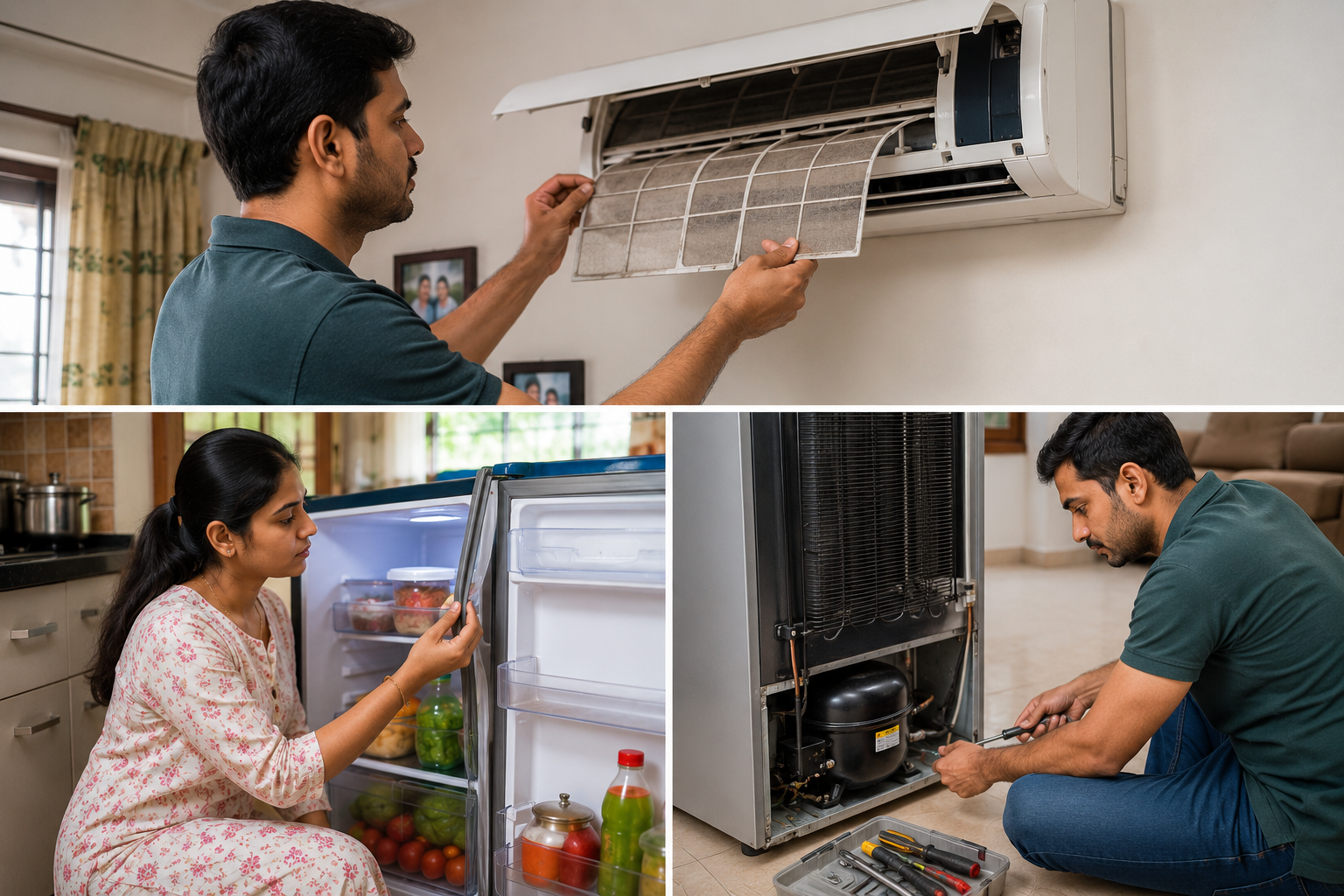
A home appliance maintenance checklist is not about fancy tools or expensive service contracts. It is about knowing which five screws to turn, which two filters to wash, and which three sounds not to ignore. This checklist covers AC, refrigerator, washing machine, geyser, and electricals. Monthly tasks take five minutes. Yearly tasks take one hour. Skip them, and a ₹500 repair becomes a ₹5,000 replacement
This happens in many homes. A small problem that could have been fixed for ₹500 becomes a big problem that costs ₹5,000. The reason is simple. No one told us what to check and when to check it.
This home appliance maintenance checklist focuses on five main appliances: AC, refrigerator, washing machine, geyser, and electricals. No complicated tools. No expensive service calls for routine tasks. Just simple things you can do yourself or ask a technician to do once a year.
Table of Contents
Home Appliance Maintenance Checklist: Monthly vs Yearly Tasks
| Appliance | Monthly task | Yearly task |
|---|---|---|
| AC | Clean filters | Coil cleaning + gas check |
| Refrigerator | Wipe door seals | Clean condenser coils |
| Washing machine | Clean drain filter | Replace inlet hose if worn |
| Geyser | Check leaks | Inspect valve + anode rod |
| Electrical system | Check sockets | Test ELCB/RCCB |
Before Summer Checklist (February – March)
Summer is when ACs, refrigerators, and water pumps work hardest. A few checks before the heat arrives prevent mid-summer failures.
AC:
- [ ] Clean both indoor and outdoor unit filters
- [ ] Hose down the outdoor unit coil (gently, no pressure washer)
- [ ] Check gas pressure through a technician
- [ ] Clear cobwebs, leaves, and dust around outdoor unit
- [ ] Check that the drain pipe drips water when AC runs
Refrigerator:
- [ ] Clean condenser coils at the back or underneath
- [ ] Check door seals with the paper test
- [ ] Defrost if ice buildup exceeds 1 cm
- [ ] Move fridge away from direct sunlight or stove if possible
Water pump (if applicable):
- [ ] Check for leaks in pipes
- [ ] Verify float valve in overhead tank stops water flow when full
- [ ] Listen for unusual noise from pump motor
Estimated time: 1-2 hours for all appliances combined.
Before Monsoon Checklist (May – June)
Monsoon brings humidity, moisture, and electrical risks.
AC (especially in humid cities):
- [ ] Check drain pipe again. Humidity increases condensation. A blocked pipe will leak water indoors.
- [ ] Run AC in dry mode (if available) for a few hours to remove internal moisture before monsoon hits.
Electricals:
- [ ] Test the earth leakage circuit breaker (ELCB/RCCB) using the test button
- [ ] Check for exposed wires or damaged plugs
- [ ] Ensure outdoor electrical connections are weatherproof
Washing machine:
- [ ] Clean the rubber door gasket thoroughly. Humidity promotes mould growth.
- [ ] Leave the door open after every wash.
Geyser:
- [ ] Geyser usage drops in monsoon. Turn off the geyser at the switch. Do not leave it in standby.
Estimated time: 30-45 minutes.
Before Winter Checklist (October – November)
Winter shifts the load from ACs to geysers and water heaters.
Geyser:
- [ ] Check pressure relief valve. Lift lever. Small amount of water should come out.
- [ ] Inspect bottom of tank for rust or water stains
- [ ] Set temperature to 50-55°C (not 65°C)
- [ ] If geyser is 2-3 years old, consider anode rod replacement
Washing machine:
- [ ] Some families switch to warm washes in winter. Run a maintenance wash (empty, hot water, vinegar) before winter starts.
- [ ] Check inlet hose for bulges or cracks
AC:
- [ ] AC usage drops. Clean filters one last time before leaving it unused for months.
- [ ] Turn off the AC at the circuit breaker to save standby power.
Electricals:
- [ ] Check room heaters (if any) for damaged cords or plugs before first use
Estimated time: 1 hour.
Five-Minute Tasks. Do Them on the First Sunday.
A good home appliance maintenance checklist starts with monthly tasks. These take five to ten minutes total. Do them on the first Sunday of every month.
Clean the AC air filters
Open the front panel of your split AC. Slide out the filters. Wash them under running tap water. Let them dry in the shade for an hour. Slide them back in. This takes five minutes. Dirty filters make the AC work harder. They increase electricity consumption by 5 to 10 percent. In Indian homes with dust, filters get clogged within three to four weeks.
If your cooling costs still feel unusually high even after regular cleaning, check how to reduce AC electricity bill in India for additional causes that increase running cost.
Wipe the refrigerator door seals
Take a wet cloth. Wipe the rubber gasket around the refrigerator door. Pay attention to the corners where crumbs and sticky residue collect. A dirty door seal does not close properly. Cold air escapes. The compressor runs longer. Your electricity bill goes up.
Check the washing machine drain filter
This applies to front load machines. Open the small flap at the bottom right or left corner. There is a screw cap. Turn it slowly. Water will come out. Keep a towel or a small bucket underneath. Clean out any coins, buttons, lint, or hair stuck inside. A blocked drain filter makes the machine take longer to drain and spin.
Listen to your appliances for one minute
Stand near each appliance while it is running. Do you hear a new sound? A clicking noise from the refrigerator? A grinding sound from the washing machine? A hissing from the AC? New sounds are often the first sign of a developing problem. Catching it early saves money.
Getting your AC ready for summer
A complete home appliance maintenance checklist splits tasks by season. For AC, do these things in February or March, before the heat arrives. If summer has already started, do them now.
Clean the outdoor unit coil
The outdoor unit has a coil with thin metal fins. Dust and dirt collect on these fins over time. Airflow reduces. The compressor works harder. You can clean it with a water spray from a garden hose. Do not use a pressure washer. The force can bend the fins. If you cannot reach the outdoor unit safely, call a technician. This costs ₹300 to ₹600.
Check the gas pressure
A technician can connect a pressure gauge to the AC. This tells them if the gas level is correct. Low gas means there is a leak. Do not just add gas. Ask the technician to find and fix the leak first. This check once a year prevents sudden cooling failures in peak summer.
Many homeowners refill gas repeatedly without fixing the actual leak. Before spending money, understand AC gas refill cost in India and common mistakes people make.
Clear the area around the outdoor unit
Remove any plants, dust, plastic bags, or cobwebs around the outdoor unit. The unit needs at least one foot of clear space on all sides for proper airflow. Many people ignore this. The AC overheats. The compressor fails early.
Check the drain pipe
The drain pipe from the indoor unit should drip water when the AC is running. If no water comes out, the pipe may be blocked. Water can back up and leak from the indoor unit onto your wall or floor. A blocked drain pipe is an easy fix. If accessible safely, a technician may use a vacuum or cleaning tool to clear the blockage.
Your Fridge Runs 24/7. Treat It That Way.
A refrigerator runs 24 hours a day, 365 days a year. That is why any home appliance maintenance checklist must include fridge-specific tasks like cleaning condenser coils and checking door seals.
Clean the condenser coils once a year
The coils are at the back of the refrigerator or underneath a front panel. Dust collects on them over time. This makes the compressor work harder. Unplug the refrigerator. Use a vacuum cleaner with a brush attachment or a long brush to remove dust. This may help improve efficiency, especially in older refrigerators with heavy dust buildup.
Older refrigerators often consume much more electricity than expected. Compare this with how much electricity a fridge uses per month in India to understand long-term running cost.
Check the door seals with a piece of paper
Open the door. Place a piece of paper against the body. Close the door on the paper. Try to pull the paper out. If it slides out easily, the seal is weak. Cold air is escaping. The compressor runs longer. New door seals cost ₹800 to ₹1500. They pay for themselves in electricity savings within a few months.
For efficiency standards, check the BEE star rating program website before buying a new refrigerator.
If your refrigerator is already cooling poorly or running continuously, see refrigerator not cooling repair cost in India before deciding whether maintenance is enough.
Defrost a single door refrigerator
If ice has built up more than one centimetre thick in the freezer, it is time to defrost. Remove all food. Turn off the refrigerator. Keep a towel inside to catch melting water. Do not use a knife or sharp object to chip away ice. You can puncture the refrigerant line. Place a bowl of hot water inside to speed up melting.
Keep the refrigerator away from heat sources
The refrigerator should not be next to the cooking stove. It should not get direct sunlight through a window. Every degree of extra heat around the refrigerator makes the compressor work harder. Move it if possible. Even shifting it a few feet away from a heat source helps.
A Washing Machine Lasts Longer When You Do These Four Things
Most people use their washing machine two to three times a week. A proper home appliance maintenance checklist includes three simple washing machine tasks: cleaning the drain filter, running a maintenance wash, and checking the inlet hose.
Clean the detergent drawer
Remove the detergent drawer. Wash it under running water. Remove any dried detergent or softener residue. A clogged drawer stops detergent from entering the machine properly. Clothes do not get clean. You may run a second cycle, wasting electricity and water.
Run a maintenance wash once a month
Run an empty cycle with hot water and one cup of white vinegar. Or use a commercial washing machine cleaner. This removes soap scum, bacteria, and mould from the drum and pipes. A clean machine cleans clothes better and uses less electricity.
Many households do not realise repeated wash cycles slowly increase power usage over time. See washing machine electricity consumption per month in India for realistic usage estimates.
Leave the door open after use
Front load machines have a rubber gasket around the door. Water collects there. If you close the door immediately after a wash, the moisture stays inside. Mould and mildew grow. The machine develops a smell. Leave the door slightly open for two to three hours after each wash.
Check the inlet hose for bulges
The water inlet hose connects your tap to the washing machine. Look at it carefully. If you see any bulges, cracks, or signs of wear, replace the hose. A burst hose can flood your home. Hoses cost ₹200 to ₹500. Replacement once every three to four years is cheap insurance.
Geyser maintenance before winter
A seasonal home appliance maintenance checklist prepares geysers before winter. Do these things in October or November, before the cold weather arrives.
Check the pressure relief valve
The pressure relief valve is a small metal part on the side or top of the storage geyser. Lift the lever slightly. A small amount of water should come out. If no water comes out or water flows continuously, the valve may be faulty. A faulty valve can cause pressure buildup inside the tank. This is a safety risk.
Look for rust or leaks
Examine the bottom of the geyser tank. Look for any brown stains or water drops. A small leak now becomes a big leak later. If you see rust, call a technician. The tank may need replacement.
Set the temperature to 50 to 55 degrees
Many geysers come from the factory set to 60 to 65 degrees. This is higher than most people need. Lower the setting to 50 or 55 degrees. You will not notice the difference while bathing. The geyser will use less electricity.
If your winter electricity bill rises sharply even without AC usage, check how much electricity a geyser uses per month in India for realistic household estimates.
Replace the anode rod every two to three years
The anode rod is a metal rod inside the tank. It attracts corrosion. It protects the tank from rusting. Over time, the rod corrodes away. If you do not replace it, the tank itself starts rusting. This is a technician job. It costs ₹800 to ₹1500. Replacing the anode rod every few years can double the life of your geyser.
Electrical safety checks for every home
These checks take ten minutes. They can prevent fires and electric shocks.
Sometimes high electricity bills are linked to hidden appliance inefficiencies or unnoticed electrical issues. See why your electricity bill is high even without AC for common household causes.
Check plugs and sockets for burn marks
Look at each plug and socket in your home. Do you see black marks? Discolouration? A burning smell? These are signs of overheating. Stop using that socket immediately. Call an electrician.
Feel the plug tops when appliances are running
After an appliance has been running for a few minutes, feel the plug top. It should be warm at most. If it is hot to touch, there is a problem. The socket may be loose. The wiring may be undersized. The appliance may be drawing too much current.
Test the earth leakage circuit breaker
Every home should have an ELCB or RCCB in the distribution box. There is a test button on it. Press it once every three months. The main switch should trip. If it does not trip, the safety device is not working. Call an electrician immediately.
Look for exposed wires
Check areas where pets or children can reach. Look for wires with torn insulation. Mice sometimes chew on wires. Old wires crack over time. Exposed wires are a serious shock and fire risk.
Call a technician sooner if you notice:
- Burning smell from plugs or appliances
- Water leaking repeatedly from AC or washing machine
- Refrigerator running continuously without stopping
- Geyser making loud rumbling noises
- Circuit breaker tripping frequently
- Sudden increase in electricity bill without clear reason
Signs you should not ignore
These signs mean something is wrong. Do not wait for the appliance to stop working completely.
| Sign | What it means | What to do |
|---|---|---|
| AC blows room temperature air | Low gas, compressor issue, or electrical problem | Call a technician |
| Refrigerator runs constantly | Dirty coils, low gas, or failing compressor | Clean coils. If still running constantly, call technician |
| Washing machine leaks water | Cracked hose, worn door seal, or blocked drain | Check hoses. Call technician if leak continues |
| Geyser makes rumbling noise | Mineral deposit buildup inside tank | Call technician to clean or descale |
| Burning smell from any appliance | Electrical overheating | Unplug immediately. Do not use until checked |
| Circuit breaker trips frequently | Overload or short circuit | Call electrician |
Do not ignore these signs. A small repair now costs less than a full replacement later.
What Maintenance Saves You: Real Numbers
| Appliance | Maintenance Task | Frequency | Cost of Ignoring | Money Saved |
|---|---|---|---|---|
| AC | Clean filters monthly | 5 min/month | 10-15% higher electricity bill + compressor wear | ₹1,000-2,000/year |
| AC | Clean outdoor coil yearly | Once a year | Poor cooling, repeated gas refills (₹800-1,500 each) | ₹2,000-3,000 per gas leak avoided |
| Refrigerator | Clean condenser coils | Once a year | Compressor runs longer, higher bill | ₹500-1,500/year |
| Refrigerator | Replace weak door seals | As needed (₹800-1,500) | Compressor runs continuously, early failure | ₹3,000-5,000 over 2-3 years |
| Washing machine | Clean drain filter | Monthly | Longer cycles, motor strain, bad odours | ₹1,000-2,000 in prevented repairs |
| Washing machine | Check inlet hose | Once a year | Burst hose floods home (₹5,000-15,000 damage) | ₹5,000-15,000 avoided |
| Geyser | Replace anode rod | Every 2-3 years (₹800-1,500) | Tank rusts through, full replacement (₹5,000-8,000) | ₹4,000-6,500 saved |
| Electricals | Test ELCB/RCCB | Every 3 months | No protection from electric shock or fire | Priceless (safety) |
Total estimated annual savings from basic maintenance: ₹5,000-10,000 per year for a typical Indian home with 2-3 appliances.
That is not a marketing number. That is the cost of one major repair avoided. Or six months of higher electricity bills before a problem becomes obvious.
These Maintenance Mistakes Cost You Real Money
Waiting until an appliance fails to service it
This is the most expensive way to maintain appliances. An AC with dirty coils consumes 10 to 15 percent more electricity for months before it fails. That wasted electricity adds up. Regular cleaning prevents this waste.
The same pattern affects cooling appliances heavily during summer months. If your bill suddenly spikes seasonally, compare it with what appliances consume the most electricity at home in India.
Using the wrong cleaning products
Some people use harsh chemicals or steel wool on appliance surfaces. This damages coatings. It can expose metal to rust. It can damage plastic parts. Use a soft cloth. Use mild soap and water. For specific tasks like AC coil cleaning, use a product made for that purpose.
Ignoring small problems until they become big problems
A small refrigerant leak becomes a big leak. A worn door seal becomes a failed compressor because the refrigerator runs constantly. A tiny water leak from the washing machine door becomes a flooded floor and a damaged motor. Fix small problems when you first notice them.
Not reading the manual
Every appliance comes with a manual. It has a maintenance section. It tells you how often to clean filters, when to replace parts, and what signs to look for. Keep the manuals in a folder. Refer to them once a year.
Estimated money saved with basic maintenance
| Maintenance task | Possible long-term savings |
|---|---|
| Cleaning AC filters regularly | Lower electricity usage + delayed compressor wear |
| Replacing weak refrigerator door seals | Reduced compressor running time |
| Fixing small washing machine leaks early | Avoid expensive motor damage |
| Cleaning refrigerator coils yearly | Lower monthly electricity bills |
| Replacing worn geyser parts early | Avoid full tank replacement |
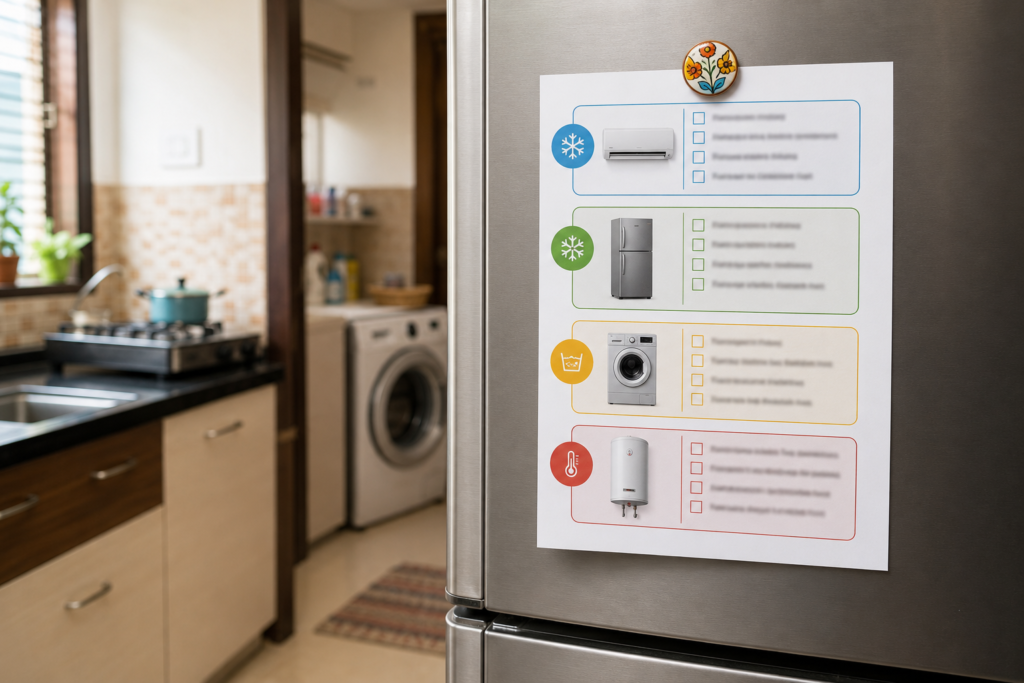
Printable quick checklist
Copy this into a document. Print it. Stick it on your refrigerator door or inside a cupboard.
Every month
- Wash AC filters
- Wipe refrigerator door seals
- Clean washing machine drain filter (front load)
- Listen for new sounds from appliances
Every 3 months
- Press test button on earth leakage circuit breaker
- Run an empty maintenance wash in washing machine
- Check for burn marks on plugs and sockets
Once a year (before summer)
- Clean AC outdoor unit coil
- Check AC gas pressure
- Clear area around outdoor unit
- Check AC drain pipe
Once a year (before winter)
- Check geyser pressure relief valve
- Look for rust or leaks on geyser
- Set geyser temperature to 50 to 55 degrees
Once a year (any time)
- Clean refrigerator condenser coils
- Check refrigerator door seals with paper test
- Defrost single door refrigerator if needed
- Check washing machine inlet hose for bulges
- Look for exposed wires in the house
Every 2 to 3 years
- Replace geyser anode rod
Common questions asked
How often should I service my AC
A professional service once a year is sufficient for most homes. Do it before summer starts. Clean the filters yourself every month.
Can I clean the AC outdoor unit myself
Yes, if you can reach it safely. Use a water spray from a garden hose. Do not use a pressure washer. If the unit is on a high wall or an unsafe balcony, call a technician.
My refrigerator is 12 years old but still works. Should I maintain it or replace it
Maintain it. But know that a new 5 star refrigerator will cut your electricity bill by ₹300 to ₹500 per month. The savings over two to three years can pay for a new refrigerator.
If repair costs are starting to repeat every few months, compare the numbers first using refrigerator repair vs replacement cost in India.
The washing machine makes a loud noise during spin cycle
Check if the machine is level. Adjust the feet if needed. Check if clothes are balanced inside the drum. If the noise continues, the drum bearings may be worn. Call a technician.
Is it worth paying for an annual maintenance contract for appliances
For ACs in hot regions, yes. A one year AMC costs ₹1500 to ₹2500 for one AC. It includes cleaning, gas check, and one free service call. For other appliances, a pay per service model is usually cheaper.
Related reads
These articles provide more detail on individual appliance maintenance and costs.
- AC Gas Refill – When Needed, Cost and Myths
- Refrigerator Repair vs Replacement – Cost Decision Guide
- Washing Machine Repair vs Replacement – Full Cost Guide
- Geyser Electricity Consumption Per Month – India Guide
- How Much Electricity Does a Fridge Use Monthly in India
Most appliance failures do not happen suddenly. They build up slowly over months through dust, blocked airflow, worn seals, leaks, or neglected maintenance. Spending a few minutes every month checking these small things can often save thousands of rupees later.
Start with one appliance this weekend. Clean the AC filters. Or wipe the refrigerator door seals. Or test the ELCB. Pick one. Do it. Then come back to this checklist next month for the next task.
That is how a ₹500 repair stays a ₹500 repair, and never becomes a ₹5,000 replacement.
Leave a Reply