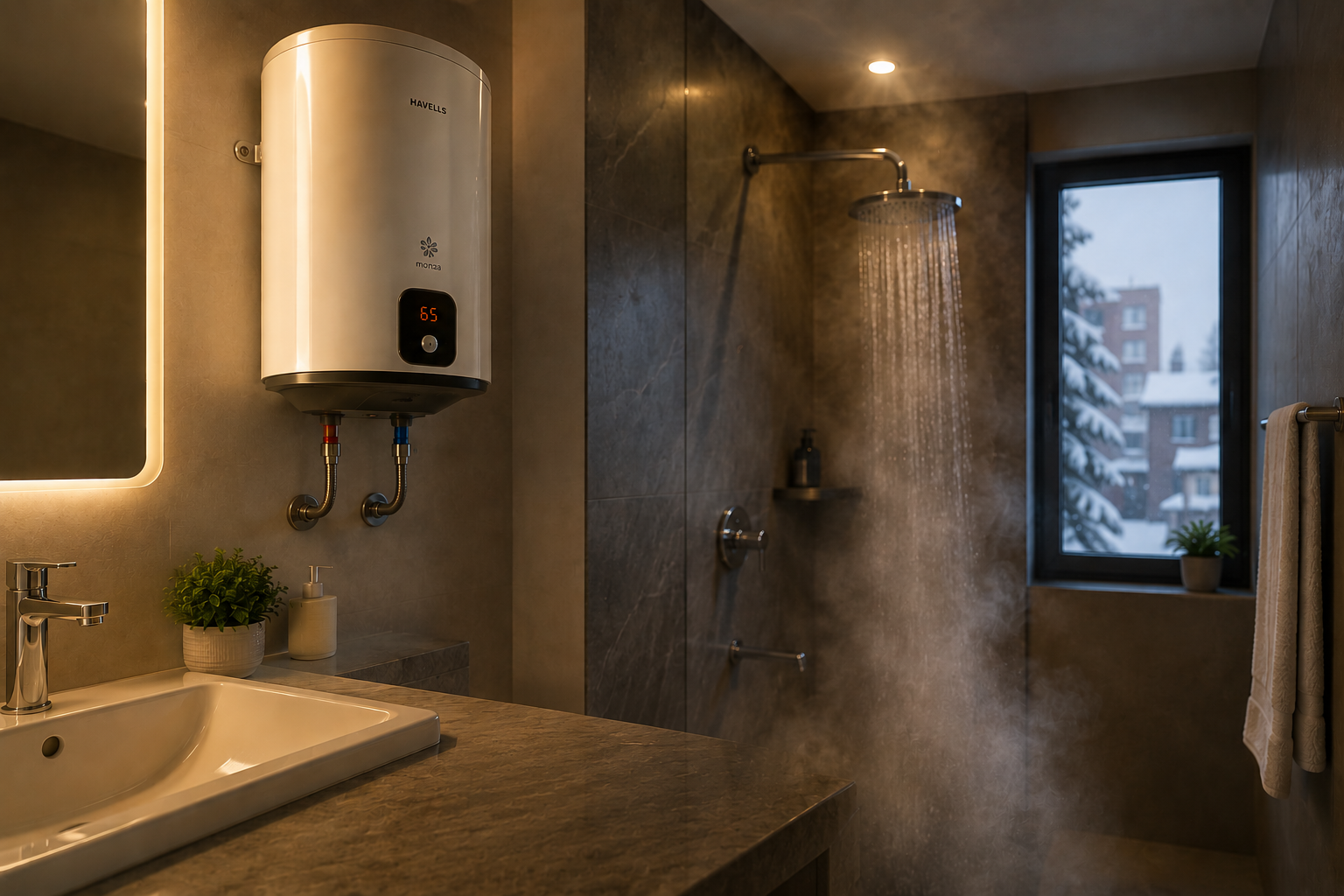
You step into the bathroom on a winter morning. The water from the tap is too cold. You turn on the geyser. You wait a few minutes. You take your shower. You leave for work. You do not think about the geyser again until the next morning.
At the end of the month, the electricity bill arrives. It is higher than the previous month. But you did not use the AC because winter was not that cold. How much electricity does a geyser use per month in India may be the real reason behind the higher bill.
In many Indian homes, how much electricity does a geyser use per month becomes important during winter months, especially when AC usage reduces.
This guide explains how much electricity does a geyser use per month, how to estimate your monthly cost, and what you can do to reduce electricity consumption without giving up hot water.
Table of Contents
Understanding How Much Electricity Does a Geyser Use Per Month in India
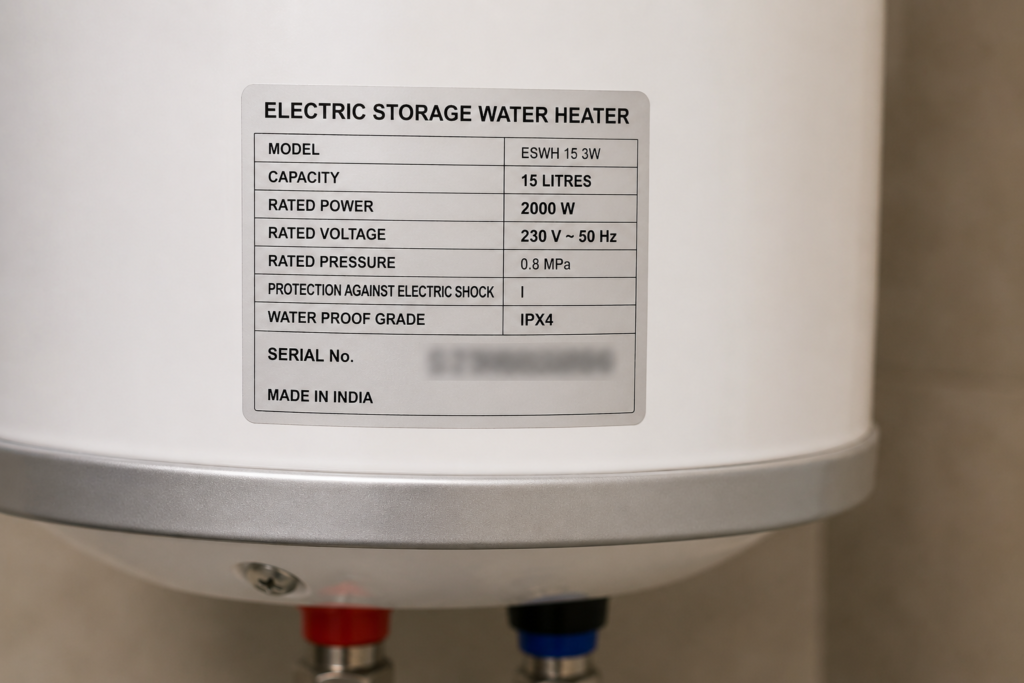
Every geyser has a power rating printed on a sticker or metal plate. This rating is in watts. It tells you how much electricity the geyser draws when it is heating water.
Common power ratings for Indian homes
| Geyser type | Capacity | Typical wattage |
|---|---|---|
| Instant geyser (non storage) | 1 to 3 litres per minute | 2000 to 3000 watts |
| Storage geyser (small) | 6 to 10 litres | 1000 to 1500 watts |
| Storage geyser (medium) | 10 to 15 litres | 1500 to 2000 watts |
| Storage geyser (large) | 15 to 25 litres | 2000 to 3000 watts |
| Storage geyser (family size) | 25 to 50 litres | 3000 to 4500 watts |
The wattage alone does not tell you monthly consumption. You also need to know how long the geyser runs each day.
Electricity usage depends not only on appliance wattage but also on daily usage patterns across the home. See what appliances consume the most electricity at home for broader comparison.
Units consumed per hour of operation
One unit of electricity is 1000 watts used for one hour. This is also called one kilowatt hour (kWh).
To calculate units per hour for your geyser:
Units per hour = Wattage ÷ 1000
Examples
| Geyser wattage | Units per hour of heating |
|---|---|
| 1000 watts | 1.0 unit per hour |
| 1500 watts | 1.5 units per hour |
| 2000 watts | 2.0 units per hour |
| 2500 watts | 2.5 units per hour |
| 3000 watts | 3.0 units per hour |
Important clarification
A storage geyser does not run continuously for one hour. It heats water to the set temperature and then turns off. It turns on again only when the water temperature drops below a certain level. So the actual running time per day is usually much less than the number of hours the geyser is switched on.
An instant geyser runs only when water is flowing through it. It does not store hot water. The running time equals the total minutes you open the hot water tap.
How Much Electricity Does a Geyser Use Per Month for Different Usage Patterns
Monthly consumption depends on three factors. The wattage of your geyser. The number of people using it. And how much hot water each person needs.
Storage geyser (2000 watts, 15 to 25 litre capacity)
| Family size | Average daily heating time | Monthly units (approx) |
|---|---|---|
| 1 person (morning bath only) | 20 to 30 minutes | 20 to 30 |
| 2 persons (morning baths only) | 35 to 50 minutes | 35 to 50 |
| 4 persons (morning baths only) | 60 to 90 minutes | 60 to 90 |
| 4 persons (morning and evening use) | 90 to 120 minutes | 90 to 120 |
Instant geyser (3000 watts, no storage)
| Usage pattern | Daily hot water minutes | Monthly units (approx) |
|---|---|---|
| 1 person (shower) | 10 to 15 minutes | 15 to 22 |
| 2 persons (showers) | 20 to 30 minutes | 30 to 45 |
| 4 persons (showers) | 40 to 60 minutes | 60 to 90 |
| Kitchen use only (washing utensils) | 15 to 20 minutes | 22 to 30 |
Small storage geyser (1000 watts, 6 to 10 litres)
This is common for kitchen use or for a single person in a small flat.
| Usage pattern | Daily heating time | Monthly units (approx) |
|---|---|---|
| Kitchen use only (2 times per day) | 15 to 20 minutes | 7 to 10 |
| One person bath (10 litre geyser) | 20 to 25 minutes | 10 to 12 |
| Two persons (bathroom use) | 30 to 40 minutes | 15 to 20 |
These numbers are estimates. Actual consumption varies based on incoming water temperature (colder in winter), thermostat setting, and how well the geyser tank retains heat.
Quick monthly cost snapshot
For many Indian homes, geyser electricity usage stays within these ranges:
| Usage type | Estimated monthly cost |
|---|---|
| Single person, small geyser | ₹100 – ₹250 |
| Couple using storage geyser daily | ₹250 – ₹450 |
| Family of 4 with regular winter use | ₹500 – ₹900 |
| Heavy winter usage in colder cities | ₹900 – ₹1,500+ |
These are approximate estimates and vary based on electricity tariff, thermostat setting, and local weather conditions.
Monthly cost calculation for different states
Once you have estimated monthly units, multiply by your state’s per unit electricity rate. The final cost also varies by slab because higher total home consumption moves you to higher slabs.
Understanding slab-based pricing helps explain why winter electricity bills sometimes rise faster than expected. See how to calculate your electricity bill at home for a full breakdown.
Cost for 2000 watt storage geyser used by 4 persons (75 units per month)
| State (approximate rate for 300-500 slab) | Per unit rate | Monthly geyser cost |
|---|---|---|
| Himachal Pradesh (lower rates) | ₹5.50 to ₹6.00 | ₹410 to ₹450 |
| Telangana | ₹5.00 to ₹6.50 | ₹375 to ₹490 |
| Jharkhand | ₹7.20 to ₹7.40 | ₹540 to ₹555 |
| Maharashtra (MSEDCL) | ₹9.00 to ₹10.00 | ₹675 to ₹750 |
| Tamil Nadu (above 500 slab) | ₹10.00 to ₹12.00 | ₹750 to ₹900 |
Cost for 3000 watt instant geyser used by 4 persons (75 units per month)
The unit consumption is similar to the storage geyser example above. The cost per state would be the same range of ₹375 to ₹900 per month depending on your state’s tariff.
Important note
If the geyser pushes your total home consumption into a higher slab, the effective cost per unit for the geyser is higher than the base rate. For example, moving from 300 units (₹6.50 per unit) to 375 units (₹7.90 per unit for the additional units) means the geyser’s units cost more than the base rate.
Winter Difference in How Much Electricity Does a Geyser Use Per Month in India
Seasonal variation is significant for geyser electricity use.
Incoming water temperature
| Season | Typical incoming water temperature (most Indian cities) |
|---|---|
| Summer (April to June) | 28 to 32 degrees Celsius |
| Monsoon (July to September) | 25 to 28 degrees Celsius |
| Winter (December to February) | 15 to 22 degrees Celsius |
The geyser has to raise water temperature to a comfortable level of around 40 to 45 degrees. The difference between incoming temperature and target temperature determines how much energy is needed.
Estimated seasonal variation
| Season | Additional heating time compared to summer | Monthly consumption impact |
|---|---|---|
| Summer (baseline) | None | Baseline |
| Monsoon | 15 to 25 percent more | 15 to 25 percent increase |
| Winter (mild, North India plains) | 40 to 60 percent more | 40 to 60 percent increase |
| Winter (cold, North India hills) | 80 to 120 percent more | 80 to 120 percent increase |
Example for a family of 4 using 2000 watt geyser
- Summer monthly consumption: 55 units
- Monsoon monthly consumption: 65 to 70 units
- Winter (Delhi, Lucknow, Jaipur): 80 to 90 units
- Winter (Shimla, Manali, Darjeeling): 100 to 120 units
If you live in a city like Chennai or Mumbai where winter temperatures are milder, the winter increase may be only 20 to 30 percent.
Common mistakes that increase geyser electricity bill
Some geyser habits silently increase monthly electricity usage without people noticing.
- Leaving the geyser switched on throughout the day
- Setting thermostat temperature too high
- Using an oversized geyser for a small household
- Ignoring dripping hot water taps
- Delaying geyser cleaning for many years
- Using old geysers with poor insulation
In many homes, small usage changes reduce electricity consumption more effectively than replacing the appliance immediately.
Tips to Reduce How Much Electricity Does a Geyser Use Per Month in India
These are practical suggestions. Each home is different. Try one or two changes and see if they work for your family.
Tip 1: Reduce thermostat setting
Most geysers come with a thermostat set to 55 to 65 degrees Celsius. This is higher than what most people need. For bathing, water mixed with cold water to reach 40 to 42 degrees is sufficient. Lower the thermostat to 45 to 50 degrees. The geyser will use less energy and still provide comfortable hot water.
A caution: Lowering the thermostat too much (below 45 degrees) may allow bacteria growth in storage tanks according to some health guidelines. A setting of 50 to 55 degrees is considered safe for most homes.
Tip 2: Turn off the geyser when not in use
Leaving a storage geyser on all day means it turns on periodically to maintain temperature. This is called standby loss. For a 15 litre geyser, standby loss can add 10 to 15 units per month. Turning it off after the morning bath and turning it on again in the evening (if needed) reduces this waste.
Tip 3: Use a timer switch
If family members forget to turn off the geyser, a mechanical or digital timer switch can help. Set it to turn on 30 minutes before the usual bath time and turn off 15 minutes after. These timers are available at electrical shops for ₹300 to ₹800.
Tip 4: Take showers instead of bucket baths
This depends on personal preference. A 5 minute shower uses roughly 15 to 20 litres of water. A bucket bath uses 20 to 25 litres. The difference is not large. But a shower with a low flow showerhead can reduce both water and electricity use.
Tip 5: Fix dripping hot water taps
If your hot water tap drips, the geyser loses both water and heat. The storage tank refills with cold water more often. The geyser runs more frequently. A single dripping tap can add 5 to 10 units per month.
Tip 6: Consider a solar water heater
For homes with roof space and sunlight for most of the year, a solar water heater can reduce or eliminate geyser electricity use for 8 to 10 months. The upfront cost is ₹10,000 to ₹25,000 depending on capacity. The payback period is usually 2 to 4 years depending on electricity rates and family size.
Homes with high electricity usage from both cooling and water heating often benefit most from solar-based solutions over the long term.
Tip 7: Insulate hot water pipes
If the distance from geyser to tap is long, hot water loses heat while traveling through pipes. Foam pipe insulation (available at hardware stores) costs ₹50 to ₹100 per meter. This is more useful for instant geysers located far from the tap.
Tip 8: Clean the geyser annually
Mineral deposits (scale) build up inside storage geysers over time. This layer acts as insulation. The geyser takes longer to heat water. A technician can clean the geyser and check the heating element. Annual service costs ₹300 to ₹600 and can restore efficiency.
For many buyers, choosing between instant and storage geysers is less about appliance price and more about long-term electricity usage and family routine.
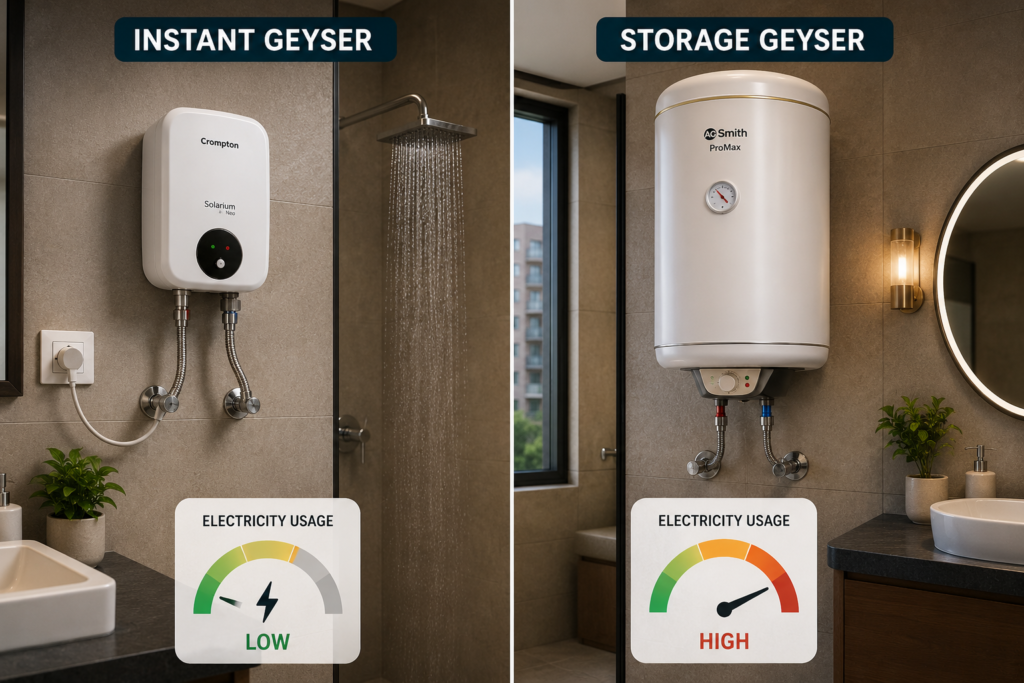
How Much Electricity Does a Geyser Use Per Month in India: Instant vs Storage Geyser
Both types have different consumption patterns. The choice affects your electricity bill.
Instant geyser
- Heats water only when tap is open
- No standby loss
- Requires higher wattage (2000 to 3000 watts)
- Better for kitchens or for a single person bathroom
- Monthly consumption depends entirely on total minutes of use
Storage geyser
- Heats a tank of water and keeps it warm
- Has standby loss (heat escapes through tank walls)
- Lower wattage (1000 to 2000 watts) but runs longer total time
- Better for families taking baths at different times
- May consume more electricity than instant if left on all day
Which one consumes less electricity
For a single person who takes one bath per day, a small storage geyser (10 to 15 litre) turned off after use and an instant geyser have similar consumption. For a family of 4 taking baths at the same time window, a storage geyser is more efficient because it heats water once for everyone. For a family where people bathe at different times, an instant geyser may be better if each person heats only the water they need.
When replacing your geyser makes sense
An old geyser can consume significantly more electricity than a new BEE star rated model: BEE star rating appliance guide
Older appliances with degraded insulation or heating elements often use more electricity than expected even when usage habits remain the same.
Signs your geyser may be inefficient
- Water takes noticeably longer to heat than a few years ago
- You hear rumbling or popping sounds from inside the tank (mineral deposit buildup)
- The outer tank feels warm to touch (insulation has degraded)
- The geyser is more than 8 to 10 years old
Expected savings from replacement
| Old geyser (10+ years, no star rating) | New 5 star rated geyser (same capacity) | Estimated monthly savings (for 75 unit usage) |
|---|---|---|
| 1500 watts, poor insulation | 1500 watts, BEE 5 star | 15 to 25 percent (₹100 to ₹200 per month) |
A new BEE 5 star geyser costs ₹4000 to ₹8000 depending on capacity. The payback period from electricity savings alone is roughly 2 to 4 years depending on usage and electricity rates.
A caution: Replacing a working geyser may not be financially worthwhile if your usage is low. Calculate the payback period before deciding.
Quick decision guide
Small household → 10 to 15 litre storage geyser usually enough
Frequent short usage → Instant geyser may work better
Family of 4 → Medium storage geyser is more practical
High electricity bill in winter → Check thermostat and usage timing first
Old geyser (8–10+ years) → Compare efficiency before replacing
Related reads
These articles may help you understand and manage other home electricity costs.
Leave a Reply