
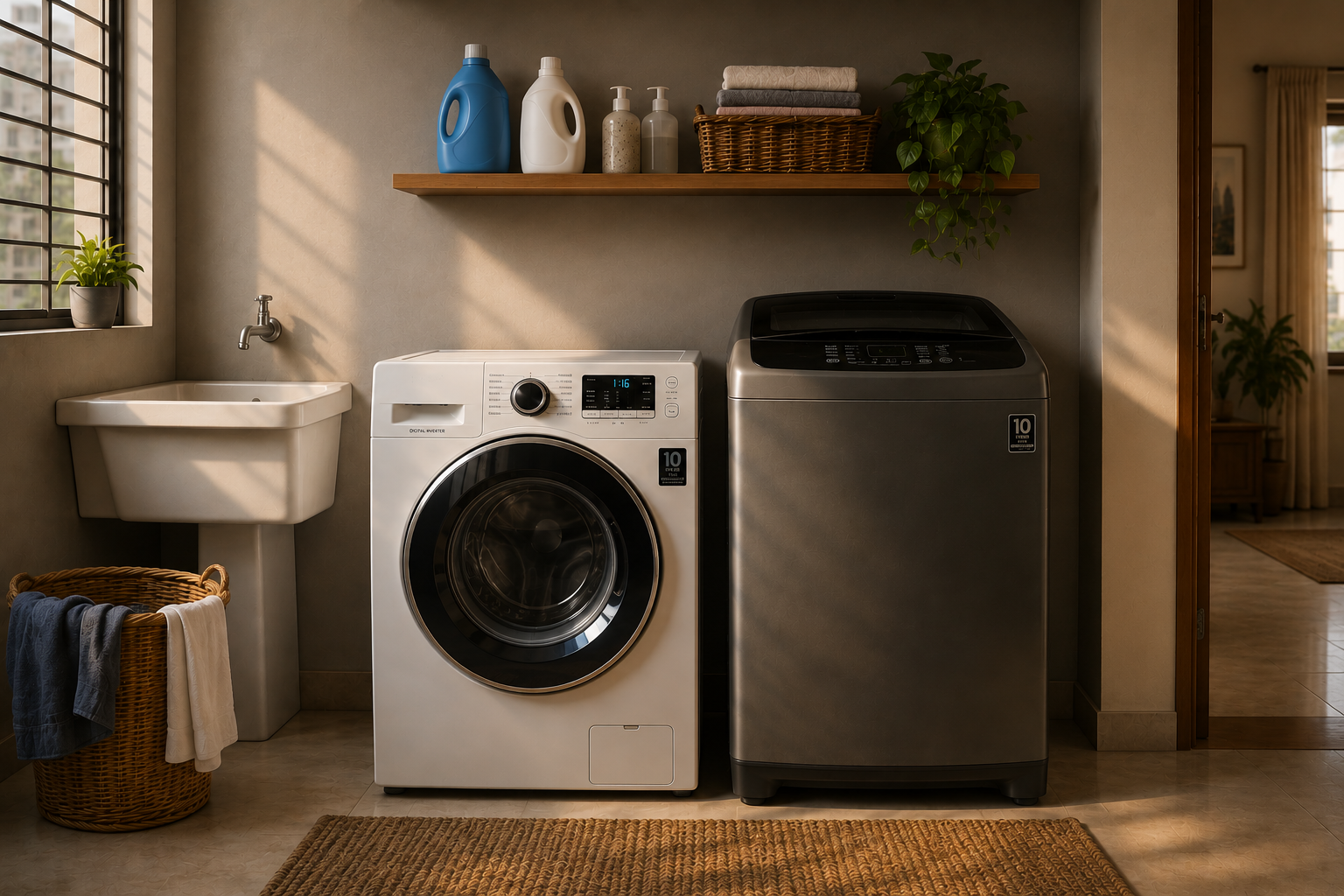
What is your washing machine electricity consumption per month? If you assume it is negligible, you may be surprised. A family using hot wash every cycle can consume 24 units per month (₹168), while a family using cold wash consumes just 4-6 units (₹30-40). That is a 5x difference, from the same machine, just different settings.
Before we calculate washing machine electricity consumption per month, know that smaller appliances like washing machines can add up, especially if you use hot water cycles.
But washing machines, especially models with water heating features, can add a noticeable amount to your monthly consumption. The difference between a cold wash and a hot wash is not small. The difference between a top load and a front load machine is also meaningful.
Even moderate changes in appliance usage habits can noticeably change the monthly electricity bill during high consumption months.
This guide explains how much electricity different types of washing machines use, how hot water cycles affect consumption, and what you can expect to pay based on your family size and usage pattern.
Table of Contents
Top Load vs Front Load: How Machine Type Affects Washing Machine Electricity Consumption Per Month
The type of washing machine you have significantly affects electricity consumption.
Electricity usage patterns also become important when deciding whether repairing or replacing an older washing machine makes financial sense.
How they differ
A top load machine has a vertical drum. It uses more water and generally has a simpler motor design. Most top load machines do not have a built in water heater. They wash with water at whatever temperature comes from the tap.
A front load machine has a horizontal drum. It uses less water and has a more efficient motor. Most front load machines have a built in water heater that can heat water up to 60 to 90 degrees Celsius. This heating element consumes significant electricity when used.
Typical wattage and consumption per cycle
| Machine type | Typical wattage | Watts per hour of operation | Units per cycle (1 hour, cold wash) |
|---|---|---|---|
| Top load (non inverter) | 300 to 500 watts | 300 to 500 | 0.3 to 0.5 units |
| Top load (inverter) | 200 to 400 watts | 200 to 400 | 0.2 to 0.4 units |
| Front load (cold wash, heater off) | 300 to 500 watts | 300 to 500 | 0.3 to 0.5 units |
| Front load (warm wash at 40°C) | 1500 to 2000 watts (heater on) | 300 to 500 for motor + 1500 to 2000 for heater when active | 0.8 to 1.8 units per cycle |
| Front load (hot wash at 60°C) | 1500 to 2000 watts (heater on) | Heater runs for longer | 1.2 to 2.5 units per cycle |
Important clarification
These numbers help estimate your washing machine electricity consumption per month. Multiply by cycles per week, then by 4.3. A front load machine running a hot wash cycle may consume 2 to 5 times more electricity than the same machine running a cold wash cycle. The motor wattage is similar. The difference is the water heater.
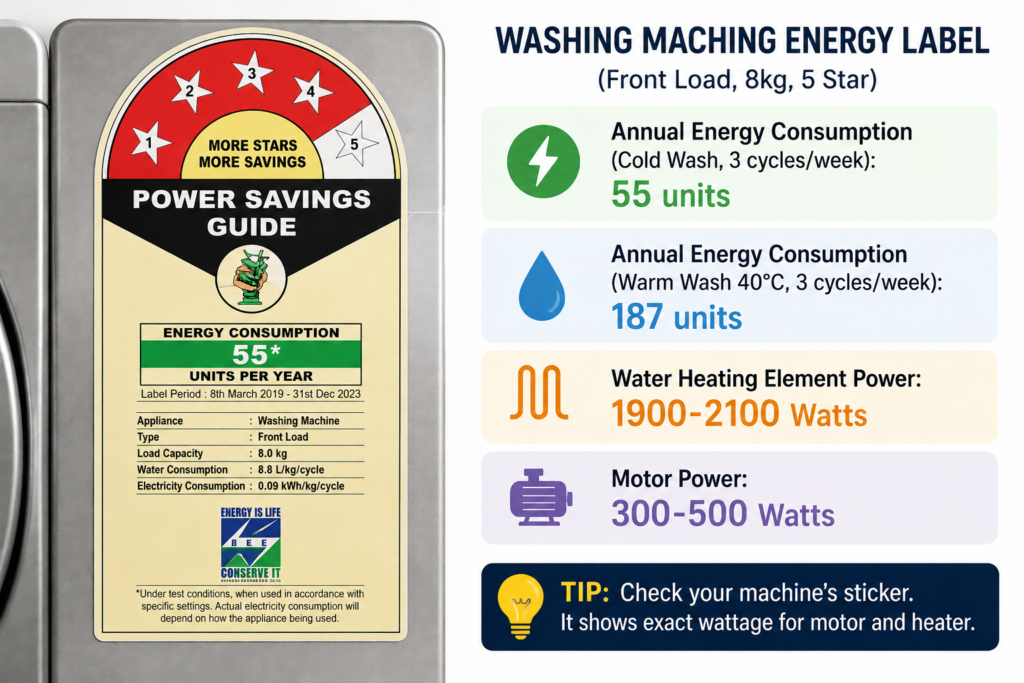
Annual consumption comparison for a family of 4 (3 cycles per week, cold wash)
| Machine type | Units per cycle | Cycles per week | Weekly units | Monthly units | Annual units |
|---|---|---|---|---|---|
| Top load (400W) | 0.4 units | 3 | 1.2 | 4.8 | 62 |
| Front load cold wash | 0.4 units | 3 | 1.2 | 4.8 | 62 |
| Front load warm wash (40°C) | 1.2 units | 3 | 3.6 | 14.4 | 187 |
| Front load hot wash (60°C) | 2.0 units | 3 | 6.0 | 24.0 | 312 |
Does Washing Machine Capacity Affect Electricity Usage?
Yes, but not in the way most people think. A larger machine does not always mean higher electricity bills.
6 kg vs 8 kg vs 10 kg — What changes?
| Capacity | Typical Motor Wattage | Units per cycle (cold wash) | Best for |
|---|---|---|---|
| 6 kg | 300-400W | 0.3-0.4 units | Couples, small families (2-3 people) |
| 8 kg | 350-450W | 0.35-0.45 units | Families of 3-4 people |
| 10 kg | 400-500W | 0.4-0.5 units | Large families (5-6+ people) |
Key insight: The difference between 6 kg and 10 kg is only 0.1 units per cycle (about ₹0.70). Not significant.
Bigger drum ≠ always higher bill
A 10 kg machine running 3 cycles per week consumes about the same as a 6 kg machine running 5 cycles per week. The number of cycles matters more than the drum size.
Half load inefficiency
Running a half load in a large machine does not cut electricity consumption in half. The motor still runs. The cycle duration is almost the same. You save very little. Wait for a full load.
Family size matching recommendation
| Family Size | Recommended Capacity | Cycles per week (approx) | Monthly Units (cold wash) |
|---|---|---|---|
| 2 people | 6 kg | 2-3 | 3-4 units (₹20-30) |
| 3-4 people | 7-8 kg | 3-4 | 4-6 units (₹30-40) |
| 5-6 people | 9-10 kg | 4-5 | 6-8 units (₹40-55) |
Conclusion: Buy the capacity that matches your family size. A larger machine running fewer cycles may consume similar electricity to a smaller machine running more cycles. But a larger machine running half loads is inefficient.
Hot Water vs Cold Wash: The Biggest Factor in Washing Machine Electricity Consumption Per Month
The water heater inside a front load washing machine is the largest factor in electricity consumption.
Why heating water consumes so much power
Heating water is the single largest factor in washing machine electricity consumption per month, often doubling or tripling your bill compared to cold wash.
A 2000 watt heating element running for 20 minutes consumes roughly 0.66 units. The motor running for 60 minutes consumes 0.4 units. In many washing machines, the heating element may consume more electricity in a short period than the motor uses during most of the wash cycle.
When hot water is actually needed
| Water temperature | When to use | Electricity impact |
|---|---|---|
| Cold (tap temperature, 20-30°C) | Most daily washes, lightly soiled clothes, dark colours, delicate fabrics | Baseline |
| Warm (40°C) | Moderately soiled clothes, towels, bed sheets, nappies | Adds 0.6 to 1.0 units per cycle |
| Hot (60°C) | Heavily soiled clothes, clothes worn by sick family members, cloth nappies, white clothes | Adds 1.5 to 2.5 units per cycle |
The Indian context
In most Indian cities, tap water is not very cold except in winter months. In summer, tap water may be 28 to 32 degrees. Cold wash at this temperature is sufficient for most clothes. Detergent powders and liquids are designed to work effectively at lower temperatures.
In winter months (December to February in North India), tap water can drop to 10 to 18 degrees. Some people prefer warm wash at 30 to 40 degrees for better detergent action. This adds to electricity consumption only in winter, not year round.
Recommendation
Use cold wash for most cycles. Reserve warm or hot wash for towels, bedsheets, heavily soiled work clothes, or when someone in the family is sick. This keeps electricity consumption low without compromising on cleanliness.
Monthly cost examples
These real examples show how washing machine electricity consumption per month changes based on family size, machine type, and wash temperature. Electricity rate assumed at ₹7 per unit. Your actual cost may differ depending on your electricity slab and state tariff structure.
Example 1: Small family (2 people, top load machine, 2 cycles per week, cold wash only)
| Component | Calculation | Amount |
|---|---|---|
| Units per cycle | 0.4 units | |
| Cycles per week | 2 | |
| Weekly units | 0.8 units | |
| Monthly units | 3.2 units | |
| Monthly cost at ₹7/unit | 3.2 × 7 | ₹22 |
| Annual cost (6 months colder months only) | Not applicable | Around ₹150 per year |
Example 2: Family of 4 (top load machine, 3 cycles per week, cold wash only)
| Component | Calculation | Amount |
|---|---|---|
| Units per cycle | 0.4 units | |
| Cycles per week | 3 | |
| Weekly units | 1.2 units | |
| Monthly units | 4.8 units | |
| Monthly cost at ₹7/unit | 4.8 × 7 | ₹34 |
| Annual cost | Around ₹400 per year |
Example 3: Family of 4 (front load machine, 3 cycles per week, cold wash only)
| Component | Calculation | Amount |
|---|---|---|
| Units per cycle | 0.4 units | |
| Cycles per week | 3 | |
| Weekly units | 1.2 units | |
| Monthly units | 4.8 units | |
| Monthly cost at ₹7/unit | 4.8 × 7 | ₹34 |
| Annual cost | Around ₹400 per year |
Example 4: Family of 4 (front load machine, 3 cycles per week, warm wash at 40°C every cycle)
| Component | Calculation | Amount |
|---|---|---|
| Units per cycle | 1.2 units | |
| Cycles per week | 3 | |
| Weekly units | 3.6 units | |
| Monthly units | 14.4 units | |
| Monthly cost at ₹7/unit | 14.4 × 7 | ₹101 |
| Annual cost | Around ₹1200 per year |
Example 5: Family of 4 (front load machine, 3 cycles per week, hot wash at 60°C every cycle)
| Component | Calculation | Amount |
|---|---|---|
| Units per cycle | 2.0 units | |
| Cycles per week | 3 | |
| Weekly units | 6.0 units | |
| Monthly units | 24.0 units | |
| Monthly cost at ₹7/unit | 24 × 7 | ₹168 |
| Annual cost | Around ₹2000 per year |
What these numbers show
A cold wash keeps your washing machine electricity consumption per month as low as ₹30. A hot wash every cycle pushes it to ₹168 or more. The monthly cost is similar to running a couple of ceiling fans. A washing machine using hot water for every cycle consumes 4 to 5 times more electricity. The difference over a year is significant.
Compared to cooling appliances, washing machines are usually a relatively small part of household electricity consumption.
Quick Calculator: Estimate Your Washing Machine Electricity Consumption Per Month
Use this simple formula:
Monthly Units = (Motor Wattage ÷ 1000) × Hours per cycle × Cycles per week × 4.3 + (Heater Wattage ÷ 1000 × Heater hours per cycle × Cycles per week × 4.3)
Step-by-step example
Your machine: Front load, 8 kg, 2000W heater, 400W motor
Your usage: 3 cycles per week, warm wash (40°C), heater runs for 20 minutes (0.33 hours)
Motor calculation:
(400 ÷ 1000) × 1 hour × 3 × 4.3 = 5.16 units
Heater calculation:
(2000 ÷ 1000) × 0.33 hours × 3 × 4.3 = 8.5 units
Total monthly: 13.66 units (₹96 at ₹7/unit)
Quick reference table
| Your Usage Pattern | Estimated Monthly Units | Estimated Monthly Cost (₹7/unit) |
|---|---|---|
| Top load, cold wash, 3 cycles/week | 4-6 units | ₹30-40 |
| Front load, cold wash, 3 cycles/week | 4-6 units | ₹30-40 |
| Front load, warm wash (40°C), 3 cycles/week | 12-15 units | ₹80-105 |
| Front load, hot wash (60°C), 3 cycles/week | 20-24 units | ₹140-168 |
| Front load, hot wash + dryer (1.5 hours), 3 cycles/week | 50-60 units | ₹350-420 |
Use this calculator to check your own numbers. You will likely find that cold wash saves you ₹500-1,000 per year compared to warm/hot wash every cycle.
Family Size Guide: Washing Machine Electricity Consumption Per Month for 2, 4, and 6 People
This table shows estimated monthly units for different family sizes and washing patterns. Assumes top load machine or front load with cold wash.
| Family size | Loads per week | Machine type | Wash type | Monthly units | Monthly cost (₹7/unit) |
|---|---|---|---|---|---|
| 2 people | 2 loads | Top load | Cold | 3 to 4 units | ₹20 to ₹30 |
| 2 people | 2 loads | Front load | Cold | 3 to 4 units | ₹20 to ₹30 |
| 2 people | 2 loads | Front load | Warm | 8 to 10 units | ₹55 to ₹70 |
| 4 people | 3 loads | Top load | Cold | 4 to 6 units | ₹30 to ₹40 |
| 4 people | 3 loads | Front load | Cold | 4 to 6 units | ₹30 to ₹40 |
| 4 people | 3 loads | Front load | Warm | 12 to 15 units | ₹80 to ₹105 |
| 4 people (winter, some warm washes) | 3 loads | Front load | Mix (cold + warm) | 6 to 8 units | ₹40 to ₹55 |
| 6 people | 5 loads | Top load | Cold | 7 to 10 units | ₹50 to ₹70 |
| 6 people | 5 loads | Front load | Warm (all cycles) | 20 to 25 units | ₹140 to ₹175 |
These are estimates. Actual consumption depends on machine efficiency, load size, cycle duration, and water temperature.
Does an Inverter Washing Machine Reduce Washing Machine Electricity Consumption Per Month?
Inverter technology in washing machines works differently than inverter ACs. An inverter washing machine uses a brushless DC motor. The motor speed can be adjusted based on the load and wash cycle requirements.
The word “inverter” can mean very different things depending on the appliance category.
How inverter washing machines save electricity
A non inverter washing machine motor runs at fixed speed. It turns on and off. An inverter motor runs continuously but at varying speeds. For small loads or gentle cycles, the motor runs slowly. For heavy loads or cotton cycles, it runs faster. This efficiency improvement is most noticeable in front load machines.
Estimated savings compared to non inverter models
| Machine type | Non inverter annual consumption (cold wash, 3 cycles/week) | Inverter annual consumption (cold wash, 3 cycles/week) | Approximate saving |
|---|---|---|---|
| Top load | 70 to 80 units | 55 to 65 units | 15 to 20 percent |
| Front load | 65 to 75 units | 50 to 60 units | 15 to 20 percent |
Annual saving in rupees (at ₹7/unit)
- Non inverter: approximately ₹500 to ₹550 per year
- Inverter: approximately ₹400 to ₹450 per year
- Saving: approximately ₹100 to ₹150 per year
Inverter washing machines typically cost ₹3000 to ₹6000 more than non inverter models. Based on electricity savings alone, the payback period is 20 to 40 years. This is not a strong financial case.
But inverter machines offer other benefits
Inverter washing machines are usually quieter. They tend to vibrate less. They have longer warranties on the motor (10 years on some brands). They are gentler on clothes due to variable speed control. These benefits may justify the higher price for some buyers. Electricity saving alone is not the primary reason to choose an inverter washing machine.
Common mistakes people make with washing machines
Running hot water cycles for every wash
Running hot water cycles for every wash, this single habit doubles or triples your washing machine electricity consumption per month.
This is the most common mistake. Many people assume hot water cleans better. For most Indian clothes washed weekly, cold water with good quality detergent is sufficient. Using the heater every cycle increases electricity consumption by 3 to 5 times.
Overloading the machine
Overloading makes the motor work harder. The machine takes longer to complete the cycle. The clothes do not get cleaned properly. The motor may wear out faster. Use the recommended load capacity. A 6 kg machine should get about 6 kg of dry clothes, not packed tightly.
Using the dryer or spin heater unnecessarily
Some front load machines have a built in dryer. Drying clothes with electricity consumes significant power. A 2000 watt dryer running for 1 hour uses 2 units. Line drying is free. Use the dryer only when absolutely necessary.
Heating based appliances usually consume significantly more electricity than motor based appliances.
Not cleaning the machine
A dirty machine works less efficiently. The motor may run longer to complete cycles. Clean the detergent drawer, drum, and filter every few months. Run a maintenance wash (empty drum, hot water cycle, no detergent) once a month.
Using the wrong detergent
Low quality detergent may not clean well at low temperatures. You may run a second cycle or use hot water to compensate. Use a good quality detergent powder or liquid designed for cold wash. This saves electricity.
Running the machine with very small loads
A half load uses almost as much electricity as a full load. The motor still runs. The cycle duration is similar. Wait until you have enough clothes for a full load. This reduces the number of cycles per week.
Standby Power: Your Washing Machine Consumes Electricity Even When Off
Many people do not realise this. A washing machine left plugged in consumes 1-5 watts continuously. The digital display, control board, and sensors stay active.
How much does standby power add?
- 2 watts × 24 hours × 30 days = 1.44 units per month
- At ₹7/unit: ₹10 per month
- Annual cost: ₹120
This is not a huge amount. But over 10 years, that is ₹1,200 — the cost of 2-3 years of cold wash electricity.
What to do
Unplug the washing machine after use. Or turn off the socket switch. This eliminates standby consumption completely. This one habit saves ₹120 per year with zero effort.
Note: Smart washing machines with Wi-Fi may consume slightly more in standby (3-5 watts). Unplugging them also saves that power.
Dryer Warning: Why Washer-Dryers Consume Much More Electricity
A washing machine with a built-in dryer (washer-dryer) is a different appliance altogether when it comes to electricity consumption.
The numbers that surprise most buyers
| Mode | Typical Wattage | Units per hour | Cost per hour (₹7/unit) |
|---|---|---|---|
| Wash only (cold) | 300-500W | 0.3-0.5 units | ₹2-3.50 |
| Wash with warm water (40°C) | 1500-2000W | 0.8-1.8 units | ₹5.50-12.50 |
| Wash with hot water (60°C) | 1500-2000W | 1.2-2.5 units | ₹8.50-17.50 |
| Drying cycle (vented or condenser) | 2000-2500W | 2.0-2.5 units per hour | ₹14-17.50 per hour |
Real example
A full wash cycle (1 hour) + drying cycle (1.5 hours) on a washer-dryer:
- Wash cycle (warm): 1.2 units (₹8.50)
- Drying cycle: 3.0 units (₹21)
- Total per load: 4.2 units (₹29.50)
If you do 3 loads per week:
- Weekly: 12.6 units (₹88.50)
- Monthly: 54 units (₹380)
- Annually (6 months of dryer use): 324 units (₹2,280)
Compare with line drying
Line drying: ₹0 per month.
Washer-dryer (3 loads/week, 6 months): ₹2,280 per year.
When a dryer makes sense
- During monsoon when clothes do not dry for days
- In very humid cities (Mumbai, Chennai, Kolkata) during rainy season
- For families with infants who need dry cloth nappies quickly
- When you have no balcony or outdoor space
Recommendation
If you buy a washer-dryer, use the drying function only when necessary. Use cold wash to keep base consumption low. Line dry whenever possible. The drying cycle will dominate your washing machine electricity consumption per month if used regularly.
What you should do now
Here is a step by step plan to manage your washing machine electricity consumption.
Step 1: Check your machine type and settings
If you have a front load machine, check the temperature setting on your most used cycle. If it is set to 40 or 60 degrees, change it to cold (20 to 30 degrees). Use warm or hot only for specific loads.
Step 2: Count your weekly cycles
How many cycles do you run per week? Can you combine some loads to reduce the number of cycles? Running 4 cycles instead of 5 per week reduces annual consumption by 20 percent.
Step 3: Calculate your current consumption
Use this formula to calculate your exact washing machine electricity consumption per month: Wattage × hours per cycle × cycles per week × 4.3. Compare with the tables in this article. If your consumption is much higher, you may be using hot water or running very long cycles.
Tracking appliance wise usage often helps households identify where electricity costs are increasing gradually over time.
Step 4: Adjust your habits
- Switch to cold wash for all regular loads
- Use warm wash only for towels, bedsheets, and heavily soiled clothes
- Use hot wash only when someone in the family is sick or for cloth nappies
- Run full loads whenever possible
- Line dry clothes instead of using a dryer
Step 5: Consider your next purchase
If you are buying a new washing machine and want to save electricity, front load machines with cold wash are efficient. Inverter models are quieter but the electricity saving is small. The bigger factor is your habit of using or not using the water heater.
Many homeowners underestimate how small appliances collectively affect the monthly electricity bill. Calculating appliance wise consumption gives a clearer picture of where the bill is actually going.
Common questions asked
Does a washing machine consume electricity when plugged in but not running
Yes, a small amount. Most modern machines draw 1 to 5 watts in standby mode. This adds up to 0.7 to 3.6 units per month if left plugged in continuously. Unplug the machine after use or turn off the socket switch.
How much electricity does a wash cycle consume in units
For a top load machine with cold wash: 0.3 to 0.5 units per cycle. For a front load machine with cold wash: 0.3 to 0.5 units per cycle. For a front load machine with warm wash (40°C): 0.8 to 1.8 units per cycle. For a front load machine with hot wash (60°C): 1.2 to 2.5 units per cycle.
Is it cheaper to wash clothes by hand
Yes, hand washing consumes no electricity. But it uses more water and your time. For small loads or delicate clothes, hand washing makes sense. For daily laundry of a family, a washing machine on cold wash is reasonably efficient.
Does a front load machine always consume more electricity than a top load
Only when using the water heater. For cold wash cycles, front load and top load machines have similar consumption. Front load machines actually use less water and have higher spin speeds, which reduces drying time.
Should I buy a machine with a higher star rating
Yes, a 5 star rated washing machine is more efficient than a 3 star model. The difference is usually 10 to 15 percent. For a family that does 3 loads per week, the annual electricity saving from a 5 star machine is around ₹50 to ₹80. Not a large amount, but every bit helps.
For official efficiency standards and star rating comparisons, visit the BEE star rating program website.
Household electricity costs usually rise gradually through multiple appliance habits rather than one single device alone.
Related reads
These articles provide more information on appliance electricity consumption and repair decisions.
Leave a Reply