

Why electricity bill high without AC? You look at your bill. ₹2,800. But you have not used the AC this month. No heater. No new appliance. Still the number is up. You are not alone. This guide reveals the 7 hidden reasons silently adding ₹1,000-2,000 to your monthly bill.
If you keep asking ‘why electricity bill high without ac’, know that you are not alone. This situation is common across Indian homes. Many households assume the AC is the only large consumer. When the bill stays high without AC, the reason is usually a combination of smaller appliances that add up, including what appliances consume the most electricity at home in India, an old inefficient refrigerator, a geyser used more than needed, or a water pump running longer than necessary.
This guide answers ‘why electricity bill high without ac’ by walking you through each hidden consumer, from old refrigerators to standby power.
Quick Diagnosis: Is Your Bill High Without AC?
Check these 7 common sources first. If any sound familiar, you have found the reason.
☐ Old refrigerator (10+ years) running almost continuously
☐ Geyser used longer than needed (especially in winter)
☐ Water pump running too often (leaking tap or stuck float valve)
☐ Multiple devices on standby power (router, set top box, chargers)
☐ Meter reading error or estimated billing correction
☐ Wiring leakage or pump overflow unnoticed
☐ Older appliances without BEE star ratingsMost households find their answer in the first 3 checks.
Table of Contents
7 Hidden Consumers: Why Electricity Bill High Without AC
When AC is off, understanding why electricity bill high without ac starts with a simple audit of these hidden consumers. Some are obvious. Some are easy to overlook.
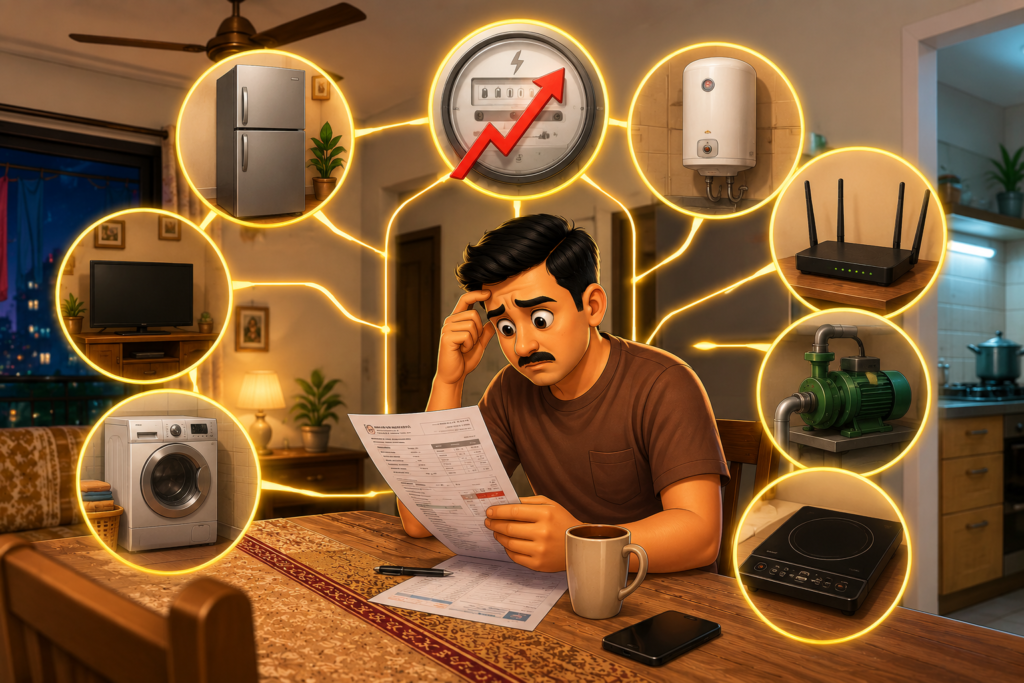
Common hidden consumers ranked by typical monthly consumption
| Appliance | Typical monthly units | Notes |
|---|---|---|
| Old refrigerator (10+ years) | 100 to 180 units | Often the largest consumer without AC |
| Geyser (storage, family of 4) | 60 to 100 units | Winter months only or year round in cold regions |
| Water pump (1 HP, 1 hour daily) | 22 to 30 units | Often overlooked |
| Induction cooktop (daily use) | 35 to 55 units | Replaces LPG for some families |
| Second refrigerator or old freezer | 50 to 90 units | Common in many Indian homes |
| Desktop computer (heavy use) | 45 to 70 units | Gaming or work from home |
| Washing machine with hot wash cycles | 20 to 25 units | Only if using heater for every cycle |
| Iron box (daily use) | 15 to 25 units | Adds up faster than expected |
| Old television (non LED) | 30 to 50 units | Plasma or CRT TVs are inefficient |
| Water heater for bathing buckets | 500 to 1000 watts | Depends on usage |
| Many devices on standby | 10 to 20 units | Routers, set top boxes, chargers |
Why the total adds up
None of these alone matches an AC’s consumption of 250 to 400 units per month. But four or five of them together can easily add 150 to 250 units. At ₹7 per unit, that is ₹1000 to ₹1750 per month.
Top 5 Reasons Your Bill is High Without AC (Ranked)
| Rank | Source | Typical Monthly Units | Typical Cost (₹7/unit) |
|---|---|---|---|
| 1 | Old Refrigerator (12+ years) | 120-180 units | ₹840-1,260 |
| 2 | Geyser (winter usage) | 60-100 units | ₹420-700 |
| 3 | Water Pump (1 HP, 1 hour/day) | 22-30 units | ₹154-210 |
| 4 | Standby Power (router, TV, set top box) | 15-30 units | ₹105-210 |
| 5 | Induction Cooktop / Desktop PC | 35-55 units | ₹245-385 |
Fix these 5, and your bill will drop by ₹1,500-2,500 per month.
Old Refrigerator: #1 Reason Why Electricity Bill High Without AC
An old refrigerator is often the #1 answer to ‘why electricity bill high without ac’, consuming 120-180 units monthly.
You can also check how much electricity a fridge uses per month in India for a more detailed breakdown.
Why old refrigerators consume so much
Refrigerator efficiency standards have improved significantly over the past 10 to 15 years. An old refrigerator may have poor insulation, a worn out compressor, or dirty condenser coils. The compressor runs longer to maintain temperature. Some old units run almost continuously.
Estimated consumption by refrigerator age
| Refrigerator age | Typical monthly units | Monthly cost at ₹7/unit | Annual cost |
|---|---|---|---|
| Less than 5 years (3 to 5 star) | 35 to 55 units | ₹245 to ₹385 | ₹2940 to ₹4620 |
| 5 to 8 years (2 to 3 star) | 55 to 85 units | ₹385 to ₹595 | ₹4620 to ₹7140 |
| 8 to 12 years (1 to 2 star) | 85 to 120 units | ₹595 to ₹840 | ₹7140 to ₹10080 |
| More than 12 years (no BEE label) | 120 to 180 units | ₹840 to ₹1260 | ₹10080 to ₹15120 |
For current efficiency standards and star ratings, check the BEE star rating program website before buying a new refrigerator.
Signs your refrigerator may be consuming too much
- The compressor runs almost continuously. You hear it running most of the time with few breaks.
- The outer body feels warm to touch, especially on the sides. This indicates poor insulation or the compressor working too hard.
- There is ice buildup inside the freezer even in frost free models.
- The door seals are loose. A piece of paper slides out easily when trapped between the door and the body.
- The refrigerator is more than 10 years old.
What you can do
If replacing the refrigerator is not an option, clean the condenser coils at the back or underneath. Check door seals. Avoid keeping the refrigerator in direct sunlight or near the cooking area. Defrost manually if ice buildup is excessive.
But for a refrigerator older than 12 years, replacement with a new 5 star model often pays for itself in electricity savings within 3 to 4 years.
If you are comparing repair costs first, see refrigerator repair vs replacement cost in India.
Geyser: The Winter Answer to Why Electricity Bill High Without AC
In homes without AC, the geyser is often the second largest consumer after the refrigerator.
You may also want to read how much electricity a geyser uses per month in India.
Geyser consumption in different seasons
| Season | Typical monthly units (family of 4, storage geyser) | Monthly cost at ₹7/unit |
|---|---|---|
| Summer | 20 to 35 units | ₹140 to ₹245 |
| Monsoon | 30 to 50 units | ₹210 to ₹350 |
| Winter (mild, North India plains) | 50 to 75 units | ₹350 to ₹525 |
| Winter (cold, hills or North India peak winter) | 80 to 120 units | ₹560 to ₹840 |
This is another reason why electricity bill high without ac in winter, the geyser replaces the AC as the main consumer.
Why geyser consumption increases without AC
This may seem obvious. But the pattern matters. In summer, you may not notice the geyser on your bill because the AC is the main consumer. In winter, the AC is off but the geyser consumption increases significantly. The bill may not drop as much as you expect because the geyser replaces the AC as the main consumer.
Reducing geyser consumption
- Lower the thermostat setting from 60 degrees to 50 or 55 degrees
- Turn off the geyser after use instead of leaving it on all day
- Take shorter showers or use buckets with a mix of hot and cold water
- Consider a solar water heater if feasible for your home
Pump and motor usage
Water pumps are among the most overlooked electricity consumers. Many homeowners do not realise how much power a pump uses or how long it runs.
Typical pump consumption
| Pump type | Power rating | Daily run time | Monthly units | Monthly cost at ₹7/unit |
|---|---|---|---|---|
| 0.5 HP pump | 370 to 400 watts | 30 minutes | 6 to 8 units | ₹40 to ₹55 |
| 0.5 HP pump | 370 to 400 watts | 1 hour | 11 to 15 units | ₹80 to ₹105 |
| 1 HP pump | 750 to 800 watts | 30 minutes | 11 to 15 units | ₹80 to ₹105 |
| 1 HP pump | 750 to 800 watts | 1 hour | 22 to 30 units | ₹150 to ₹210 |
| 1 HP pump | 750 to 800 watts | 2 hours | 45 to 60 units | ₹315 to ₹420 |
Why pumps run more than needed
- Leaking taps or pipes cause the tank to empty faster than expected.
- The float valve in the overhead tank may be stuck, causing overflow and continuous pumping.
- The pump is turned on manually and forgotten for hours.
- In apartments with common pumps, this cost is shared. In independent houses, you pay for all of it.
What you can do
Check for leaks in pipes and taps. Observe the float valve in your overhead tank. Does water overflow? If yes, get it fixed. If you use a manual switch, set a timer or alarm to turn off the pump after 30 to 60 minutes depending on tank size.
Standby Power: The Silent Reason Why Electricity Bill High Without AC
Standby power, also called phantom load or vampire power, is the electricity devices consume when they are turned off but still plugged in. The device is not actively used but is ready to turn on quickly.
Standby power consumption of common devices
| Device | Typical standby wattage | Monthly standby units | Monthly cost at ₹7/unit |
|---|---|---|---|
| Wifi router | 5 to 10 watts | 3.5 to 7 units | ₹25 to ₹50 |
| Set top box (DTH) | 5 to 15 watts | 3.5 to 10 units | ₹25 to ₹70 |
| Desktop computer (shut down but plugged in) | 2 to 5 watts | 1.5 to 3.5 units | ₹10 to ₹25 |
| Laptop charger (plugged in without laptop) | 0.5 to 2 watts | 0.3 to 1.5 units | ₹2 to ₹10 |
| Phone charger (plugged in without phone) | 0.1 to 0.5 watts | 0.1 to 0.3 units | ₹1 to ₹2 |
| Television (off but plugged in) | 1 to 3 watts | 0.7 to 2 units | ₹5 to ₹15 |
| Microwave (display on) | 2 to 5 watts | 1.5 to 3.5 units | ₹10 to ₹25 |
| Washing machine (idle) | 1 to 3 watts | 0.7 to 2 units | ₹5 to ₹15 |
The total adds up
A typical Indian home may have a wifi router, set top box, television, microwave, laptop charger, and two phone chargers on standby continuously. The total standby consumption can be 15 to 30 units per month. At ₹7 per unit, that is ₹100 to ₹200 per month, or ₹1200 to ₹2400 per year.
For a full home-level estimate, use this guide on how to calculate electricity bill at home in India.
What you can do
Unplug devices when not in use. Use a power strip with a switch for entertainment devices (TV, set top box, speakers). Turn off the power strip after use. The wifi router is often left on 24 hours. If you are away for a few hours, turning it off saves a small amount.
Meter and billing issues
Sometimes the problem is not your consumption. It is the meter or the bill.
Possible issues to check
| Issue | What to look for | What to do |
|---|---|---|
| Meter reading error | Bill shows unusually high consumption compared to previous months | Check your meter reading against the bill. The reading on the bill should match the number on your meter. |
| Estimated billing | Bill says “estimated” instead of “actual” | The electricity company may have estimated consumption instead of reading the meter. Pay the bill but request an actual reading next month. |
| Previous month underbilling | Consumption seems normal but bill is high because last month was too low | Compare last 3 to 4 months of bills. A correction may appear. If seasonal usage patterns seem confusing, read why electricity bill is high in summer for additional causes that affect Indian homes. |
| Meter is faulty | Consumption seems impossible for your home (example: 800 units with no AC) | Request a meter test from the electricity board. There is usually a fee, refunded if the meter is found faulty. |
| Wiring leakage | Power leaking to ground due to damaged wiring | Switch off all appliances and check if the meter still moves. If yes, get an electrician to check for leakage. |
| Neighbour or common area tapping | In rare cases, unauthorised connection issues may also contribute. | Switch off your main breaker when no appliances are running. If the meter still moves, there may be unauthorised connection. |
A simple home check
Turn off all appliances at the plug point. Do not just turn them off with the device switch. Unplug or use the socket switch. Check your meter. The disc (for old meters) should not move. The digital reading should not increase. If the meter still shows consumption, either something is still powered (like a geyser or refrigerator) or there is leakage or unauthorised connection.
Step by step home electricity audit
You can do this audit yourself in one weekend.
Step 1: Gather your bills
Collect electricity bills for the last 6 months. Look for patterns. Which months are highest? Which are lowest? Does the variation match your usage of AC, geyser, or other seasonal appliances?
Step 2: Check your meter
At a time when most appliances are off (late night or when family is away), note the meter reading. Do not use any appliance for 1 hour. Check the reading again. If it has increased by more than 0.1 or 0.2 units, something is consuming power without your knowledge.
Step 3: List all appliances
Write down every electrical device in your home. Include the refrigerator, geyser, pump, washing machine, induction cooktop, television, computer, router, set top box, iron, mixer, and any small appliances.
Step 4: Estimate consumption for each
Use the wattage label on each appliance. Multiply by estimated daily usage hours. Divide by 1000 to get units per day. Add them up for a monthly estimate.
Step 5: Compare with your bill
If your estimated consumption matches the bill, you have found why electricity bill high without ac, your appliances are the hidden sources. If your estimate is much lower than the bill, look for hidden consumers (old refrigerator, pump running too long, standby power, or meter issues).
Step 6: Identify the largest consumers
Rank your appliances by estimated monthly consumption. The top three are usually refrigerator, geyser (in winter or cold regions), and pump. Start your reduction efforts with these.
Real-World Observations from Indian Homes
Observation 1: Last winter, my neighbor Mr. Sharma called me confused. His family hadn’t used the AC for two months, but his bill was ₹2,900. We spent an hour checking his home. The reason wasn’t one big appliance. It was his 12-year-old refrigerator running non-stop and a stuck float valve in his water tank. This guide is the checklist we used to find the problem.
Observation 2: A homeowner in Chennai discovered their water pump was running 3 hours daily due to a stuck float valve. Fixed it. Pump now runs 30 minutes daily. Saved ₹300 per month. Zero cost, just observation.
Electricity Usage Estimator: Calculate Your Own Bill
Use this table to estimate your monthly consumption. Fill in your numbers.
| Appliance | Typical Watts | Your Hours/Day | Daily Units | Monthly Units (×30) | Monthly Cost (₹7/unit) |
|---|---|---|---|---|---|
| Refrigerator (old) | 150-250W (continuous) | 24 hours | 3.6-6.0 | 108-180 | ₹756-1,260 |
| Refrigerator (new 5 star) | 70-120W (continuous) | 24 hours | 1.7-2.9 | 51-87 | ₹357-609 |
| Geyser (storage, family of 4) | 2000W (2 hours/day) | 1-2 hours | 2.0-4.0 | 60-120 | ₹420-840 |
| Water Pump (1 HP) | 750W | 0.5-1 hour | 0.38-0.75 | 11-23 | ₹77-161 |
| Wifi Router | 10W | 24 hours | 0.24 | 7.2 | ₹50 |
| Set Top Box | 10W | 5 hours active + 19 standby | 0.24 | 7.2 | ₹50 |
| LED TV (43 inch) | 80W | 4 hours | 0.32 | 9.6 | ₹67 |
| Ceiling Fan (old) | 70W | 10 hours | 0.70 | 21 | ₹147 |
| Ceiling Fan (BLDC 5 star) | 30W | 10 hours | 0.30 | 9 | ₹63 |
| LED Bulbs (5 bulbs × 10W) | 50W | 6 hours | 0.30 | 9 | ₹63 |
| Laptop Charger | 45W | 4 hours | 0.18 | 5.4 | ₹38 |
| Phone Chargers (2) | 10W | 3 hours | 0.03 | 0.9 | ₹6 |
How to use: Find each appliance, estimate your daily hours, multiply. Add all monthly units. Compare with your bill.
Tip: If your calculated total is much lower than your bill, check for an old refrigerator, water pump running too long, or wiring leakage.
What you should do now
Here is a checklist to reduce your electricity bill without AC.
Immediate actions (no cost or low cost)
- Unplug devices when not in use. Pay special attention to set top box, computer, and chargers.
- Turn off the geyser after use. Do not leave it on all day.
- Check if the water pump is running longer than needed. Set a timer or alarm.
- Clean the refrigerator coils at the back or underneath.
- Check refrigerator door seals. Replace if loose.
- Use cold wash for washing machine. Avoid hot water cycles.
- Air dry clothes instead of using a dryer.
Medium cost actions
- Replace old refrigerator (more than 12 years) with a new 5 star model
- Add a timer switch for the geyser (₹300 to ₹800)
- Add a timer switch for the water pump (₹300 to ₹800)
- Replace old ceiling fans with BEE 5 star fans
- Replace old tubelights and CFLs with LED bulbs
Monitor for one month
After making changes, compare the next bill with the same month last year. The difference may be larger than you expect.
Electricity consumption varies by appliance condition, usage habits, climate, family size, and local electricity tariff. The examples in this guide are approximate ranges intended for educational purposes.
Common questions asked
Can a tv increase electricity bill significantly
A modern LED TV consumes 80 to 150 watts. Running it for 5 hours daily adds 12 to 22 units per month. That is ₹85 to ₹155 at ₹7 per unit. Not huge, but not zero. An old plasma or CRT TV consumes 2 to 3 times more.
Does a water purifier consume a lot of electricity
Most RO water purifiers consume 30 to 60 watts when running. The motor runs only when filling the tank, typically 2 to 4 hours per day depending on usage. Monthly consumption is 2 to 7 units. Not a major contributor.
Can a slow moving fan consume less electricity
No. A fan running at low speed consumes almost as much power as at high speed. The speed regulator (electronic or resistive) wastes the rest as heat. For ceiling fans, BEE star rated fans with BLDC motors consume much less power (28 to 35 watts) compared to old fans (60 to 75 watts).
How much electricity does an iron box use
An iron box is 800 to 1500 watts. Using it for 1 hour daily adds 24 to 45 units per month. That is ₹170 to ₹315. Ironing once a week or in batches reduces consumption.
My electricity bill doubled even without AC. What could be the reason
Check three things. First, an old refrigerator or a refrigerator with a failing compressor. Second, a water pump running longer than before (leak or stuck float valve). Third, a meter reading error or estimated billing correction. Do the home audit described above.
Related reads
These articles provide more detail on specific appliance consumption.
Leave a Reply