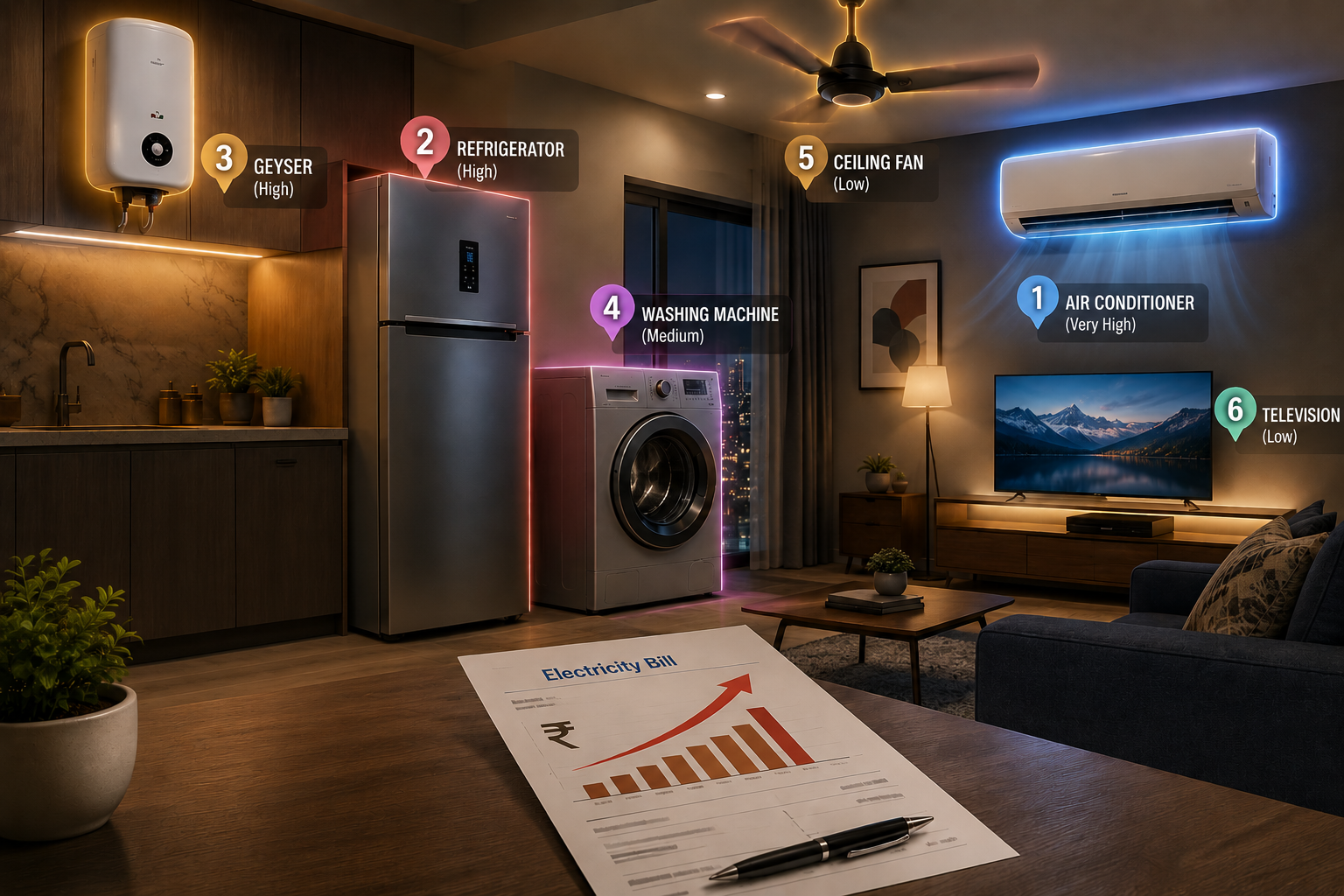
You look at your electricity bill. The number is high. But you are not sure which appliance is responsible. Is it the AC running all night? The old refrigerator in the kitchen? Or the geyser that everyone uses in the morning?
This confusion is common. Many people assume appliances that consume the most electricity are always the largest appliances. That is not always true. Some small appliances used for many hours can add up. Some large appliances used for short periods barely matter.
This guide ranks appliances that consume the most electricity based on monthly household electricity usage. The rankings are based on typical Indian usage patterns. Your actual consumption may be higher or lower depending on how you use each appliance.
You can also compare appliance efficiency ratings using the BEE star rating appliance guide.
Understanding which appliances that consume the most electricity are affecting your home can help reduce unnecessary monthly power costs.
Table of Contents
How Appliances That Consume the Most Electricity Are Ranked
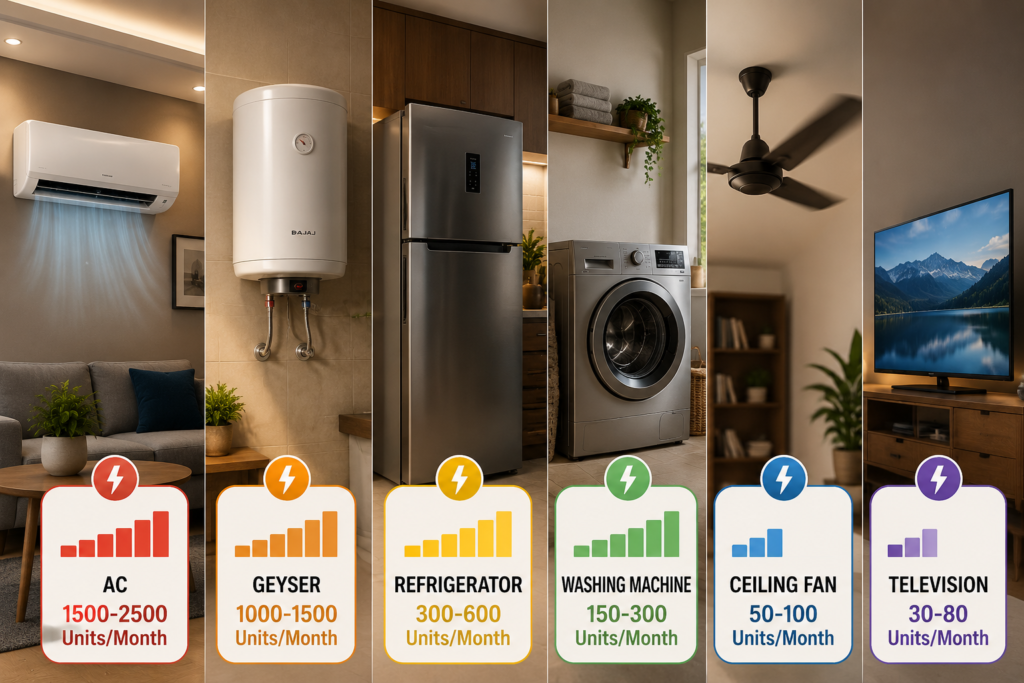
Quick Snapshot of Appliances That Consume the Most Electricity
For most Indian households, electricity usage is usually concentrated around a few major appliances.
Typical ranking of appliances that consume the most electricity in many homes:
- Air conditioner
- Geyser
- Refrigerator
- Water pump
- Washing machine
The exact order of appliances that consume the most electricity depends on climate, appliance age, and daily usage habits. For example, homes without AC usage may see the geyser or refrigerator become the biggest contributor instead.
Before looking at appliances that consume the most electricity, it helps to understand the method behind the rankings.
Each appliance in this ranking uses these assumptions:
- A standard 3 BHK home in a Tier 2 city
- Family of 4 people
- Usage patterns common in Indian households
- Appliances with average 3 star efficiency ratings (unless specified otherwise)
Your home may have different appliance models, different usage hours, or different family sizes. So your actual consumption ranking may differ. But the general order across categories tends to be similar for most Indian homes.
The consumption numbers shown are monthly estimates in kilowatt hours (units). One unit is 1000 watts used for one hour.
Rank 1 – Air Conditioner Among Appliances That Consume the Most Electricity
The AC is usually the largest electricity consumer in Indian homes during summer months.
For a deeper breakdown, see how much electricity a 1.5 ton AC consumes per month under different usage conditions.
Why it consumes so much
An AC uses a compressor that runs for extended periods. Even a 5 star inverter AC draws significant power compared to other appliances. The difference between AC and other appliances is not small. A 1.5 ton AC running for 8 hours can consume as much electricity as a refrigerator running for an entire month.
Usage habits also matter more than most people realize. Small changes in temperature and maintenance can noticeably affect monthly consumption. See how to reduce AC electricity bill for practical methods.
Typical monthly consumption
| AC type | Usage per day | Monthly units (approx) |
|---|---|---|
| 1 ton 3 star window AC | 6 hours | 180 to 220 |
| 1 ton 3 star split AC | 6 hours | 160 to 200 |
| 1.5 ton 3 star split AC | 8 hours | 300 to 380 |
| 1.5 ton 5 star inverter AC | 8 hours | 220 to 280 |
| 2 ton 3 star split AC | 8 hours | 400 to 500 |
Variation factors
If you use the AC only on weekends or for a few hours in the evening, the consumption will be much lower. If you run it all night and during the day, the consumption will be higher.
Monthly electricity cost range (at ₹7 per unit)
Actual electricity cost depends on your local tariff slab and electricity tariff information by state.
- Low usage (1 ton, 5 hours daily): ₹800 to ₹1200
- Medium usage (1.5 ton, 8 hours daily): ₹2000 to ₹2700
- High usage (2 ton, 12 hours daily): ₹3500 to ₹5000
Choosing the right AC type also affects long-term electricity and maintenance cost. See split AC vs window AC – cost and electricity comparison before upgrading.
Rank 2 – Geyser Among Appliances That Consume the Most Electricity
The geyser is often the second largest consumer in many Indian homes. It can even exceed AC consumption in winter months or in homes that do not use AC much.
Why it consumes so much
A geyser typically has a high wattage rating of 1500 to 3000 watts. Even running for 30 to 60 minutes a day adds up quickly. In winter, people use hotter water and may run the geyser for longer.
Typical monthly consumption
| Geyser capacity | Usage per day | Monthly units (approx) |
|---|---|---|
| 15 litre storage | 30 minutes | 23 to 30 |
| 25 litre storage | 45 minutes | 34 to 45 |
| 50 litre storage | 1 hour | 45 to 60 |
| Instant geyser (3 litre per minute) | 30 minutes | 30 to 40 |
Important note
For a family of 4 taking baths at different times, the geyser may be used for 1.5 to 2 hours total per day. In that case, monthly consumption can reach 90 to 120 units.
Monthly electricity cost range (at ₹7 per unit)
- Low usage (one person, 15 litre, 20 minutes): ₹160 to ₹220
- Medium usage (family of 4, 25 litre, 1 hour): ₹250 to ₹350
- High usage (family of 4, storage geyser used multiple times): ₹500 to ₹800
Rank 3 – Refrigerator Among Appliances That Consume the Most Electricity
The refrigerator runs 24 hours a day. But it does not run continuously. The compressor cycles on and off based on temperature inside.
Why it is ranked third
Because it runs all day every day, even a moderately efficient refrigerator can consume 100 to 200 units per month. However, newer inverter refrigerators use significantly less power than older models.
If your refrigerator is more than 8 to 10 years old, compare its running cost with newer models using how much electricity does a fridge use monthly in India.
Typical monthly consumption
| Refrigerator type | Age | Monthly units (approx) |
|---|---|---|
| 200 litre, 2 star | New (2020 onwards) | 60 to 80 |
| 200 litre, 2 star | More than 10 years old | 100 to 150 |
| 300 litre, 3 star inverter | New | 45 to 60 |
| 300 litre, 3 star non inverter | New | 70 to 90 |
| 400 litre, 4 star inverter | New | 55 to 75 |
| Old refrigerator (pre 2010) | Any | 120 to 200 |
Important note
An old refrigerator with poor door seals or a compressor that struggles to maintain temperature can consume 2 to 3 times more electricity than a new energy efficient model.
Monthly electricity cost range (at ₹7 per unit)
- Energy efficient model (new 300 litre inverter): ₹300 to ₹450
- Standard model (5 to 7 years old): ₹500 to ₹700
- Old inefficient model (more than 12 years old): ₹900 to ₹1400
Rank 4 – Water pump or motor
Many Indian homes have a water pump to fill overhead tanks. This appliance is often overlooked because it runs for short periods. But the power rating is high.
Why it is ranked fourth
A 0.5 HP (horsepower) pump draws 370 to 400 watts. A 1 HP pump draws 750 to 800 watts. In apartment buildings or homes with ground water, pumps may run for 1 to 2 hours daily in summer. This adds up to a noticeable amount.
Typical monthly consumption
| Pump type | Daily run time | Monthly units (approx) |
|---|---|---|
| 0.5 HP pump | 30 minutes | 6 to 8 |
| 0.5 HP pump | 1 hour | 12 to 15 |
| 1 HP pump | 1 hour | 22 to 28 |
| 1 HP pump | 2 hours | 45 to 55 |
Monthly electricity cost range (at ₹7 per unit)
- Low usage (0.5 HP, 30 minutes): ₹50 to ₹60
- Medium usage (0.5 HP, 1 hour): ₹85 to ₹105
- High usage (1 HP, 1.5 hours): ₹230 to ₹290
Rank 5 – Washing machine
Washing machines consume most of their electricity when heating water. If you use cold water only, consumption is much lower.
Why it is ranked fifth
A washing machine runs for a limited number of cycles per week. Even with heating, the total monthly hours are low compared to AC or refrigerator.
Typical monthly consumption
| Usage pattern | Cycles per week | Monthly units (approx) |
|---|---|---|
| Cold wash only (6 kg machine) | 4 | 8 to 12 |
| Warm wash (40 degrees, 6 kg machine) | 4 | 15 to 22 |
| Hot wash (60 degrees, 6 kg machine) | 4 | 25 to 35 |
| Hot wash daily (8 kg machine) | 7 | 60 to 80 |
Important note
In many Indian homes, washing machines are used with cold water because water from the tap is not very cold except in winter months. In that case, the washing machine is not a major consumer.
Monthly electricity cost range (at ₹7 per unit)
- Cold wash only: ₹60 to ₹85
- Mixed warm and cold wash: ₹120 to ₹180
- Hot wash daily (family with young children): ₹400 to ₹560
Rank 6 – Induction cooktop and electric kettle
These small appliances have high wattage but very short running times.
Why they are ranked sixth
An induction cooktop (1500 to 2000 watts) can consume as much as a geyser when running. But most home cooks use it for 30 to 45 minutes total per day. An electric kettle (1200 to 1500 watts) runs for 3 to 5 minutes per use. The short duration keeps total consumption moderate.
Typical monthly consumption
| Appliance | Daily use | Monthly units (approx) |
|---|---|---|
| Induction cooktop (1 person, one meal) | 20 minutes | 10 to 15 |
| Induction cooktop (family of 4, two meals) | 45 minutes | 35 to 50 |
| Electric kettle (2 uses per day) | 6 minutes | 4 to 6 |
| Electric kettle (6 uses per day, large family) | 18 minutes | 12 to 18 |
Monthly electricity cost range (at ₹7 per unit)
- Low induction usage: ₹70 to ₹105
- High induction usage: ₹250 to ₹350
- Electric kettle typical: ₹30 to ₹45
Rank 7 – Ceiling fans and lights
These are used for many hours but have low wattage. They add up across multiple rooms.
Why they are ranked seventh
A ceiling fan uses 60 to 75 watts. Run 4 fans for 12 hours a day, and you get 30 to 35 units per month. LED lights use 8 to 12 watts each. Even 10 lights for 8 hours a day add only 20 to 25 units.
Typical monthly consumption for a 3 BHK home
| Lighting and fans | Quantity | Hours per day | Monthly units |
|---|---|---|---|
| Ceiling fans | 4 | 12 | 90 to 110 |
| LED lights | 10 | 6 | 14 to 18 |
| Tube lights | 2 | 5 | 6 to 8 |
| Bathroom exhaust fans | 2 | 2 | 3 to 5 |
Monthly electricity cost range (at ₹7 per unit)
- Fans for all rooms: ₹630 to ₹770
- Lights and fans total: ₹750 to ₹950
Rank 8 – Television and entertainment
Modern LED TVs are much more efficient than older plasma or CRT televisions.
Typical monthly consumption
| TV type | Size | Daily hours | Monthly units |
|---|---|---|---|
| LED TV | 32 inch | 4 | 10 to 15 |
| LED TV | 43 inch | 4 | 12 to 18 |
| LED TV | 55 inch | 4 | 18 to 25 |
| Set top box or streaming device | Any | 4 | 3 to 5 |
Monthly electricity cost range (at ₹7 per unit)
- Small TV occasional use: ₹50 to ₹80
- Large TV daily use: ₹140 to ₹200
Rank 9 – Laptop, phone chargers, wifi router
These devices are often left on for many hours but their power draw is very low.
Typical monthly consumption
| Device | Daily hours | Monthly units (approx) |
|---|---|---|
| Laptop (not gaming) | 6 | 8 to 12 |
| Phone charger (one phone) | 3 (actual charging time) | 1 to 2 |
| Wifi router | 24 | 5 to 8 |
| Desktop computer (without gaming) | 4 | 12 to 18 |
Important note
A gaming desktop with a powerful graphics card can consume 300 to 500 watts during gaming sessions. That changes the ranking significantly for homes with heavy gaming use.
Monthly electricity cost range (at ₹7 per unit)
- Normal work from home setup: ₹100 to ₹150
- Heavy gaming desktop: ₹300 to ₹600
Surprising Insights About Appliances That Consume the Most Electricity
Insight 1: An old refrigerator can cost you more than a new AC
A 15 year old refrigerator consuming 200 units per month costs ₹1400 per month at ₹7 per unit. A new 5 star inverter AC running 8 hours daily costs around ₹2000. The gap is much smaller than most people assume.
In many homes, replacing an inefficient old appliance reduces electricity bills more effectively than trying to cut small daily usage habits.
Insight 2: Small appliances left on can add up
A 100 watt appliance left on for 24 hours consumes 72 units per month. That is almost as much as a new refrigerator. Check for old routers, set top boxes, or night lamps that stay on continuously.
Insight 3: Geyser is the hidden winter cost
In homes without AC use (winter months or hill stations), the geyser often becomes the largest consumer. A family of 4 using a storage geyser for 1.5 hours a day can consume 100 to 120 units in winter.
Insight 4: Pump usage varies widely by housing type
For apartments with common pumps, you may not see this on your bill. For independent houses with borewell pumps, this can be a major cost. Some homes in water scarce areas run pumps for 3 to 4 hours daily.
Insight 5: Induction cooking can be cheaper than LPG
This depends on your electricity rate and LPG cylinder price. At ₹7 per unit and a ₹800 LPG cylinder lasting 30 days, induction cooking may cost slightly more or less. But for a single person living alone, induction is often cheaper because there is no fixed cylinder rental.
| Appliance | Typical Monthly Cost | Impact Level |
|---|---|---|
| AC | ₹2,000 – ₹5,000 | Very High |
| Geyser | ₹250 – ₹800 | High |
| Refrigerator | ₹300 – ₹1,400 | High |
| Water pump | ₹80 – ₹300 | Medium |
| Washing machine | ₹60 – ₹500 | Medium |
| Fans & lights | ₹700 – ₹950 | Medium |
| TV & entertainment | ₹50 – ₹200 | Low |
| Laptop & router | ₹100 – ₹150 | Low |
What to Control First Among Appliances That Consume the Most Electricity
If you want to reduce your electricity bill, start with appliances that consume the most electricity first. But the order depends on your home.
If your AC runs more than 6 hours daily
The AC is likely 50 to 70 percent of your bill. Reducing AC use or setting a higher temperature will have the largest impact.
Many households also underestimate the impact of servicing. Dirty filters and low airflow can silently increase electricity consumption over time. See AC service cost in Chennai for maintenance insights that apply broadly across India.
If your AC runs rarely or you live in a cool climate
Check the geyser and refrigerator first. An old refrigerator or a geyser used by many family members may be your main consumer.
If your bill is high but you use AC only a few hours
Look for a pump running longer than needed or an old refrigerator. Also check if someone in the house uses a room heater or an old desktop computer for many hours.
If your bill is moderately high and you already have efficient appliances
Look for small devices left on continuously. An old set top box, a wifi router from 5 years ago, or a second refrigerator in the kitchen can add 30 to 50 units per month without being noticed.
Understanding appliances that consume the most electricity makes it easier to identify where your monthly bill is actually going instead of guessing based only on appliance size.
Most homes can lower electricity bills faster by identifying appliances that consume the most electricity instead of focusing only on small devices.
Related reads
These articles provide more detail on specific appliances and cost reduction.
Leave a Reply to How Much Electricity Does a Geyser Use Per Month? Smart India Usage Guide (2026) Cancel reply