
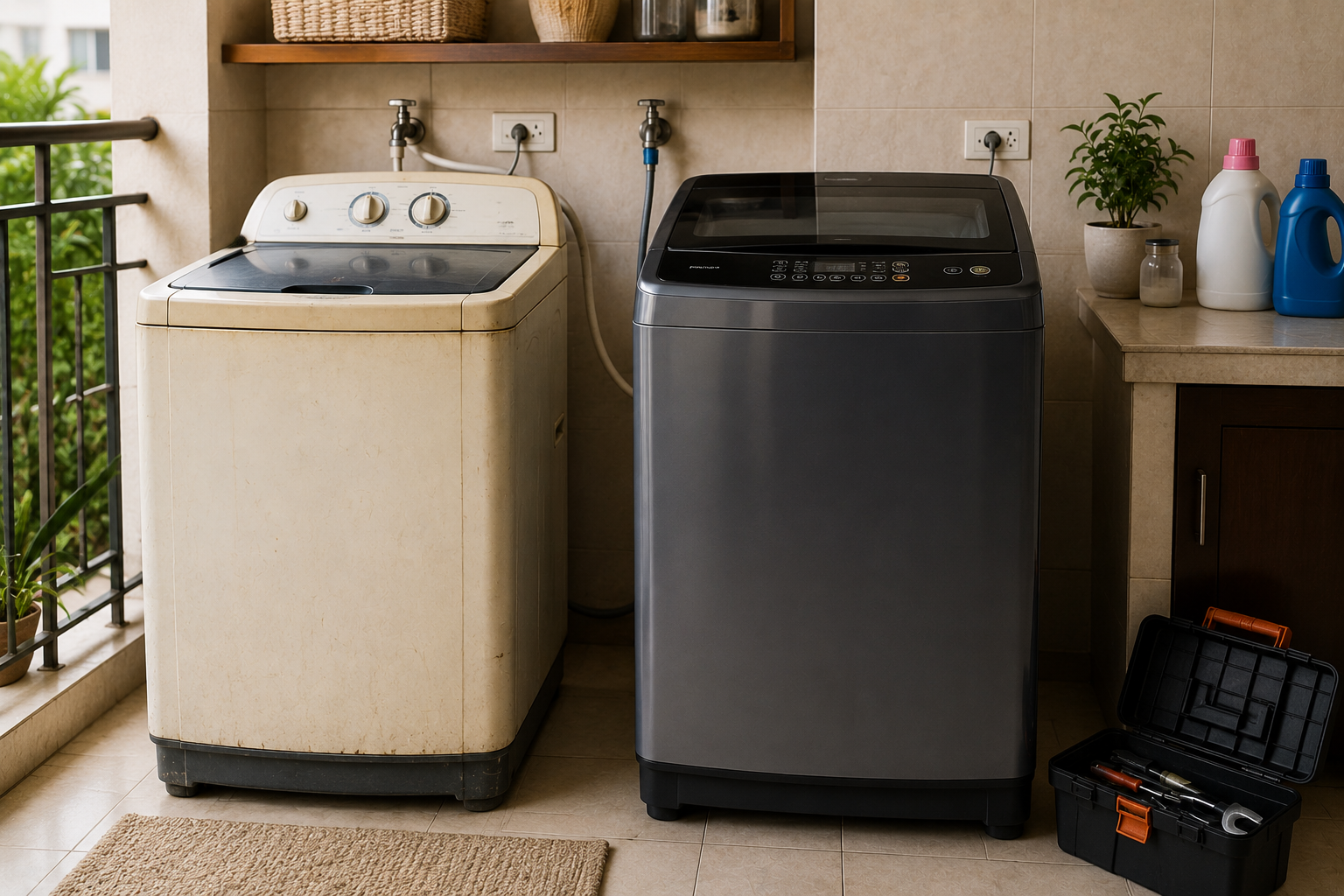
Your washing machine starts making a noise. Or it fills with water but does not spin. That leads to a common washing machine repair vs replacement question. Do you spend money on repairs for a machine that is a few years old? Or do you put that money toward buying a new one?
This decision comes up for many Indian households every year. Washing machines are not cheap to repair or replace. The right choice depends on the age of your machine, the type of repair needed, and how much you use it.
Electricity usage and long term running cost also matter, especially for older appliances that consume more power over time.
This guide covers common repair costs, the age versus cost rule, long term cost considerations, and a simple decision framework to help you choose.
Table of Contents
Types of washing machines and their common problems
Before looking at repair costs, it helps to know which type of machine you have. Repair costs vary significantly between types.
Semi automatic washing machine
These have two tubs. One for washing. One for spinning. The user moves clothes between tubs. These machines are simpler mechanically. Parts are generally cheaper. Repair costs are usually lower than fully automatic machines.
Many semi automatic models also consume slightly less electricity than older fully automatic machines.
Common problems:
- Wash motor failure
- Spin motor failure
- Pump failure for water drainage
- Timer or control knob issues
- Belt slipping or breaking
Fully automatic top load washing machine
These have a single tub. The machine does washing, rinsing, and spinning automatically. The user loads clothes and starts the cycle. These are more common in Indian homes now.
Common problems:
- Motor or drive system failure
- Control board failure
- Water inlet valve issues
- Door lid switch failure
- Drain pump failure
Fully automatic front load washing machine
These have a door at the front. Clothes are loaded horizontally. These machines are more efficient with water and electricity. They also have more complex electronics. Repair costs are typically higher than top load machines.
However, front load machines are usually more water and electricity efficient in long term use.
Common problems:
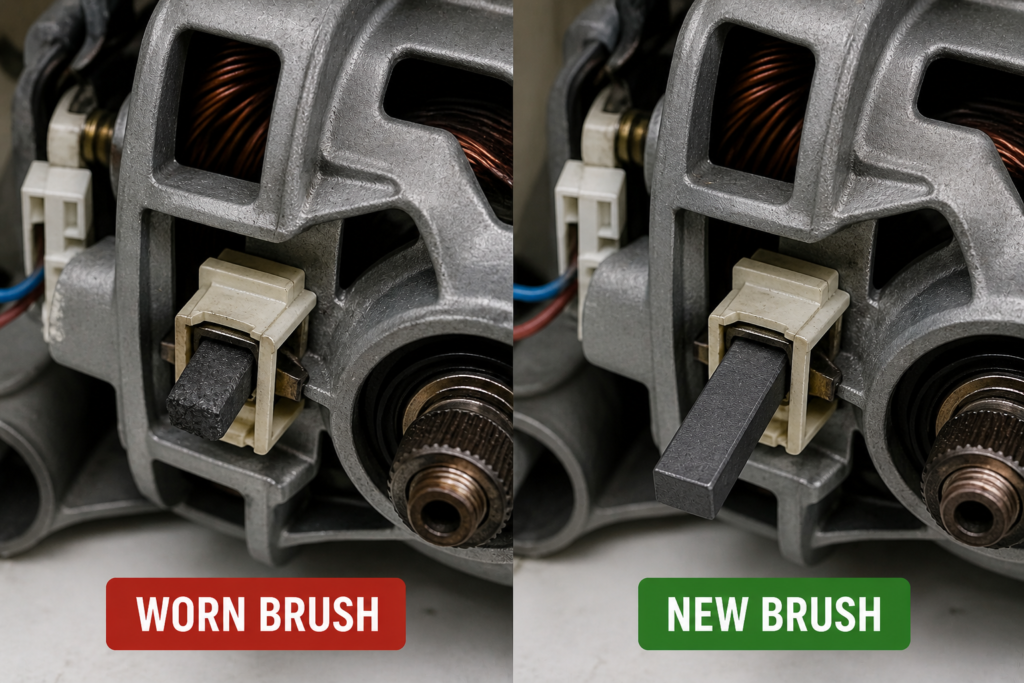
- Motor or carbon brush wear (front load motors use carbon brushes that wear out)
- Control board or PCB failure
- Door lock mechanism failure
- Drum bearing failure (expensive repair)
- Heating element failure (for hot wash models)
- Drain pump failure
Common repair costs for washing machines in 2026
The numbers below are estimates. Actual costs vary by city, brand, and technician. Always get a written estimate before authorizing any repair.
Semi automatic washing machine repair costs
| Component or repair | Expected cost range |
|---|---|
| Wash motor replacement | ₹1200 to ₹2000 |
| Spin motor replacement | ₹1000 to ₹1800 |
| Pump replacement | ₹400 to ₹800 |
| Timer or control knob replacement | ₹300 to ₹600 |
| Belt replacement | ₹200 to ₹400 |
| General service (cleaning, lubrication, belt check) | ₹300 to ₹500 |
Fully automatic top load washing machine repair costs
| Component or repair | Expected cost range |
|---|---|
| Motor replacement | ₹2500 to ₹4500 |
| Control board (PCB) replacement | ₹2000 to ₹5000 |
| Water inlet valve replacement | ₹600 to ₹1200 |
| Door lid switch replacement | ₹300 to ₹600 |
| Drain pump replacement | ₹800 to ₹1500 |
| Capacitor replacement | ₹300 to ₹600 |
| General service (drain cleaning, filter cleaning, belt check) | ₹400 to ₹700 |
Fully automatic front load washing machine repair costs
| Component or repair | Expected cost range |
|---|---|
| Carbon brush replacement (common wear item) | ₹500 to ₹1000 |
| Motor replacement | ₹4000 to ₹8000 |
| Control board (PCB) replacement | ₹4000 to ₹10000 |
| Door lock mechanism replacement | ₹800 to ₹1800 |
| Drain pump replacement | ₹1200 to ₹2500 |
| Drum bearing replacement (labor intensive) | ₹3000 to ₹6000 |
| Heating element replacement | ₹1500 to ₹3000 |
| General service (drum cleaning, filter cleaning) | ₹600 to ₹1000 |
Important note on drum bearing replacement for front load machines
This is one of the most expensive repairs. The technician has to disassemble the machine, remove the drum, press out old bearings, and press in new ones. The labor cost alone is high. Some technicians will not do this repair. They may recommend replacement instead. If your front load machine needs drum bearings and is more than 6 to 7 years old, replacement may be the better choice.
City-wise repair ranges
| City | Typical Labor Cost |
|---|---|
| Chennai | Medium |
| Bengaluru | High |
| Mumbai | High |
| Hyderabad | Medium |
| Tier-2 cities | Lower |
Actual repair bill examples
Example repair bill: Front load carbon brush replacement in Chennai
Carbon brush set: ₹450
Labor: ₹500
Total: ₹950
Example repair bill: Top load drain pump replacement in Bengaluru
Pump: ₹900
Labor: ₹600
Total: ₹1500
Age Versus Cost Rule in Washing Machine Repair vs Replacement
The age of your washing machine is one of the most important factors in any washing machine repair vs replacement decision.
Expected lifespan of washing machines
| Machine type | Expected lifespan with regular use | Expected lifespan with heavy use (daily, large loads) |
|---|---|---|
| Semi automatic | 8 to 12 years | 6 to 9 years |
| Fully automatic top load | 7 to 10 years | 5 to 8 years |
| Fully automatic front load | 8 to 12 years | 6 to 10 years |
These are general ranges. Some machines last longer. Some fail earlier. Usage patterns, water quality, and maintenance all affect lifespan.
The 30-50 percent rule
A common guideline used by appliance owners and repair technicians is the 30-50 percent rule.
- If the repair cost is less than 30 percent of the price of a new comparable washing machine, repair is usually worth it.
- If the repair cost is between 30 and 50 percent of a new machine, consider the age of the machine. If it is older than 5 to 6 years, replacement may be better.
- If the repair cost exceeds 50 percent of a new machine, replacement is usually the better choice.
Example application
A new fully automatic top load washing machine costs ₹18000.
- A motor replacement costing ₹3000 is 17 percent of a new machine. Repair makes sense.
- A control board replacement costing ₹6000 is 33 percent of a new machine. If the machine is 2 to 3 years old, repair may still make sense. If the machine is 7 years old, consider replacement.
- A motor plus control board failure costing ₹10000 is 55 percent of a new machine. Replacement is likely better.
Long Term Cost Considerations for Washing Machine Repair vs Replacement
The repair cost today is not the only factor. You also need to consider what might fail next.
Monthly electricity consumption can silently become a major long term expense for older appliances.
The domino effect of aging components
In a washing machine that is 6 or 7 years old, the motor, control board, bearings, and pump have all been through years of use. Replacing the motor today does not make the control board new. The control board could fail next month. Then you pay another ₹4000. The total of two repairs may exceed the price of a new machine.
Water quality impact on machine lifespan
In areas with hard water, washing machines have shorter lives. Mineral deposits build up in pipes, valves, and the drum. This is similar to how hard water affects geysers and other heating appliances in Indian homes.
Heating elements fail faster in front load machines. For homes with hard water, a 7 year old machine may be closer to end of life than the same age machine in a soft water area.
Electricity and water efficiency of old machines
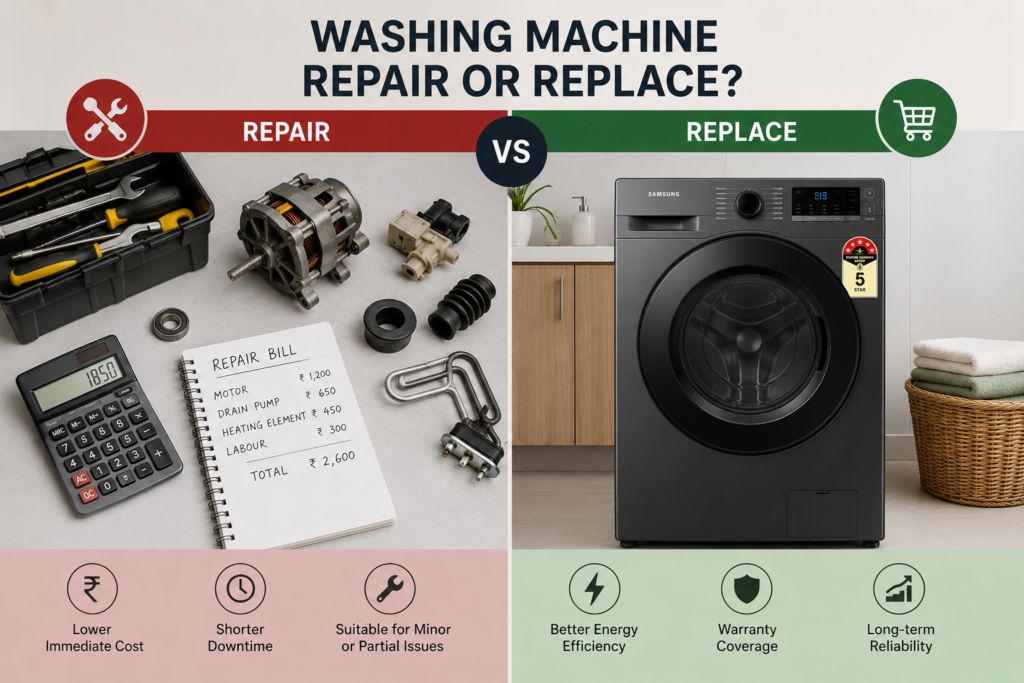
Newer washing machines, especially 5 star rated models, use less electricity and water. The difference may not be huge, but it adds up over years. A 5 star front load machine uses roughly 30 to 40 percent less electricity than a 10 year old machine of the same type. A 5 star top load machine is more efficient but the gap is smaller.
Check the official BEE star rating program for the latest efficiency standards.
Example efficiency savings
Assume a 10 year old front load machine uses 300 units per year for a family of 4. A new 5 star front load machine uses 200 units per year. At ₹7 per unit, annual electricity saving is ₹700. Water saving may add another small benefit. Over 5 years, the electricity saving could be around ₹3500, depending on usage and electricity rates. This is not enough to justify replacement on its own. But when combined with a costly repair, it can tip the balance.
Quick Washing Machine Repair vs Replacement Guide
| Situation | Better choice |
|---|---|
| Machine under 5 years old + small repair | Repair |
| Machine above 8 years old + major repair | Replacement |
| Control board or drum bearing failure in old machine | Usually replacement |
| Minor issue like pump or belt | Repair |
| Electricity bill concern with very old machine | Consider replacement |
| Rust, leaks, repeated failures | Replacement |
This quick guide helps narrow the decision, but the final choice depends on repair quality, machine condition, and how heavily the machine is used in your home.
Decision framework for washing machine repair vs replacement
Use this step by step process when your washing machine fails.
Step 1: Identify the problem and get a written estimate
Ask the technician to tell you which component has failed. Ask for a breakdown of parts cost and labor cost. Get the estimate in writing on paper or WhatsApp.
Step 2: Check the age of your washing machine
Look for the manufacturing date on the label. This is usually inside the door panel or on the back of the machine. Note the year.
Step 3: Look up the current price of a similar new machine
Check online prices for a comparable model from the same brand or similar brands. Note the approximate price.
Step 4: Apply the 30-50 percent rule
Calculate repair cost as a percentage of new machine price. Compare with the age based guidance below.
Step 5: Consider usage and condition
- How often do you use the machine? Daily, twice a week, once a week?
- Has the machine been serviced regularly?
- Are there other signs of wear like rust, unusual noises, or leaks?
- Do you live in an area with hard water?
Step 6: Make your decision
| Machine age | Repair type | Recommendation |
|---|---|---|
| Less than 3 years | Any repair | Repair (likely under warranty for some parts) |
| 3 to 5 years | Minor (motor, pump, door lock, carbon brush) | Repair |
| 3 to 5 years | Major (control board, drum bearings) | Repair usually, but get warranty on repair |
| 5 to 7 years | Minor | Repair |
| 5 to 7 years | Major | Consider replacement if repair cost exceeds 40 percent of new machine |
| 7 to 9 years | Any repair above ₹3000 (top load) or ₹4000 (front load) | Replacement recommended |
| 9+ years | Any non trivial repair | Replacement recommended |
These are guidelines for your washing machine repair vs replacement decision. Your specific situation may differ.
When repair clearly makes sense
There are situations where repairing is almost always the better choice.
The machine is under warranty or recently out of warranty
If your washing machine is less than 2 years old and the problem is not covered by warranty, a repair costing ₹2000 to ₹4000 is still better than spending ₹15000 to ₹30000 on a new machine.
The problem is a known wear item
Carbon brushes in front load machines are designed to wear out every few years. Replacing them is routine maintenance, not a sign of machine failure. Similarly, belts in semi automatic machines wear out. These repairs are inexpensive and expected.
The machine is in good condition otherwise
If the washing machine looks clean, has no rust, the drum turns smoothly, and there are no unusual noises during operation, repairing a failed component is reasonable.
You have a high end or expensive machine
If your washing machine cost ₹40000 or more, a repair costing ₹5000 to ₹10000 may still be worth it. The cost of replacing the machine with a similar model is much higher.
When replacement clearly makes sense
These situations suggest replacement may be the wiser choice in a washing machine repair vs replacement comparison.
The machine is more than 8 years old and needs a major repair
Control board failure, motor failure, or drum bearing failure on an 8 year old machine usually means replacement is better. The machine has already given most of its expected life.
The same replacement logic is often used for refrigerators and older cooling appliances as well.
The repair cost is more than half the price of a new machine
At this point, spending money on the old machine is hard to justify. Even if the repair works, other components may fail soon.
The same component has failed twice in a short period
If you replaced the motor last year and the motor failed again, there may be a deeper problem. The wiring or control board may be damaging the motor. Replacement is safer.
The technician recommends against repair
Some repairs are technically possible but not practical. If a reputable technician says “I can do it but I do not recommend it,” listen to that advice. They have seen many machines and know which repairs do not last.
The machine has rust or physical damage
Rust on the outer body may be cosmetic. Rust inside the drum or on the suspension system can affect performance and hygiene. Replacement is better.
You need a different type or size of machine
If your family has grown and a 5 kg machine is too small, or if you want to move from a top load to a front load for better cleaning, replacement is a lifestyle upgrade. The financial comparison is not the only factor.
What to do if you decide to repair
If you choose repair, here are some suggestions.
Ask for a warranty on the repair
For motor or control board replacement, ask for at least 3 months of warranty. Some technicians offer 6 months on new parts.
Use brand authorized service for major repairs
For control board replacement, consider using the brand’s authorized service center. The cost may be higher but the part is genuine and the work is guaranteed.
Keep the old parts if replaced
If the repair involves replacing a component, ask the technician to show you the old part. This confirms the part was actually replaced.
Save the repair bill
Keep the bill with the technician’s name, phone number, date, parts replaced, and warranty terms.
What to do if you decide to replace
If you choose replacement, here are some suggestions.
Check the BEE star rating
Look for a 5 star rated model if you plan to keep the machine for 7 to 10 years. For front load machines, the electricity saving over a 3 star model can be significant.
Compare capacity to your needs
A family of 4 typically needs 6 to 7 kg capacity for top load and 7 to 8 kg for front load. Larger capacity machines use more water and electricity per cycle. Do not buy more capacity than you need.
Dispose of the old machine properly
Do not leave it on the street. Some cities have e waste collection. Some retailers offer free pickup when you buy a new machine. You can also check CPCB e-waste guidelines for proper appliance disposal in India.
Consider selling the old machine
If the old washing machine is still working but you are replacing it for other reasons, sell it on OLX or Facebook Marketplace. A working 5 to 6 year old top load machine may sell for ₹3000 to ₹8000 depending on brand and condition.
Repair decisions become easier when you compare repair cost, electricity usage, and expected remaining lifespan together instead of looking at only the technician estimate.
Basic Washing Machine Maintenance Timeline
yearly hose inspection
monthly filter cleaning
quarterly drum cleaning
Related reads
These articles cover related appliance cost decisions that may help you.
- Washing machine not spinning – fix cost and decision guide
- Refrigerator repair vs replacement – full cost guide
- How much electricity does a fridge use monthly in India
- What appliances consume the most electricity at home
- 1.5 Ton AC Electricity Consumption: How Much Does It Cost Per Month? (India 2026)
Leave a Reply to Save Money: 3-24 Units Washing Machine Electricity Consumption Per Month India Cancel reply