
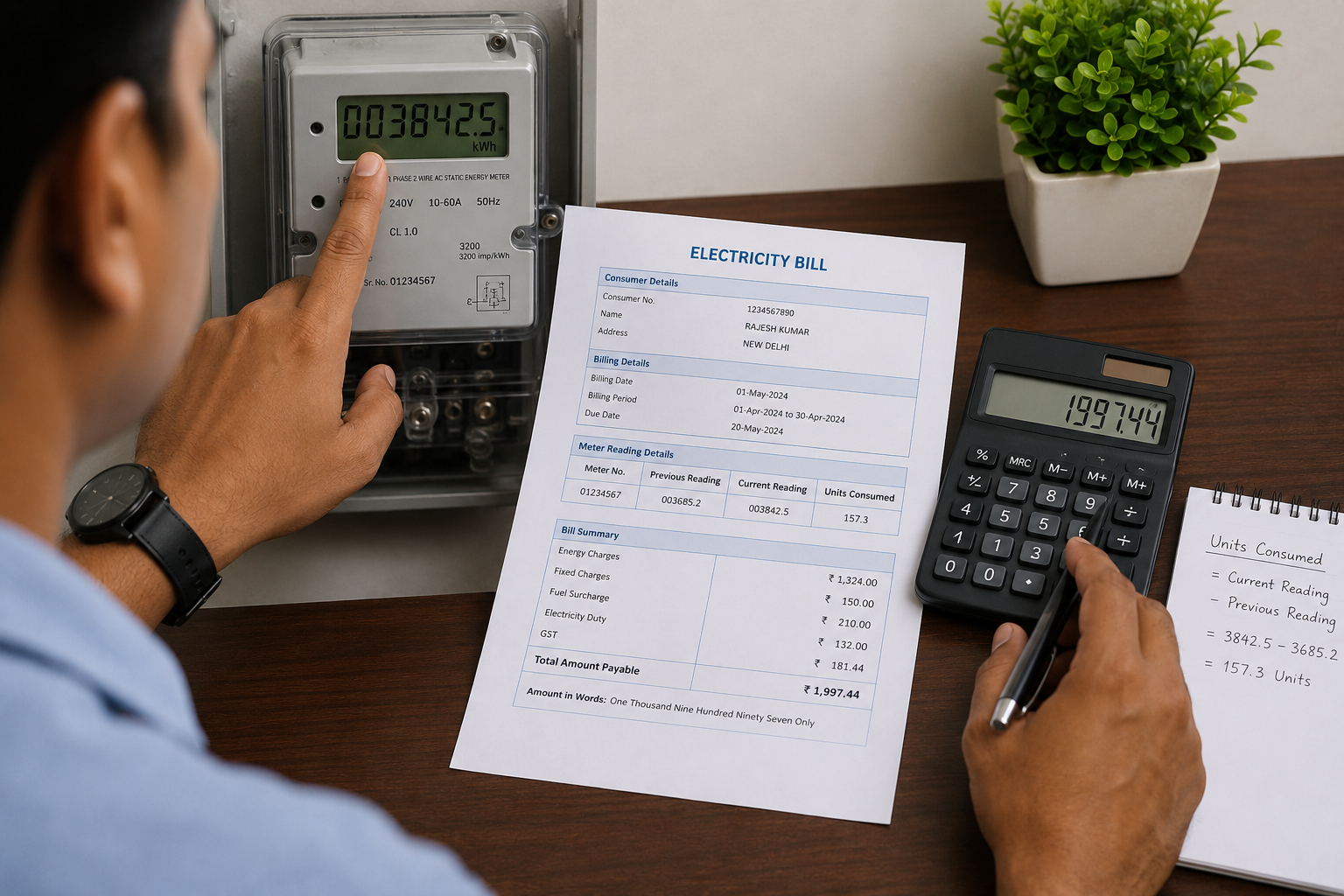
You get your electricity bill every month. You see the total amount and the number of units consumed. But how those units turned into that specific number is not always clear. The bill has multiple charges. Fixed charges, energy charges, taxes, fuel adjustments. It can feel like a maze.
This guide explains each component in simple terms. It also helps you calculate electricity bill amounts manually instead of depending only on online estimates.
It shows you how to calculate electricity bill amounts using your meter reading and your state’s tariff rates. The goal is not to help you dispute every charge. The goal is to help you understand where your money goes so you can make informed decisions about your electricity use.
If your bill increases sharply during summer, understanding how to reduce AC electricity bill can help lower overall consumption.
Table of Contents
What is One Unit of Electricity in Electricity Bill Calculation
Before calculating anything, it helps to understand what a “unit” means.
One unit of electricity is one kilowatt hour (kWh). This means using 1000 watts of power for one hour .
Here are some examples to make this concrete:
| Appliance | Power rating | Time to consume 1 unit |
|---|---|---|
| Old 100 watt bulb | 100 watts | 10 hours |
| Ceiling fan | 60 to 75 watts | 13 to 16 hours |
| LED TV (40 inch) | 80 to 100 watts | 10 to 12 hours |
| Laptop charger | 45 to 65 watts | 15 to 22 hours |
| Refrigerator (300 litre) | 150 to 200 watts running | 5 to 6 hours of compressor run time |
| 1.5 ton AC | 1500 to 1800 watts | 33 to 40 minutes |
| Geyser (2000 watts) | 2000 watts | 30 minutes |
| Washing machine (with heater) | 2000 watts when heating | 30 minutes heating time |
The table above is for understanding the concept. Actual consumption depends on how long each appliance runs and its efficiency rating .
Your electricity meter records every unit you consume. The difference between this month’s reading and last month’s reading is your consumption for the billing cycle.
Components Used to Calculate Electricity Bill in India
Common billing confusion
Many people assume:
Many people try to calculate electricity bill totals using only the final amount, which creates confusion.
- “One unit” means one appliance running once
- Every unit is charged at the same rate
- The bill amount is only based on energy usage
In reality, most bills include:
- slab-based pricing
- fixed charges
- taxes and fuel adjustment charges
This is why two homes using similar appliances may still receive different bills.
An electricity bill in India has several parts. Not all of them appear on every bill. But most residential bills include the following .
Energy charge
This is the cost of the actual electricity you consumed. It is calculated by multiplying your total units by the per unit rate applicable to your consumption slab. This is usually the largest component of your bill.
Fixed charge
This is a charge based on your sanctioned load (the total wattage of appliances you are allowed to run). It covers the cost of maintaining the distribution network. For most residential connections, this is a small amount. For example, in Telangana, the fixed charge is ₹10 per month for consumption up to 800 units and ₹50 per month for consumption above 800 units .
Electricity duty or tax
This is a tax levied by the state government. The rate varies by state. It is typically calculated as a percentage of your energy charge or a fixed amount per unit .
Fuel adjustment charge (FAC)
This charge covers changes in the cost of fuel used to generate electricity. If coal or gas prices increase, this charge goes up. If prices decrease, you may see a credit. This charge is updated every few months.
Homes with older cooling appliances may notice higher bills over time. Compare split AC vs window AC – electricity and maintenance comparison.
Other charges and rebates
Some bills include a meter rent charge. Others include rebates for on time payment or for using solar water heaters. Late payment fees apply if you pay after the due date.
How Slab Rates Affect Electricity Bill Calculation in India
Understanding slab pricing is essential if you want to calculate electricity bill totals accurately for your home.
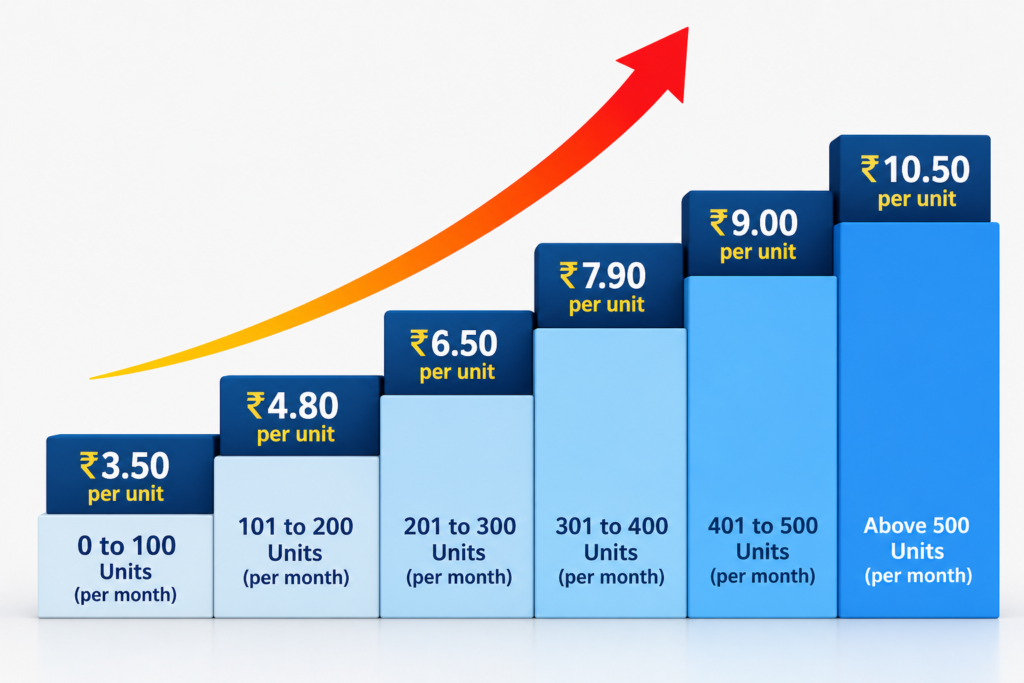
Why your bill rises faster after certain units
| Monthly usage | What changes |
|---|---|
| Under 100 units | Lower slab rates apply |
| 200–300 units | Mid slab pricing begins |
| Above 400 units | Per-unit rates increase sharply |
| Above 500 units | Highest slab rates apply in many states |
This is why reducing even 50–100 units can significantly affect the final bill.
Most state electricity boards use a slab system. This means the per unit rate increases as you consume more units. The first few units are charged at a lower rate. Units beyond a certain threshold are charged at a higher rate.
This is called a progressive tariff or telescopic tariff. It encourages lower consumption by making higher consumption more expensive.
Example slab structure (illustrative)
| Slab (units per month) | Per unit rate (₹) |
|---|---|
| 0 to 100 | ₹3.50 |
| 101 to 200 | ₹4.80 |
| 201 to 300 | ₹6.50 |
| 301 to 400 | ₹7.90 |
| 401 to 500 | ₹9.00 |
| Above 500 | ₹10.50 |
The actual rates vary by state and by distribution company within each state. The table above is only for understanding how slabs work. You need to check your own state’s tariff order for the exact rates.
You can verify official tariff orders through the Central Electricity Authority website: Central Electricity Authority website
How slab calculation works
If you consume 350 units in a month, you do not pay the same rate for all 350 units. Instead:
- First 100 units: 100 × ₹3.50 = ₹350
- Next 100 units (101 to 200): 100 × ₹4.80 = ₹480
- Next 100 units (201 to 300): 100 × ₹6.50 = ₹650
- Remaining 50 units (301 to 350): 50 × ₹7.90 = ₹395
Total energy charge = ₹350 + ₹480 + ₹650 + ₹395 = ₹1875
This is before adding fixed charges, taxes, and fuel adjustment.
If your state has a different slab structure, the calculation method remains the same. You just replace the rates and slab limits with your state’s numbers.
Many users are surprised that crossing a slab by even 20–30 units can noticeably increase the final amount.
Step by Step Guide to Calculate Electricity Bill Manually
You can calculate your bill using your meter reading and your state’s tariff rates. Here is the process.
Step 1: Note your meter readings
Find your current meter reading and your previous meter reading. These are usually printed on your bill. Or you can read them directly from your meter.
Units consumed = Current reading – Previous reading
For example:
- Current reading: 45,800 kWh
- Previous reading: 45,400 kWh
- Units consumed = 400 kWh (400 units)
Step 2: Find your state’s tariff rates
Search for “[your state name] electricity tariff order 2026” on your state electricity board’s website. Look for the domestic or residential category. Note the slab limits and per unit rates.
Step 3: Calculate energy charge
This is the most important step when you calculate electricity bill charges manually.
Apply the slab rates to your consumed units using the method shown in the previous section.
Step 4: Add fixed charge
Find the fixed charge for your sanctioned load. This is usually a small monthly amount.
Step 5: Add electricity duty
Electricity duty is often 5 to 10 percent of the energy charge. Some states charge a fixed amount per unit. Check your previous bill to see the rate.
Step 6: Add fuel adjustment charge
This is shown as a separate line item on most bills. It is calculated per unit consumed. The rate changes every few months. You can find the current rate on your distribution company’s website.
Most state electricity boards publish tariff revisions and fuel adjustment charges on their official portals: official electricity board portals
Step 7: Add other charges if any
Some bills include meter rent (usually ₹10 to ₹50 per month). Others include service charges.
Step 8: Subtract any rebates
If you paid your previous bill on time, some companies offer a small rebate. Prepaid smart meter users may also get a rebate in some states.
Example: How to Calculate Electricity Bill for 400 Units
Assume:
- Units consumed: 400 units
- State: illustrative example (not actual rates)
| Component | Calculation | Amount (₹) |
|---|---|---|
| Energy charge (slab based) | As per slab calculation | ₹1875 |
| Fixed charge | As per sanctioned load | ₹50 |
| Electricity duty (assume 8% of energy charge) | 1875 × 0.08 | ₹150 |
| Fuel adjustment charge (assume ₹0.50 per unit) | 400 × 0.50 | ₹200 |
| Meter rent | Fixed | ₹20 |
| Subtotal | ₹2295 | |
| Late payment (if applicable) | 0 (paid on time) | ₹0 |
| On time payment rebate (if any) | -₹50 | -₹50 |
| Total bill amount | ₹2245 |
Your actual bill will have different numbers based on your state’s rates.
Example home calculation with real appliances
Instead of starting from meter readings, you can also estimate your consumption based on the appliances you use. This helps you understand which appliances contribute most to your bill.
Example home: 3 BHK in a Tier 2 city
| Appliance | Power rating | Hours per day | Days per month | Monthly units |
|---|---|---|---|---|
| 1.5 ton AC (3 star) | 1600 watts | 8 | 30 | 384 |
| Ceiling fan (2 fans) | 70 watts each (140 total) | 12 | 30 | 50 |
| LED lights (6 lights) | 10 watts each (60 total) | 8 | 30 | 14 |
| Refrigerator (300 litre, 3 star) | 180 watts running | 24 (runs 8 hours effectively) | 30 | 43 |
| Geyser (2000 watts) | 2000 watts | 0.5 (30 minutes) | 30 | 30 |
| Washing machine (used 2 days a week with heating) | 2000 watts when heating | 1 hour per use × 8 uses | 30 | 16 |
| Laptop + wifi + phone chargers | 100 watts total | 6 | 30 | 18 |
| Water pump (if applicable) | 750 watts | 1 | 30 | 23 |
| Total estimated monthly units | 578 |
These calculations are estimates. Actual consumption depends on the star rating of your appliances, the age of the appliances, and your usage patterns. For example, a 5 star inverter AC would consume fewer units than a 3 star non inverter AC. A newer refrigerator with inverter compressor would use less power than an older model .
Once you have estimated units, you can apply your state’s slab rates to get an approximate bill amount.
State wise tariff differences in 2026
Electricity rates vary significantly across states. Here are some examples based on recent tariff announcements. These rates are for comparison only. You must check your own state’s official tariff order for accurate rates.
Maharashtra (MSEDCL)
For residential consumers, rates in 2026 follow a multi slab structure. Consumption up to 100 units is charged at approximately ₹4.43 per unit. Consumption between 101 and 300 units is charged at approximately ₹9.64 per unit. Higher slabs have progressively higher rates. Note that Maharashtra rates are among the higher in India .
Tamil Nadu (Tangedco)
For consumption up to 200 units, the rate is approximately ₹4.95 per unit. Between 201 and 250 units, the rate increases to approximately ₹6.65 per unit. Between 251 and 300 units, the rate is approximately ₹8.80 per unit. Above 500 units, rates exceed ₹12 per unit .
In high-temperature states, AC usage patterns heavily affect monthly electricity costs. Understanding how to reduce AC electricity bill can make a noticeable difference during summer months.
Telangana (TGERC)
For 2026-27, Telangana has retained existing tariffs. The first 50 units are charged at ₹1.95 per unit. Consumption between 51 and 100 units is charged at ₹3.10 per unit. For consumption beyond 100 units, slab rates range from ₹3.40 per unit for the first 100 units to ₹10 per unit for consumption above 800 units .
Himachal Pradesh
For 2026-27, residential rates have seen a minor reduction of 1 paisa per unit. For lifeline category (up to 60 units), the rate is approximately ₹4.71 per unit. For consumption between 1 and 125 units, the rate is ₹5.44 per unit. For consumption above 125 units, the rate is ₹5.89 per unit .
Andhra Pradesh
For 2026-27, the state government has approved no increase in electricity tariffs. Commercial tariffs have been reduced from ₹12.25 per unit to ₹9.95 per unit for eligible consumers .
Jharkhand
For 2026-27, rates have increased by approximately 6.12 percent. Rural domestic consumers now pay approximately ₹7.20 per unit (up from ₹6.70). Urban domestic consumers pay approximately ₹7.40 per unit (up from ₹6.85) .
These rates change from year to year. Always refer to your latest bill or your electricity board’s website for current rates.
Common Mistakes While Trying to Calculate Electricity Bill
Mistake 1: Applying the same rate to all units
Many people multiply total units by a single per unit rate they saw somewhere. This gives an incorrect number because slab rates increase with consumption.
Mistake 2: Forgetting fixed charges and taxes
The energy charge is usually 70 to 85 percent of the bill. The remaining is fixed charges, electricity duty, fuel adjustment, and other fees. Ignoring these components underestimates the bill.
Mistake 3: Using old tariff rates
States revise tariffs every year, usually effective April 1. Comparing your current bill with rates from two years ago will not give accurate results.
Mistake 4: Misreading the meter
Digital meters show multiple readings. Some show cumulative consumption. Some show current draw. Make sure you are looking at the total kWh reading, not the instantaneous power reading.
Mistake 5: Assuming the bill is always correct
While most bills are accurate, occasional reading or processing errors can happen. If a bill looks unusually high compared to your normal usage, reviewing the meter reading and recent consumption is reasonable. In some cases, a missing decimal point or a software glitch has produced bills of crores of rupees for regular households. If your bill seems unusually high, compare it with your meter reading and your previous bills before paying.
Using Online Tools to Calculate Electricity Bill Quickly
Most state electricity boards offer online bill calculators on their websites. You can also find third party calculators.
To use these calculators, you typically need:
- Your consumer number or service connection number
- The billing cycle dates
- Your current meter reading (or you can use the units from your last bill)
These calculators apply the correct slab rates and taxes for your distribution company. They are more convenient than manual calculation. However, they are only estimates. The final bill generated by the distribution company is what you must pay .
A caution about online calculators: Not all third party calculators are updated with the latest tariff rates. If the calculator shows a result very different from your actual bill, the rates or slab limits may be outdated.
Learning how to calculate electricity bill amounts correctly also makes it easier to identify which appliances increase monthly costs the most.
Once you learn how to calculate electricity bill charges manually, it becomes easier to identify which appliances increase your monthly usage the most.
Related reads
These articles may help you understand and reduce your electricity consumption.
- What appliances consume the most electricity at home
- How much electricity does a 1.5 ton AC consume per month
- How to reduce AC electricity bill (practical guide India)
- Why Your Electricity Bill Is High in Summer
- How much electricity does a fridge use monthly in India
- Split AC vs Window AC – Electricity and Maintenance Comparison
Learning how to calculate electricity bill amounts correctly can also help you reduce unnecessary electricity consumption over time.
Leave a Reply to Save Money: Washing Machine Repair vs Replacement India 2026 (₹1.5k-18k) Cancel reply