
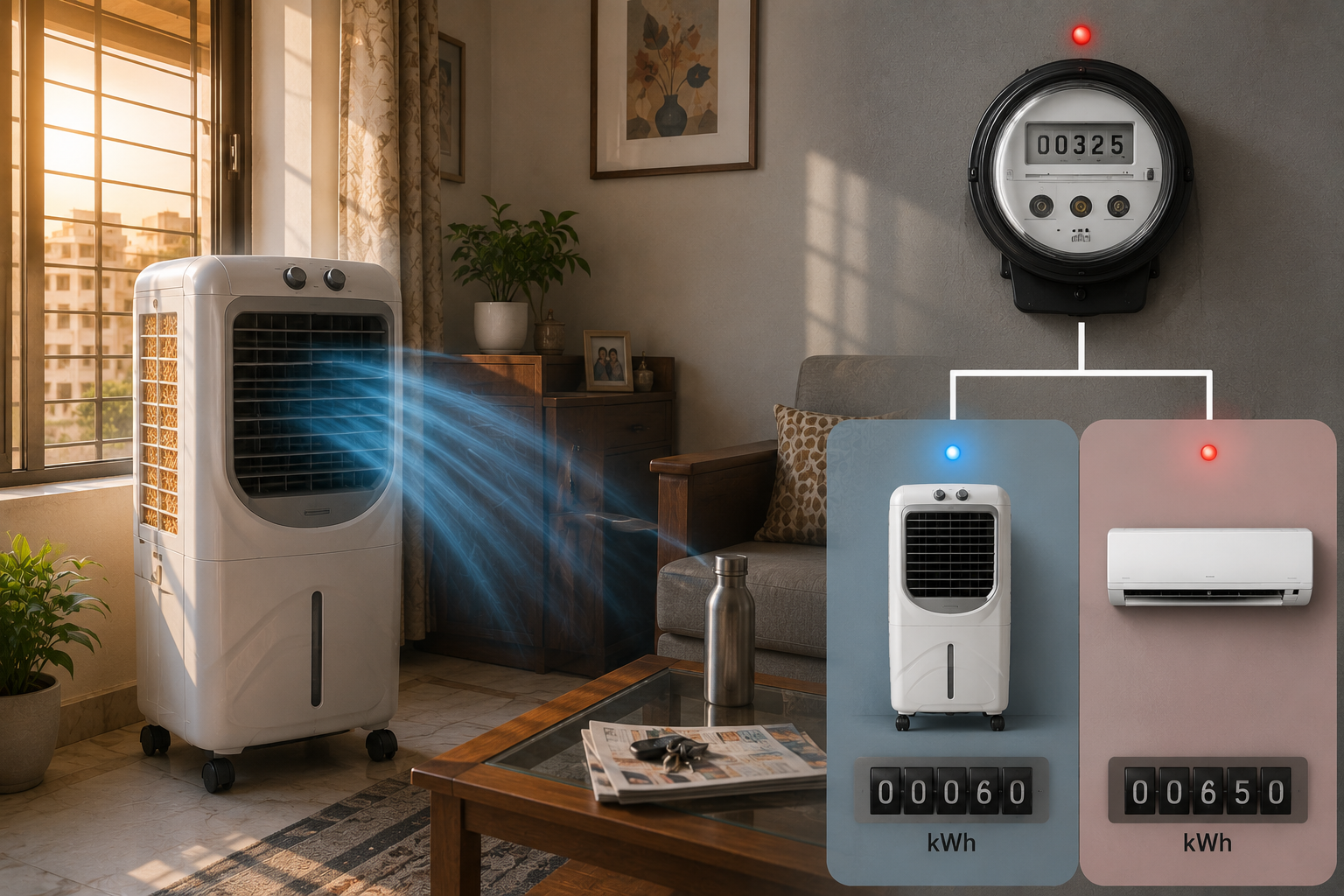
If you are worried about summer electricity bills, understanding cooler electricity consumption per month is the first step. An AC can add ₹2,000 to your monthly bill. A cooler? Maybe ₹250. This guide breaks down exactly how many units different cooler types consume, what it costs at your electricity rate, and whether a cooler makes sense for your city and room size.
This is a fair question. Coolers are common in Indian homes, especially in drier regions. But electricity costs add up over time. For many Indian households, cooling appliances become one of the biggest contributors to summer electricity bills. Knowing the actual consumption helps you decide whether a cooler makes sense for your home or if saving for an AC is a better long term choice.
This guide explains cooler wattage, monthly consumption for different types of coolers, electricity costs based on usage hours, and a comparison with AC electricity consumption.
Table of Contents
Air Cooler Wattage Explained: How It Affects Cooler Electricity Consumption Per Month
An air cooler is a cooling appliance that uses water evaporation and airflow to reduce room temperature.
Air coolers work on a simple principle. A water pump circulates water over cooling pads. A fan draws hot air through these pads. The water evaporates. The air temperature drops. The cooled air is blown into the room.
The key point is that a cooler does not have a compressor. An AC’s compressor consumes most of the electricity. A cooler has only two main electrical components. A fan motor and a water pump.
This is why cooler electricity consumption per month is usually a fraction of what an AC would use for the same hours.
Typical wattage range for different cooler types
| Cooler type | Fan motor wattage | Water pump wattage | Total wattage (approx) |
|---|---|---|---|
| Personal cooler (small, for one person) | 50 to 80 watts | 10 to 20 watts | 60 to 100 watts |
| Medium cooler (for a small room up to 150 sq ft) | 100 to 150 watts | 20 to 30 watts | 120 to 180 watts |
| Large cooler (for a medium room 150 to 250 sq ft) | 150 to 250 watts | 30 to 50 watts | 180 to 300 watts |
| Desert cooler (for large rooms or halls) | 250 to 400 watts | 50 to 80 watts | 300 to 480 watts |
Important clarification
These are running wattages. The cooler draws this much power when both the fan and pump are running. The pump does not run continuously in many coolers. Some coolers have a timer or a float valve that turns the pump on and off. But for estimating consumption, assuming both run continuously gives a safe upper limit.
How cooler wattage compares to other appliances
| Appliance | Typical wattage |
|---|---|
| Ceiling fan | 60 to 75 watts |
| LED TV (43 inch) | 80 to 100 watts |
| Personal cooler | 60 to 100 watts |
| Medium cooler | 120 to 180 watts |
| Large cooler | 180 to 300 watts |
| Desert cooler | 300 to 480 watts |
| 1.5 ton AC (compressor running) | 1500 to 1800 watts |
In many homes, a medium cooler may consume only a small fraction of the electricity used by a 1.5 ton AC.
Expert Insight: The Evaporation Limit
A cooler’s cooling capacity is directly limited by the wet-bulb temperature, a measure that combines heat and humidity. When humidity exceeds 60-70%, the air is already near saturation. Evaporation slows significantly. The cooler adds moisture but cannot lower temperature effectively.
This is not a product defect. It is a physical limit of evaporative cooling. In cities like Chennai or Kolkata during monsoon, even the most powerful desert cooler cannot match an AC’s dehumidifying performance.
Practical takeaway: Before buying a cooler, check your city’s average humidity in summer. If it regularly exceeds 60%, skip the cooler and save for an AC. If humidity is below 40%, a cooler is highly cost-effective.
How to Calculate Cooler Electricity Consumption Per Month (Formula + Examples)
To calculate monthly consumption, you need the cooler wattage and the number of hours you run it each day.
Formula
Monthly units (kWh) = (Wattage × Hours per day × Days per month) ÷ 1000
Example 1: Medium cooler (150 watts) running for 8 hours daily
(150 watts × 8 hours × 30 days) ÷ 1000 = 36 units per month
Example 2: Large cooler (250 watts) running for 10 hours daily
(250 watts × 10 hours × 30 days) ÷ 1000 = 75 units per month
Example 3: Desert cooler (400 watts) running for 12 hours daily
(400 watts × 12 hours × 30 days) ÷ 1000 = 144 units per month
Quick Reference: Cooler Electricity Consumption Per Month by Type and Usage
| Cooler type | Wattage | Daily usage | Monthly units |
|---|---|---|---|
| Personal cooler | 80 watts | 6 hours | 14 units |
| Personal cooler | 80 watts | 8 hours | 19 units |
| Personal cooler | 80 watts | 10 hours | 24 units |
| Medium cooler | 150 watts | 6 hours | 27 units |
| Medium cooler | 150 watts | 8 hours | 36 units |
| Medium cooler | 150 watts | 10 hours | 45 units |
| Large cooler | 250 watts | 6 hours | 45 units |
| Large cooler | 250 watts | 8 hours | 60 units |
| Large cooler | 250 watts | 10 hours | 75 units |
| Desert cooler | 400 watts | 8 hours | 96 units |
| Desert cooler | 400 watts | 10 hours | 120 units |
| Desert cooler | 400 watts | 12 hours | 144 units |
These numbers are estimates of cooler electricity consumption per month based on continuous operation. Your actual consumption depends on your cooler’s wattage and pump runtime.
Desert cooler vs personal cooler difference
The difference between cooler types is significant. A personal cooler running 8 hours daily consumes roughly 19 units per month. A desert cooler running the same hours consumes about 96 units per month. That is five times more electricity.
Personal cooler (60 to 100 watts)
Best for:
- One person sitting at a desk or bed
- Small rooms up to 100 square feet
- Homes in moderately hot regions
- People who move the cooler from room to room
Monthly electricity cost at ₹7 per unit (8 hours daily): around ₹135 to ₹160
Medium cooler (120 to 180 watts)
Best for:
- Small bedroom or home office
- Rooms up to 150 square feet
- Couples or two people in a room
Monthly electricity cost at ₹7 per unit (8 hours daily): around ₹250 to ₹320
Large cooler (180 to 300 watts)
Best for:
- Medium to large bedrooms
- Living rooms up to 250 square feet
- Families of 3 to 4 people in one room
Monthly electricity cost at ₹7 per unit (8 hours daily): around ₹380 to ₹500
Desert cooler (300 to 480 watts)
Best for:
- Large living rooms and halls
- Open plan spaces
- Dry and hot regions (Rajasthan, Gujarat, parts of Maharashtra and Madhya Pradesh)
- Commercial spaces like small shops or workshops
Monthly electricity cost at ₹7 per unit (8 hours daily): around ₹670 to ₹1000
A note on effectiveness by region
Coolers work well in dry heat regions (Delhi, Rajasthan, Gujarat, Madhya Pradesh, parts of Maharashtra). They are less effective in humid coastal regions (Mumbai, Chennai, Kolkata, Kochi). In humid weather, the air already has moisture. Evaporation happens slowly. Cooling is minimal. In such regions, a cooler may run for many hours without providing much comfort.
Real City Example: Jaipur vs Mumbai
Jaipur (dry heat): A desert cooler running 10 hours daily consumes about 120 units per month. At ₹7/unit, that is ₹840 per month. The same room cooled by a 1.5 ton AC would consume 350+ units (₹2,450+ per month). The cooler saves ₹1,600+ per month. A family in Jaipur can comfortably use a cooler from April to September.
Mumbai (humid coastal): The same desert cooler running 10 hours daily still consumes 120 units (₹840). But the cooling effect is minimal because humidity is already high. The room feels damp, not cool. Most families in Mumbai eventually switch to an AC for reliable cooling despite the higher electricity cost.
Takeaway: Cooler electricity consumption per month is the same in both cities. But the value you get from that electricity is completely different based on humidity.
Real Household Scenario: When a Cooler Works and When It Doesn’t
Scenario 1 (works well): A family in Jaipur with a 200 sq ft living room buys a desert cooler. They run it 10 hours daily during May-June. Outside temperature is 42°C. The cooler brings the room down to 32°C with airflow. With a ceiling fan, this is comfortable. Their monthly electricity bill for cooling is ₹840. An AC would cost ₹2,500+.
Scenario 2 (ineffective): The same family moves to Mumbai for work. They bring the same desert cooler to their new apartment. In July, humidity is 85%. Outside temperature is 32°C. The cooler blows damp air. The room feels sticky at 30°C. They run it for 10 hours, still uncomfortable. Electricity consumption is still 120 units (₹840), but they get no comfort. They buy an AC next month.
Scenario 3 (personal cooler): A student in a PG accommodation in Pune has a 100 sq ft room. They buy a personal cooler (80W). They run it 6 hours in the evening. Monthly consumption: 14 units (₹100). Pune has moderate humidity. The cooler provides enough cooling for one person at a desk. This is highly cost-effective.
Takeaway: The same cooler electricity consumption per month can deliver great value in one city and zero value in another. Know your climate first.
Electricity cost by usage hours
This section shows monthly electricity costs for a medium cooler (150 watts) and a large cooler (250 watts) at different electricity rates. Your electricity rate depends on your state and your total consumption slab.
Monthly cost for medium cooler (150 watts)
| Daily hours | Monthly units | Cost at ₹5/unit | Cost at ₹7/unit | Cost at ₹9/unit |
|---|---|---|---|---|
| 4 hours | 18 units | ₹90 | ₹126 | ₹162 |
| 6 hours | 27 units | ₹135 | ₹189 | ₹243 |
| 8 hours | 36 units | ₹180 | ₹252 | ₹324 |
| 10 hours | 45 units | ₹225 | ₹315 | ₹405 |
| 12 hours | 54 units | ₹270 | ₹378 | ₹486 |
Monthly cost for large cooler (250 watts)
| Daily hours | Monthly units | Cost at ₹5/unit | Cost at ₹7/unit | Cost at ₹9/unit |
|---|---|---|---|---|
| 4 hours | 30 units | ₹150 | ₹210 | ₹270 |
| 6 hours | 45 units | ₹225 | ₹315 | ₹405 |
| 8 hours | 60 units | ₹300 | ₹420 | ₹540 |
| 10 hours | 75 units | ₹375 | ₹525 | ₹675 |
| 12 hours | 90 units | ₹450 | ₹630 | ₹810 |
Monthly cost for desert cooler (400 watts)
| Daily hours | Monthly units | Cost at ₹5/unit | Cost at ₹7/unit | Cost at ₹9/unit |
|---|---|---|---|---|
| 4 hours | 48 units | ₹240 | ₹336 | ₹432 |
| 6 hours | 72 units | ₹360 | ₹504 | ₹648 |
| 8 hours | 96 units | ₹480 | ₹672 | ₹864 |
| 10 hours | 120 units | ₹600 | ₹840 | ₹1080 |
| 12 hours | 144 units | ₹720 | ₹1008 | ₹1296 |
These numbers are estimates. Your actual cost may vary based on your cooler’s actual wattage and your electricity tariff.
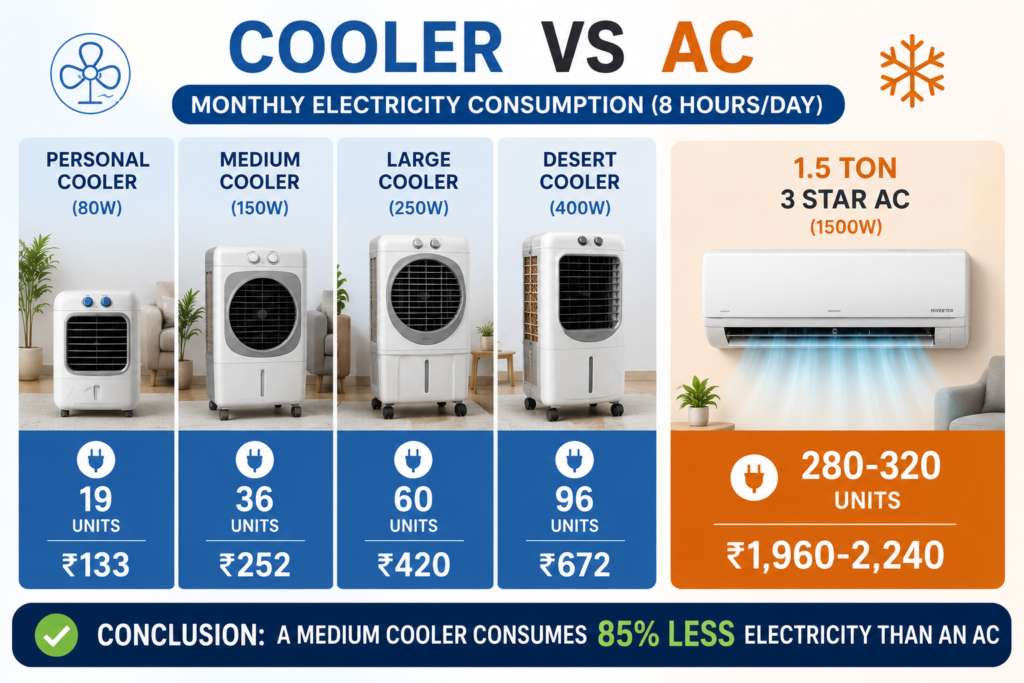
Cooler vs AC: Cooler Electricity Consumption Per Month Compared to 1.5 Ton AC
This comparison shows why coolers are popular in regions where they work effectively.
Assumptions for comparison
- 8 hours of daily usage for 6 months (May to October)
- Electricity rate of ₹7 per unit
- Cooler: medium cooler (150 watts)
- AC: 1.5 ton 3 star split AC running at 24 degrees with moderate usage
The efficiency gap between cooling appliances becomes more noticeable during long summer usage.
Monthly consumption and cost
| Appliance | Monthly units | Monthly cost | Annual cost (6 months) |
|---|---|---|---|
| Medium cooler (150W, 8 hrs) | 36 units | ₹252 | ₹1512 |
| Large cooler (250W, 8 hrs) | 60 units | ₹420 | ₹2520 |
| Desert cooler (400W, 8 hrs) | 96 units | ₹672 | ₹4032 |
| 1.5 ton 3 star AC (8 hrs, 24°C) | 280 to 320 units | ₹1960 to ₹2240 | ₹11760 to ₹13440 |
For reference, AC efficiency is measured under BEE efficiency standards, coolers are not currently rated by BEE but you can check their portal for appliance benchmarks.
The difference
A medium cooler costs roughly ₹250 per month to run. A 1.5 ton AC costs roughly ₹2000 per month. This comparison shows that cooler electricity consumption per month is roughly 85 percent lower than an AC running the same hours.
Can a cooler replace an AC
This depends on your region and comfort expectations.
In dry heat regions (Delhi, Jaipur, Lucknow, Nagpur, Ahmedabad), a desert cooler or large cooler can keep a room comfortable even on hot afternoons. The air feels cool and moist. Many families in these regions use coolers as their primary cooling device.
In humid regions (Mumbai, Chennai, Kolkata, Kochi, Goa), a cooler provides little relief on humid days. The air feels heavy and damp. An AC is more effective. In these regions, a cooler may work on dry days but cannot replace an AC during the peak humid season.
Upfront cost difference
| Appliance | Typical price range |
|---|---|
| Personal cooler | ₹3000 to ₹6000 |
| Medium cooler | ₹5000 to ₹8000 |
| Large cooler | ₹7000 to ₹12000 |
| Desert cooler | ₹10000 to ₹18000 |
| 1.5 ton 3 star split AC | ₹28000 to ₹38000 |
| 1.5 ton 5 star split AC | ₹34000 to ₹45000 |
A cooler is significantly cheaper to buy. The combination of lower upfront cost and lower running cost makes coolers attractive for many Indian households.
For buyers considering ACs instead of coolers, long term electricity cost becomes an important part of the decision.
Is a Cooler Cheaper Than an AC in the Long Run? (5-Year Cost Comparison)
Let’s compare total cost over 5 years including purchase price and electricity.
Assumptions:
- 5 years of summer usage (6 months per year)
- 8 hours daily usage
- Electricity at ₹7/unit
- Medium cooler (150W) vs 1.5 ton 3 star AC (1,500W)
| Cost Component | Medium Cooler | 1.5 Ton 3 Star AC |
|---|---|---|
| Purchase price | ₹6,000 | ₹32,000 |
| Monthly electricity cost | ₹252 | ₹1,960-2,240 |
| Annual electricity cost (6 months) | ₹1,512 | ₹11,760-13,440 |
| 5-year electricity cost | ₹7,560 | ₹58,800-67,200 |
| Maintenance cost (pads, pump over 5 years) | ₹2,000 | ₹3,000 (annual service) |
| Total 5-year cost | ₹15,560 | ₹93,800-1,02,200 |
Conclusion: A cooler is significantly cheaper over 5 years — roughly one-sixth the cost of an AC.
But (important caveat): This comparison only makes sense if a cooler actually keeps you comfortable in your climate. In humid cities, the cooler electricity consumption per month may be low, but the cooling benefit is zero. Paying ₹15,000 over 5 years for no comfort is worse than paying ₹1,00,000 for actual cooling.
Verdict: In dry regions, cooler wins. In humid regions, AC wins despite higher cost.
Common mistakes people make with coolers
Using a cooler in a humid region expecting AC like cooling
Humidity plays a major role in how effective any cooling appliance feels during Indian summers.
A cooler works by evaporation. In humid weather, the air already has moisture. The cooler adds more moisture without much cooling. The room becomes damp and uncomfortable. This is not a cooler problem. It is a mismatch between the technology and the climate.
Not opening windows when using a cooler
An AC requires closed windows and doors. A cooler requires the opposite. A cooler works by pushing hot air out of the room. It needs cross ventilation. Open a window or door on the opposite side of the room. This allows the cooled air to circulate and the hot air to exit.
Using a small cooler for a large room
A personal cooler in a large living room will not cool the space. The cooler blows cool air only near where it is placed. For a large room, a desert cooler with higher airflow is needed. Undersizing a cooler leads to disappointment and wasted electricity.
Undersized cooling appliances often run longer without providing enough comfort.
Not cleaning cooling pads and water tank
Cooling pads collect dust and minerals over time. Clogged pads reduce airflow and cooling efficiency. The fan runs but little cooling happens. The water tank can develop algae or mould if not cleaned. This affects air quality. Clean pads and tank at the start of summer and once every month during use.
Running the pump without the fan
Some people turn on the water pump but leave the fan off. This wastes water and does not cool the room. The pump should run only when the fan is running.
Not adding ice or cold water
On very hot days, adding ice or cold water to the cooler tank increases cooling. The air passing through the water chilled pads becomes colder. This simple step improves cooler performance significantly.
Hidden Costs of Using a Cooler (Beyond Electricity)
Electricity is not the only cost. Consider these factors before buying a cooler.
Water usage
- A medium cooler uses 10-20 litres per day
- A desert cooler uses 30-60 litres per day
- Over 4 summer months: 1,200 to 7,200 litres
- If you pay for tanker water, this adds real cost
- In water-scarce areas, this matters
Maintenance costs
- Cooling pads need replacement every 1-2 years (₹300-₹1,000)
- Water pump may fail after 2-3 years (₹400-₹800 replacement)
- Tank cleaning requires time and effort
- Algae and mould prevention needs regular attention
Noise levels
- Desert coolers can be noisy (50-60 decibels)
- May disturb sleep if placed in bedroom
- Personal and medium coolers are quieter but still audible
Humidity discomfort (in wrong climate)
- In coastal cities, coolers increase indoor humidity
- Can cause sticky feeling, mould on walls
- May worsen dust mite allergies
- This is why many humid-city households eventually sell their coolers and buy ACs
What you should do now
Here is a step by step approach for choosing and using a cooler.
Step 1: Check your climate
If you live in a dry region (low humidity), a cooler is a good option. If you live in a humid coastal region, consider an AC or use a cooler only on dry days.
Step 2: Measure your room size
Estimate the square footage of the room where you plan to use the cooler.
| Room size | Recommended cooler type |
|---|---|
| Up to 100 sq ft | Personal or small cooler |
| 100 to 150 sq ft | Medium cooler |
| 150 to 250 sq ft | Large cooler |
| Above 250 sq ft | Desert cooler |
Step 3: Calculate expected electricity cost
Use the tables in this article. Multiply monthly units by your per unit electricity rate. Decide if the cost fits your budget.
Understanding appliance level electricity consumption makes it easier to estimate your full monthly bill.
Step 4: Ensure proper ventilation
For a cooler to work effectively, your room needs an open window or door on the opposite side of the cooler. If your room has no cross ventilation, a cooler may not be effective.
Step 5: Plan for maintenance
Before summer starts, clean the cooling pads and water tank. At the start of each month during summer, empty and clean the tank. Check the pump for proper operation.
Summary recommendation table
| Your situation | Recommendation |
|---|---|
| Live in dry region (Delhi, Rajasthan, Gujarat, MP, Maharashtra interior), want low running cost | Desert cooler or large cooler |
| Live in dry region, want maximum cooling regardless of cost | AC (cooler as backup on mild days) |
| Live in humid region (Mumbai, Chennai, Kolkata, Kerala) | AC (In highly humid cities, many households eventually change from coolers to inverter ACs for more reliable cooling comfort.) |
| Live in humid region but on a tight budget | Use cooler on dry days, add ice. Expect limited cooling on humid days. |
| Small room, one person, limited budget | Personal or medium cooler |
| Large living room, family of 4, dry region | Desert cooler |
Common questions asked
Does a cooler consume more electricity if the water pump runs continuously
Yes, but the pump is a small part of the total consumption. The fan motor consumes most of the electricity. In most coolers, the pump can be turned off once the cooling pads are wet. Some coolers have automatic pump cycling.
Can I run a cooler on an inverter or UPS
Yes, coolers have low wattage compared to ACs. A small inverter with 500 to 800 VA capacity can run a medium cooler for several hours. This is useful in areas with power cuts.
How much water does a cooler use
A medium cooler uses 10 to 20 litres of water per day depending on humidity and usage hours. A desert cooler can use 30 to 60 litres per day. This is an additional cost if you buy water. In areas with water shortage, consider this factor.
Is a cooler safe for people with asthma or allergies
Coolers can circulate dust and mould if not cleaned regularly. Clean pads and tank frequently. Some coolers have honeycomb pads that trap dust better than traditional wood wool pads.
Can a cooler cool a room as much as an AC
No. A cooler typically lowers room temperature by 5 to 10 degrees Celsius depending on humidity. An AC can lower temperature by 10 to 15 degrees or more. A cooler provides comfort cooling, not cold air.
Choosing between a cooler and an AC is usually a balance between upfront cost, electricity bill, climate, and comfort expectations.
Related reads
These articles provide more information on cooling options and electricity consumption.
Leave a Reply