

Finding the best AC for top floor rooms starts with understanding one hard truth: your ceiling is fighting against you. Unlike lower floors, a top floor apartment has no buffer above. The concrete roof absorbs afternoon sun for hours, then releases that heat into your room well past sunset. A standard AC that works fine on the second floor may struggle here. This guide helps you choose the right AC capacity, features, and insulation fixes that actually work for top floor conditions.
This is a common problem in Indian homes on top floors. The reason is not the AC. The reason is the heat coming from the roof and the walls. A standard AC may struggle in these conditions. Choosing the right AC and making a few changes to the room can make a noticeable difference.
This guide explains why top floor rooms get hotter, what capacity AC you need, and which features help in these conditions.
Table of Contents
Why Top Floor Rooms Get Hotter: Finding the Best AC for Top Floor Rooms
A top floor room receives heat from three directions. Other floors receive heat only from walls and windows.
Heat from the roof
The roof is exposed to direct sunlight for most of the day. In summer, roof surface temperatures in India can reach 55 to 65 degrees Celsius or even higher. This heat transfers through the concrete slab into the room below. The ceiling becomes warm. That warmth radiates down into the room. Your AC has to remove this heat continuously.
Heat from walls (all floors face this)
Walls exposed to direct sunlight also absorb heat. On top floors, walls are often more exposed because there are no floors above to provide shade.
No buffer floor above
On lower floors, the flat above you acts as insulation. The heat that hits the roof is absorbed by the flat above. Your ceiling stays cooler. On top floors, there is no flat above. The heat transfers directly into your room.
What this means for your AC
Your AC has to work harder and run longer to maintain the same temperature compared to the same size room on a lower floor. A 1.5 ton AC that works well on the second floor may struggle on the top floor. The compressor runs more continuously. The electricity bill is higher.
Longer compressor running time can significantly increase monthly power consumption during Indian summers.
Expert Insight: The “Stored Heat” Problem
Top floor rooms can remain warm for hours after sunset because the roof slab continues releasing stored heat into the room. Unlike walls that cool down relatively quickly once the sun goes down, a concrete roof slab absorbs heat all day and acts like a thermal battery. It releases that heat from 7 PM to 11 PM, exactly when most families are at home relaxing or sleeping. This is why your top floor bedroom feels warm even at 10 PM, and why your AC keeps running long after sunset.
Is 1 Ton AC Enough? Choosing the Best AC for Top Floor Rooms by Size
For most top floor rooms, a 1 ton AC is likely not enough, even if the room size falls within the typical recommendation for 1 ton.
Standard recommendation for ground or middle floors
| Room size | Recommended AC capacity |
|---|---|
| Up to 120 square feet | 1 ton |
| 120 to 180 square feet | 1.5 ton |
| Above 180 square feet | 2 ton |
Top floor adjustment
For top floor rooms exposed to direct sunlight for most of the day, add 0.5 ton to the standard recommendation.
Adjusted recommendation for top floor rooms:
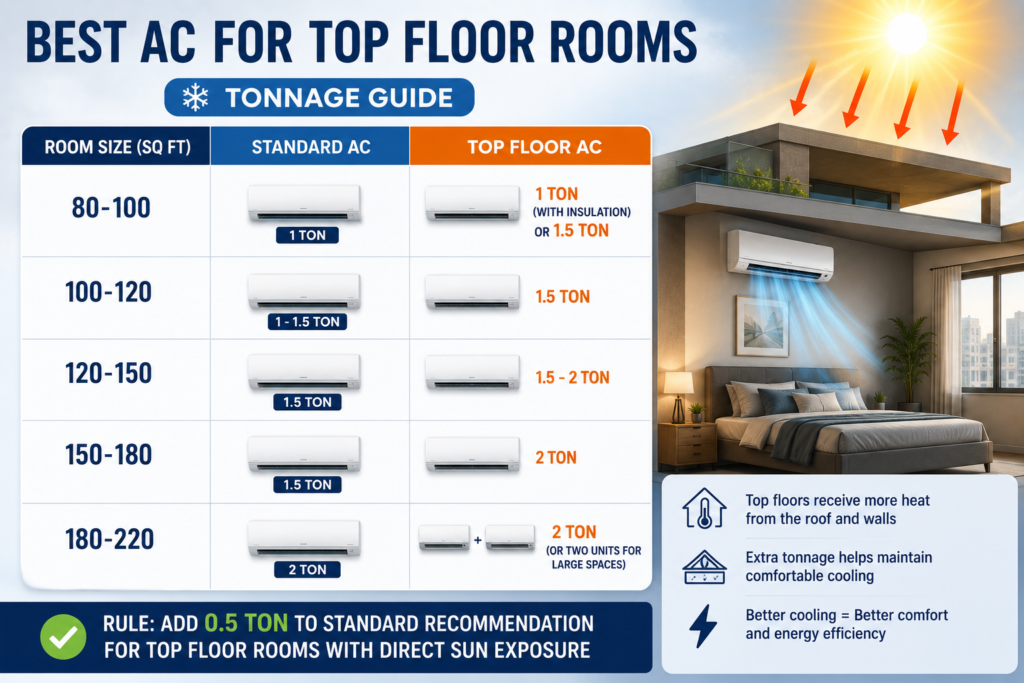
| Room size | Recommended AC capacity |
|---|---|
| Up to 100 square feet | 1 ton (consider 1.5 ton if high heat load) |
| 100 to 150 square feet | 1.5 ton |
| 150 to 200 square feet | 2 ton |
Example
A 10×12 foot bedroom is 120 square feet. On a middle floor, a 1 ton AC may be sufficient. On a top floor with direct sun exposure and a concrete roof without insulation, a 1.5 ton AC is recommended.
A caution
When searching for the best AC for top floor rooms, remember that a 1.5 ton AC in a small top floor room will cool faster and cycle off sooner. This does not harm the AC. Modern inverter ACs adjust capacity automatically. The electricity consumption of a 1.5 ton inverter AC in a 120 square foot top floor room may be similar to or even lower than a 1 ton AC running continuously trying to keep up with the heat load.
Real example: A 1 ton AC that cools a second floor bedroom comfortably in Bengaluru may struggle in a top floor Chennai apartment exposed to direct afternoon sunlight. The same brand, same model, same room size, but one floor up and a different city climate changes everything. The Chennai top floor needs 1.5 tons despite the room size suggesting 1 ton.
Inverter vs Non Inverter: What Is the Best AC for Top Floor Rooms
Inverter ACs are strongly recommended for top floor rooms. The reason is how they handle prolonged operation.
Non inverter AC behaviour
A non inverter AC has a fixed speed compressor. It turns on at full power and runs until the set temperature is reached. Then it turns off completely. When temperature rises again, it turns on at full power again. This on-off cycle repeats.
In a top floor room with high heat load, the AC may never reach the set temperature. The compressor runs continuously at full power. It never gets a break. This is hard on the compressor and consumes significant electricity.
Inverter AC behaviour
An inverter AC has a variable speed compressor. It runs at high speed initially to cool the room quickly. As the room approaches the set temperature, the compressor slows down. It runs at low speed to maintain temperature. It does not turn off completely.
In a top floor room with high heat load, the inverter AC runs at medium to high speed for longer periods. But it can adjust. It does not have to run at full power continuously. It finds the right speed to match the heat load. This is more efficient and puts less stress on the compressor.
For homes where the AC runs for long hours every day, inverter technology usually becomes more cost effective over time.
Recommendation for top floor
Choose a 5 star inverter AC. The long term electricity difference between 3 star and 5 star models becomes more noticeable in high heat top floor rooms. The efficiency difference compared to 3 star is more valuable on top floors where the AC runs for longer hours. For anyone looking for the best AC for top floor rooms, inverter technology is non negotiable for high heat load conditions.
Electricity Impact: What Top Floor AC Costs Mean for Your Bill
A top floor AC running 8 hours daily in summer consumes roughly 20-40% more electricity than the same AC on a middle floor.
Estimated monthly difference for a 1.5 ton AC (8 hours/day, 6 months):
| Floor Type | Estimated Monthly Units | Estimated Monthly Cost (₹7/unit) |
|---|---|---|
| Middle floor (standard heat load) | 250-300 units | ₹1,750-2,100 |
| Top floor (high heat load) | 350-420 units | ₹2,450-2,940 |
| Extra cost for top floor | +100-120 units | +₹700-840 per month |
Over 6 months of summer usage, a top floor AC can cost ₹4,200-5,000 more per year in electricity compared to the same AC on a lower floor.
What this means for your purchase decision: Paying extra for a 5 star inverter AC on a top floor pays back faster because your running hours are longer. The electricity savings from 5 star vs 3 star are larger in absolute terms when your baseline consumption is higher.
Best tonnage by room size for top floor rooms
These are guidelines based on typical Indian top floor conditions. Actual requirements depend on roof construction, insulation, window direction, and local climate.
Small top floor bedroom (80 to 100 square feet)
- Recommended: 1 ton 5 star inverter AC
- If high heat load (no insulation, west facing roof, all day sun exposure): 1.5 ton
- Examples: Small master bedroom in a 2 BHK apartment, single occupancy room in a shared flat
Medium top floor bedroom (100 to 150 square feet)
- Recommended: 1.5 ton 5 star inverter AC
- 1 ton likely insufficient, especially in afternoon and evening hours
- Examples: Master bedroom in a 2 BHK, standard bedroom in a 3 BHK
Large top floor room (150 to 200 square feet)
- Recommended: 2 ton 5 star inverter AC
- 1.5 ton will struggle during peak afternoon hours
- Examples: Large master bedroom, combined living and sleeping space, home office in a bedroom
Top floor living room (150 to 250 square feet)
- Recommended: 2 ton (consider two 1 ton or 1.5 ton units for very large spaces)
- Living rooms have additional heat load from people, lights, television, and frequently opened doors
- Examples: Hall in a 2 BHK or 3 BHK apartment
Important clarification
These recommendations assume a concrete roof without special insulation. If your top floor has a false ceiling, terrace garden, or reflective roof coating, the heat load will be lower. In such cases, you may use the standard recommendation without the 0.5 ton addition.
Importance of insulation and curtains for top floor rooms
Even the best AC cannot work efficiently if the room is poorly insulated. For top floor rooms, addressing the source of heat is as important as choosing the right AC.
Roof insulation options
Adding insulation between the roof and your ceiling reduces the heat entering your room.
| Solution | Cost range (approximate) | Effectiveness | Difficulty |
|---|---|---|---|
| False ceiling with insulation material | ₹150 to ₹300 per square foot | High | Professional installation |
| Roof heat reflective paint (white coating on terrace) | ₹2000 to ₹5000 for a 2 BHK terrace | Medium to high | DIY or professional |
| Terrace garden or potted plants on roof | ₹3000 to ₹10000 depending on plants | Medium | DIY but requires maintenance |
| Roof tiles or insulation sheets | ₹100 to ₹200 per square foot | Medium to high | Professional installation |
Windows and curtains
Windows facing west and south receive the most direct sunlight in the afternoon. This heat enters the room and makes the AC work harder.
| Solution | Cost range (approximate) | Effect on room temperature |
|---|---|---|
| Thick blackout curtains (with thermal lining) | ₹800 to ₹2500 per window | Reduces heat entry by 20 to 30 percent |
| Reflective film on window glass | ₹50 to ₹150 per square foot | Reduces heat entry by 30 to 40 percent |
| Double glazed windows (for new construction or major renovation) | ₹5000 to ₹15000 per window | Reduces heat entry significantly but high cost |
| External window shades or awnings | ₹1000 to ₹4000 per window | Blocks sunlight before it hits the glass |
Start with low cost options first
If you are on a budget, start with blackout curtains and reflective film on windows. If you have access to the roof, white reflective paint is a low cost solution that makes a noticeable difference. A false ceiling with insulation is more expensive but provides year round benefit.
Common mistakes people make with top floor ACs
Buying a 1 ton AC for a 120 square foot top floor bedroom
This is the most common mistake. Standard charts say 1 ton is enough for 120 square feet. But top floor heat load changes the requirement. The AC runs continuously but cannot maintain temperature. The electricity bill is high. The room never feels truly cool.
An undersized AC may keep running continuously without reaching the target temperature.
Placing the outdoor unit in direct sunlight
On top floors, the outdoor unit is often placed on the roof terrace. If it is in direct sunlight with no shade, the compressor has to work harder to reject heat. Provide a shade cover or a small roof above the outdoor unit, leaving space for air circulation.
Keeping curtains open during the day
Natural light is nice. But direct sunlight through windows adds significant heat to the room. Close curtains or blinds on windows facing west and south during afternoon hours.
Ignoring gaps around doors and windows
Cool air escapes. Warm air enters. Check for gaps under doors. Use a door sweep or a rolled towel to block the gap. Check window seals. Apply weather stripping if needed.
Setting an extremely low temperature
Lower temperature settings do not cool the room faster, but they can increase compressor running time and electricity usage.
Setting to 18 degrees in a top floor room that is already hot will not cool it faster. The AC runs continuously but may never reach 18 degrees. Set to 24 to 25 degrees. The AC will still run for longer periods than on lower floors. But at least a realistic target temperature is achievable.
Not cleaning filters frequently
Top floor rooms often have more dust, especially if the terrace is accessible. Dirty filters reduce airflow. Cooling efficiency drops. The AC runs even longer. Clean filters every 2 to 3 weeks during summer.
Real example: Many Indian apartment owners discover the issue only after moving into the top floor during peak April or May summer. They had the same AC model in their previous flat (one floor down) and it worked perfectly. After moving up, the same AC runs continuously but the room never feels cool. This is not a defect in the AC. It is the difference in heat load. The solution is either adding insulation to the roof or upgrading to a larger capacity AC.
Best AC for Top Floor Bedrooms: Features That Actually Matter
Based on the factors discussed, here is what to look for when buying an AC for a top floor room.
Must have features
| Feature | Why it matters for top floor |
|---|---|
| Inverter compressor | Handles prolonged operation efficiently. Adjusts speed to match high heat load. |
| 5 star BEE rating | Higher efficiency important for long running hours. Saves electricity over time. Check the official BEE star rating program for current efficiency standards. |
| High ambient temperature operation | Look for ACs rated to operate up to 52 or 55 degrees. Important for roof mounted outdoor units. |
| Larger tonnage than standard | Add 0.5 ton to standard recommendation. A 1.5 ton in a 120 sq ft top floor room is better than 1 ton. |
Good to have features
| Feature | Why it matters for top floor |
|---|---|
| Stabilizer free wide voltage range | Top floor power supply can fluctuate. Wide range (130V to 290V) reduces need for external stabilizer. |
| Anti corrosion coating (Blue Fin, Ocean Black) | Roof installations expose outdoor unit to sun and rain. Coating protects condenser from corrosion. |
| Sleep mode or timer | Useful for night cooling. AC can reduce cooling after a few hours as outdoor temperature drops. |
| Convertible cooling modes | Allows running AC at lower capacity at night when outdoor temperature drops and heat load reduces. |
Brands to consider
Most major brands offer models suitable for high heat load. LG, Daikin, Panasonic, Hitachi, and Carrier have models with high ambient cooling (up to 52 to 55 degrees). Godrej and Voltas have more affordable options that still perform adequately for top floor rooms with proper insulation.
What you should do now
Here is a step by step plan for a top floor room owner.
Step 1: Assess your current situation
Measure your room size. Note which direction your windows face. Check if sunlight directly hits the roof. Feel the ceiling on a hot afternoon. Is it warm to touch?
Step 2: Reduce heat load first
Before buying a new AC or replacing an existing one, try low cost insulation fixes. Paint the roof white with reflective paint. Install blackout curtains. Apply reflective film on windows. Seal gaps under doors.
Step 3: Evaluate your current AC
If you already have an AC and it is struggling, check if it is the right capacity. A 1 ton AC in a 120 square foot top floor room may be undersized. Consider upgrading to 1.5 ton.
If your current AC frequently struggles during afternoon hours, the issue may not always be a repair problem.
Step 4: When buying a new AC, oversize by 0.5 ton
If the standard chart for your floor says 1 ton, buy 1.5 ton. If it says 1.5 ton, buy 2 ton. The extra capacity helps on the hottest afternoons. An inverter AC will adjust capacity on cooler days and at night.
Step 5: Ensure proper installation
Proper installation quality affects cooling performance, compressor stress, and long term electricity usage.
For top floor rooms, outdoor unit placement matters. Place it in shade if possible. Ensure good airflow around it. Use a stand to keep it above ground level on the terrace.
Summary recommendation table
| Room size (square feet) | Standard recommendation | Top floor recommendation (direct sun exposure) |
|---|---|---|
| 80 to 100 | 1 ton | 1 ton with good insulation, or 1.5 ton |
| 100 to 120 | 1 ton to 1.5 ton | 1.5 ton |
| 120 to 150 | 1.5 ton | 1.5 ton to 2 ton |
| 150 to 180 | 1.5 ton | 2 ton |
| 180 to 220 | 2 ton | 2 ton (consider two units for very large spaces) |
These guidelines help you identify the best AC for top floor rooms, but your actual requirement may vary based on roof construction and local climate.
Common questions asked
Can a 1.5 ton AC cool a top floor room of 150 square feet
With good roof insulation and blackout curtains, yes. Without insulation, it may struggle on very hot afternoons. A 2 ton would be more comfortable.
Does a top floor AC consume more electricity than same room on lower floor
Yes, typically 20 to 40 percent more depending on heat load and insulation. This is why higher star rating and proper insulation are important for top floor rooms.
Will a false ceiling help my top floor AC work better
Yes, a false ceiling with insulation material reduces heat transfer from the roof. The AC does not have to work as hard. Electricity consumption decreases. Comfort improves.
Should I buy a window AC or split AC for top floor
Split AC is strongly recommended for top floor rooms. The compressor is outside. The indoor unit is quieter. Window ACs let in some heat through the installation gap. Split ACs have better cooling performance.
My top floor room has a terrace garden above. Do I still need a larger AC
Terrace gardens reduce heat load significantly. Soil and plants act as insulation. You may use the standard recommendation without the 0.5 ton addition. But confirm that the garden covers most of the roof above your room.
For many Indian homes, improving cooling performance is not only about buying a bigger AC, but also about reducing electricity waste and choosing the right operating settings.
Related reads
These articles provide more detail on AC selection and electricity consumption.
Leave a Reply