
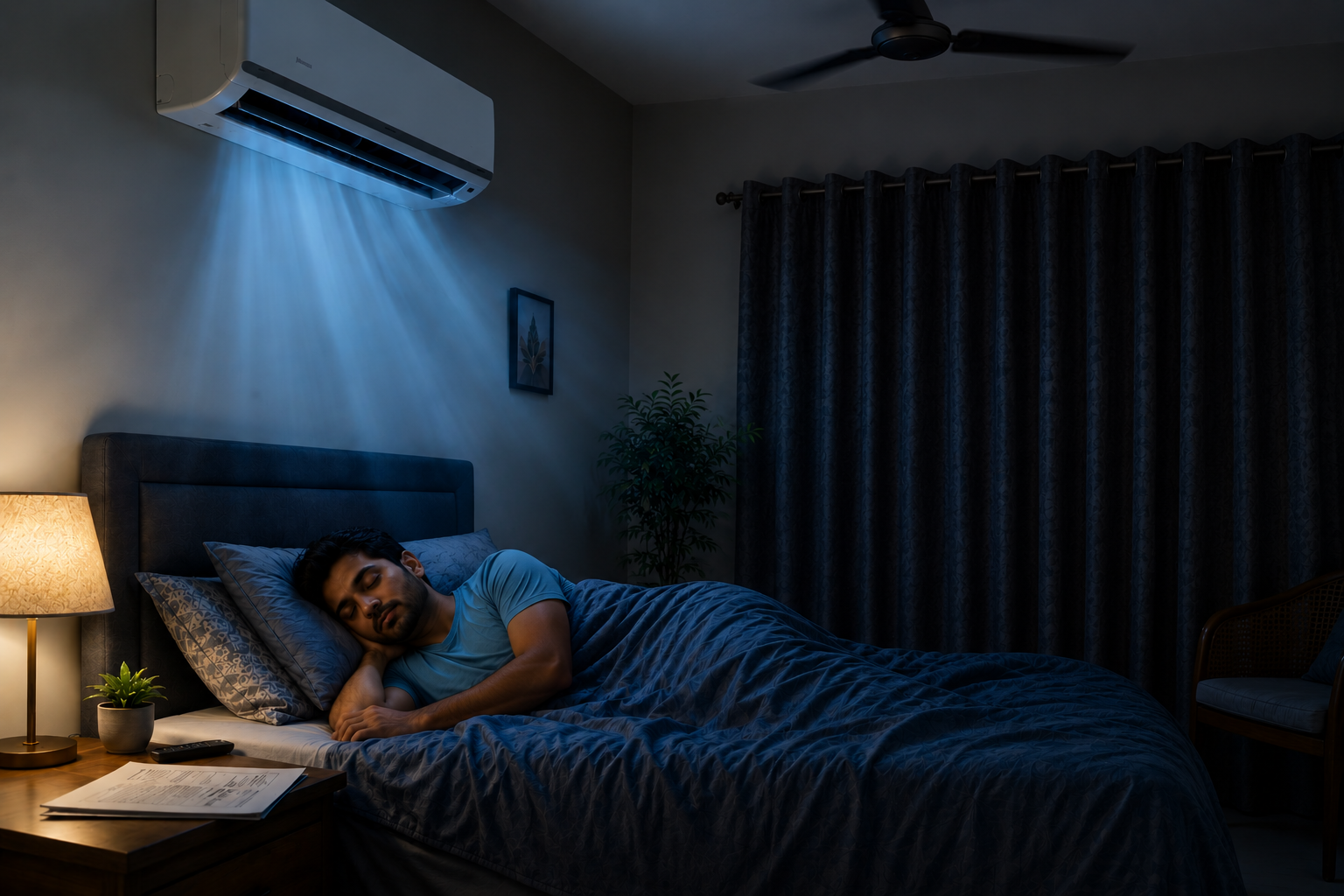
You turn on your air conditioner during summer because the heat becomes difficult to manage. When the electricity bill arrives, the number is often higher than expected. Many people are not sure how much 1.5 ton AC electricity consumption actually adds to their monthly bill. This confusion is normal because several factors influence consumption.
You may also want to understand what appliances consume the most electricity at home in India, because AC usage is often only one part of the total increase during summer months.
Many people search things like ‘how much units does a 1.5 ton AC consume per day’ or ‘why did my electricity bill suddenly increase after using AC.
This guide explains typical consumption ranges, what makes the number go up or down, and what actions you could take if you want to manage your bill better. The intent is not to give exact guarantees but to help you make more informed choices.
Table of Contents
Quick Answer: How Much Electricity Does a 1.5 Ton AC Use?
A typical 1.5 ton AC in India may consume roughly:
| Usage Pattern | Estimated Monthly Units | Approximate Monthly Cost |
|---|---|---|
| 6 hours/day | 250–320 units | ₹1,500–₹3,000 |
| 8 hours/day | 320–420 units | ₹2,000–₹4,500 |
| 12 hours/day | 500+ units | ₹4,000–₹7,000 |
Understanding 1.5 ton AC electricity consumption starts with knowing that 250–500+ units per month is normal depending on your usage pattern.
Actual bills vary by electricity tariff, AC efficiency, room insulation, temperature settings, and outdoor heat conditions.
Real Summer Usage Example:
A family in Chennai using a 1.5 ton inverter AC for 8 hours nightly during May (outside temperature 38-42°C) consumed 412 units in one month, paying ₹3,296 at ₹8/unit. Another family in Bengaluru using the same AC model for 6 hours nightly in milder weather (28-32°C) consumed 278 units, paying ₹1,946 at ₹7/unit. The AC was identical. The difference came from outdoor temperature, usage hours, and local tariff rates.
What Affects 1.5 Ton AC Electricity Consumption in Real-Life Conditions
The biggest myth about 1.5 ton AC electricity consumption is that all ACs of the same tonnage will give you the same bill, which is completely false.
No two households get the same electricity bill from the same AC model. The following factors play a role. Some are within your control. Others depend on where you live and how your room is built.
- AC type – Inverter models adjust their power use. Non inverter models run at full capacity whenever the compressor is on.
- Daily usage hours – More hours of operation increase total units consumed.
- Temperature setting – Lower settings make the compressor work longer, especially in non inverter ACs.
- Room size and insulation – A larger room or poor insulation forces the AC to run longer to maintain temperature.
- Maintenance condition – Dirty filters or low refrigerant gas reduce cooling efficiency and increase runtime.
- Outdoor temperature – On extremely hot days, the AC has to work harder to bring the room temperature down.
- Voltage and power quality – Fluctuations can affect efficiency, though the effect varies by model and stabilizer quality.
If you are unsure whether your setup needs voltage protection, this guide explains does your AC need a stabilizer in India and when it may actually help.
These factors interact with each other. For example, a well maintained inverter AC in a small, closed room with good insulation will likely consume less electricity than an old non inverter AC in a large, sunlit room, even with the same number of usage hours.
Monthly Electricity Consumption of a 1.5 Ton AC in India: A Working Estimate
Instead of a fixed number, it helps to look at a range. These estimates are based on typical conditions in Indian homes and assume normal summer temperatures between 30 to 38 degrees Celsius outside.
Power consumption basics per hour
A 1.5 ton AC generally consumes between 1.4 and 2.2 units per hour. The variation depends on:
- Whether it is a 3 star or 5 star rated model
- Inverter versus non inverter technology
- Age and maintenance of the unit
- Ambient temperature
A new 5 star inverter AC under moderate outdoor heat may consume closer to 1.4 to 1.6 units per hour. An older non inverter AC in peak summer may consume 1.8 to 2.2 units per hour.
Monthly usage example for a typical household
Let us assume these realistic conditions for a middle class Indian home:
- AC used for 8 hours per day (for example, 10 PM to 6 AM)
- Average consumption of 1.6 units per hour (a reasonable midpoint)
- 30 days in a month
Simple Formula to Calculate Your Own AC Electricity Cost:
Monthly Units = (Units Per Hour) × (Daily Usage Hours) × (Days Used)
Monthly Cost = Monthly Units × Your Electricity Tariff (₹ per unit)
For example: 1.6 units/hour × 8 hours × 30 days = 384 units × ₹8 = ₹3,072 per month.
To estimate your own 1.5 ton AC electricity consumption, you need three numbers: units per hour, daily usage hours, and your state’s tariff rate.
If your AC is less efficient or runs longer, the number will be higher. If it is more efficient or runs fewer hours, the number will be lower.
Electricity cost estimate across Indian states
Electricity tariffs vary significantly by state and by slab. In many states, domestic tariffs range from ₹6 to ₹10 per unit, but some states go lower or higher especially after crossing a certain consumption slab.
Based on the example of 384 units per month:
- At ₹6 per unit → approximately ₹2,300 per month
- At ₹8 per unit → approximately ₹3,070 per month
- At ₹10 per unit → approximately ₹3,840 per month
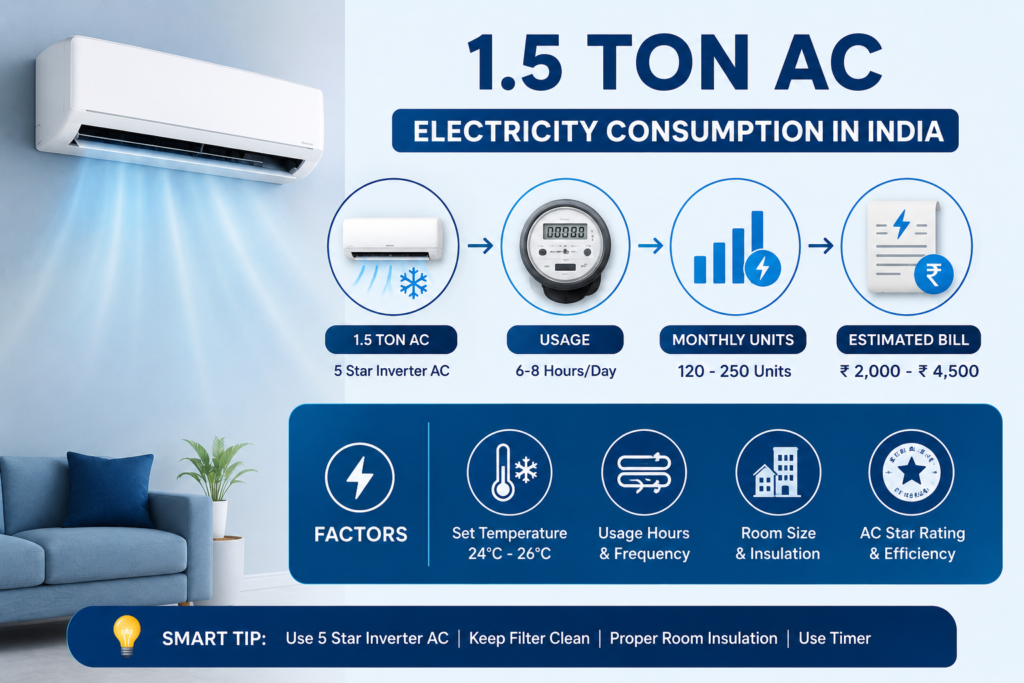
For many households, the actual monthly cost falls between ₹2,000 and ₹4,500. This range is not a promise. Your actual bill could be lower if you use the AC less or have a highly efficient model. It could be higher if you run the AC for 12 to 14 hours daily in a poorly insulated room.
Why Two Homes With Similar ACs Can Get Very Different Bills
Even if two households use a 1.5 ton AC for the same number of hours, the final electricity bill can still differ significantly because of:
- Different state electricity tariffs
- Usage during peak summer heat
- Room insulation quality
- Number of people in the room
- Sunlight exposure during the day
- Age and servicing condition of the AC
This is one reason online “exact AC bill calculators” are not always accurate for every household. They are useful for estimates, but real-life conditions matter.
What the final estimate tells you
A 1.5 ton AC will likely be one of the largest contributors to your summer electricity bill. But the exact number is not fixed. It depends on the combination of factors mentioned earlier. Two neighbors with the same AC model can see different bills because of differences in usage habits and room conditions.
If your bill feels unusually high, it helps to check your electricity meter reading over a few days rather than assuming the AC is the only cause. Other appliances like water heaters, geysers, and old refrigerators also add to the bill.
If you want a broader understanding of household consumption, this guide on how to calculate electricity bill at home in India may help you estimate overall usage more accurately.
Inverter vs Non Inverter AC: A Balanced Comparison
This is one area where buyers often receive strong opinions. A more useful approach is to understand the trade offs.
Inverter AC
- The compressor speed changes based on cooling demand. It does not turn on and off repeatedly.
- Works more efficiently when run for longer periods (typically 4+ hours continuously).
- Initial purchase cost is higher, often by ₹5,000 to ₹12,000 compared to a similar non inverter model.
- Electricity consumption is generally lower, but the savings depend heavily on usage patterns.
If you are also comparing purchase decisions, our guide on best inverter AC under ₹40,000 in India explains what to expect in terms of efficiency and ownership cost.
Non inverter AC
- The compressor runs at full speed when on and shuts off completely when the set temperature is reached.
- Works reasonably well if you use the AC for short durations, such as 2 to 3 hours at a time.
- Initial purchase cost is lower.
- Electricity consumption is usually higher, especially during peak summer when the compressor cycles on and off frequently.
| Feature | Inverter AC | Non Inverter AC |
|---|---|---|
| Initial cost | Higher | Lower |
| Electricity usage | Usually lower for long usage | Usually higher |
| Best for | 6–10+ hours daily use | Occasional short usage |
| Compressor behavior | Variable speed | On/off cycling |
| Noise levels | Often quieter | Usually louder |
A practical observation: If you run your AC for 8 or more hours daily during summer, an inverter AC may save you enough on electricity over 2 to 3 years to justify the higher purchase price. If you use AC only a few hours on occasional hot days, the savings may be smaller, and a non inverter AC might be more cost effective upfront.
Neither type is universally better. Your usage pattern matters more than marketing claims.
For verified star rating standards, check the Bureau of Energy Efficiency (BEE) official website.
What You Can Do to Reduce Electricity Cost Without Hype
These are practical steps. None of them will eliminate your AC electricity bill, but they may help reduce it. The degree of reduction will vary.
Step 1: Adjust the temperature setting
Setting the temperature to 24 or 25 degrees Celsius instead of 18 or 20 degrees reduces the load on the compressor. Most people find 24 degrees comfortable when combined with a ceiling fan or table fan. Lower settings increase runtime and electricity use.
We explored this in more detail in our article on best AC temperature for electricity saving in India, including why extremely low settings may increase power usage significantly.
Even a small temperature adjustment can reduce 1.5 ton AC electricity consumption by 10-15% without making you feel less comfortable.
Step 2: Use a fan along with the AC
A ceiling fan helps circulate the cooled air. This allows you to set the AC at a higher temperature (like 25 or 26 degrees) while still feeling comfortable. Fans consume far less electricity than lowering the AC temperature further.
Step 3: Get regular servicing done
Dirty air filters, blocked outdoor unit coils, or low refrigerant gas make the AC work harder. A basic service every 4 to 6 months, or before summer starts, helps maintain efficiency. This does not guarantee lower bills, but neglected ACs often consume more electricity.
Step 4: Keep doors and windows closed
This is simple but often ignored. When warm air keeps entering the room, the AC runs longer to remove heat. Closing doors, windows, and even curtains helps the AC maintain temperature with less effort.
Step 5: Consider an upgrade only if your AC is very old
If your current AC is more than 8 to 10 years old and is a non inverter model, a new 5 star inverter AC will likely consume less electricity. However, the replacement cost is significant. Calculate the payback period based on your summer usage. For some households, upgrading makes sense. For others, better usage habits and regular servicing are enough.
Step 6: Check for timers and sleep modes
Most modern ACs have a timer or sleep mode that gradually raises the temperature during the night. Using these features can reduce total runtime without affecting comfort noticeably.
Cautions and Realities to Keep in Mind
No action listed above will cut your AC electricity bill by 50 percent overnight. Some online claims exaggerate savings. Real life results depend on your specific situation.
If you live in a very hot region with outdoor temperatures above 40 degrees, your AC will consume more electricity no matter what settings you use. If your room has large windows facing the sun, insulation issues will cost you. Some problems require structural changes, not just operational changes.
Also, electricity tariffs differ not just by state but also by consumption slab. Crossing into a higher slab due to AC usage increases the per unit cost for all electricity you consume, not just the AC. This means a small increase in AC usage can sometimes cause a disproportionately larger bill increase.
Quick Practical Summary
- A 1.5 ton AC typically consumes between 1.4 to 2.2 units per hour.
- Monthly cost for 8 hours daily usage falls roughly between ₹2,000 and ₹4,500 for most Indian households.
- Inverter ACs save electricity mainly when used for long hours daily. For short usage, the savings are smaller.
- Lower temperature settings, poor maintenance, and poor insulation increase consumption.
- Using a fan, cleaning filters, and setting 24 to 25 degrees are low cost actions that may help.
Important Reality Check
A higher electricity bill does not always mean your AC is faulty. Seasonal tariff slab changes, hotter weather, longer runtime, and other appliances can also contribute to the increase.
Frequently Asked Questions About 1.5 Ton AC Electricity Consumption
Does inverter AC really save electricity?
Yes, but mainly when you run it for 4+ continuous hours. For short 2-3 hour sessions, the savings are small (5-10%). For 8+ hours daily, an inverter AC can save 20-30% compared to a non inverter model.
Is 1.5 ton AC enough for a 12×12 room?
Yes, a 1.5 ton AC is actually slightly more than enough for a 12×12 foot room (144 sq ft). A 1 ton AC would also work, but a 1.5 ton will cool faster and may consume more electricity than necessary unless you set it wisely.
How many units does a 1.5 ton AC consume in 8 hours?
Between 11 and 18 units, depending on star rating, inverter technology, room insulation, and outdoor temperature. A typical 5 star inverter AC consumes 12-14 units in 8 hours.
Does setting AC at 18°C increase the bill?
Significantly. Running a 1.5 ton AC at 18°C instead of 24°C can increase electricity consumption by 30-40% because the compressor never gets a break. You are paying for extreme cooling that your body may not even need.
Is 24°C really better for electricity saving?
Yes. Every degree lower than 24°C increases electricity consumption by roughly 3-6%. Setting at 18°C instead of 24°C can add 18-36% to your bill.
Related Reads
How to Reduce AC Electricity Bill in India (2026)
3 Star vs 5 Star AC Electricity Cost Difference Over 5 Years
Best AC Temperature for Electricity Saving in India
Split AC vs Window AC – Cost, Electricity & Maintenance Comparison
What Appliances Consume the Most Electricity at Home in India?
Leave a Reply to Reduce AC Electricity Bill in India (2026) – Practical Ways That Work Cancel reply