
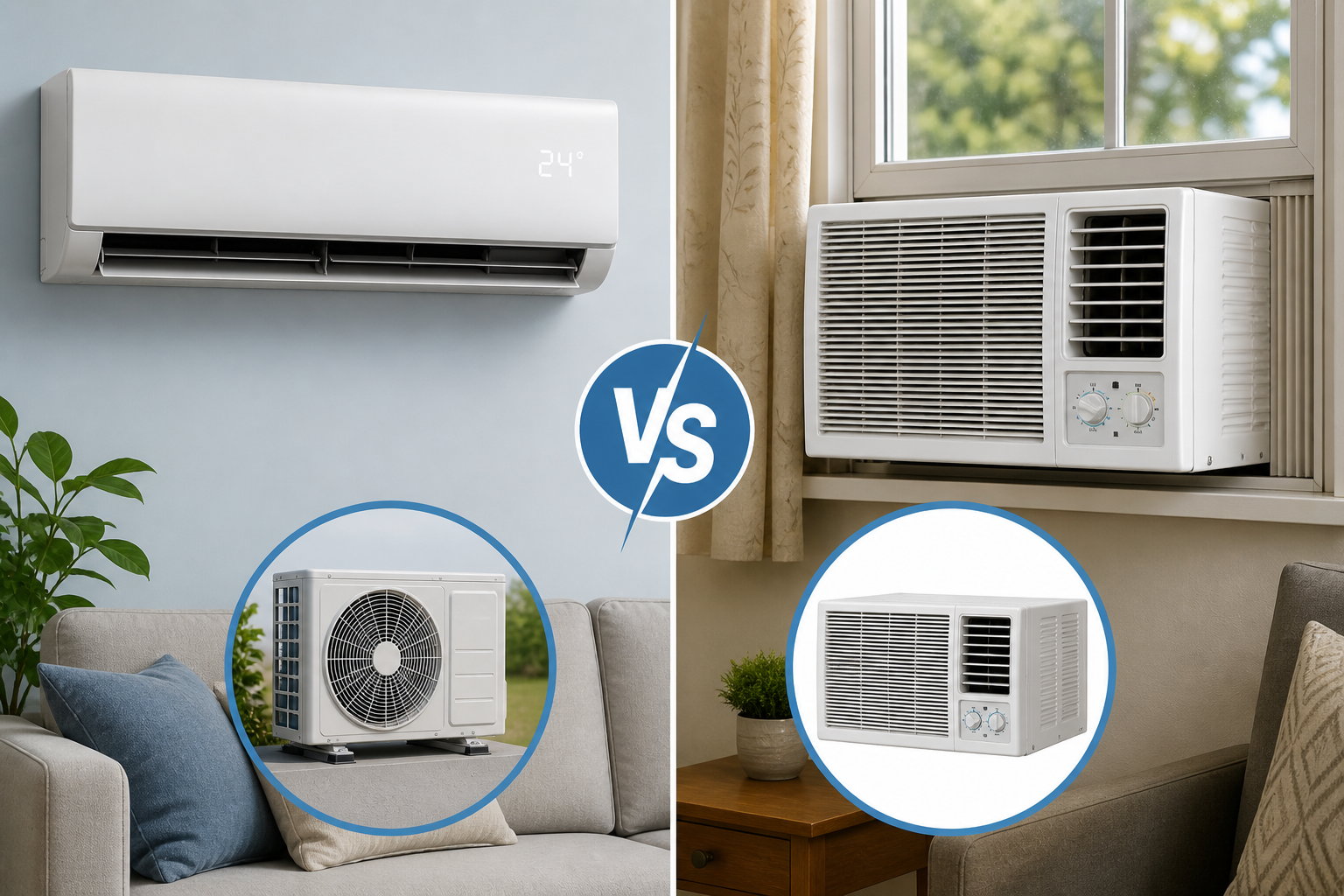
When comparing split AC vs window AC, most buyers look at price, electricity cost, and long-term maintenance before making a decision.
You walk into an electronics store or browse online. You see split ACs on one side and window ACs on the other. Both have similar cooling capacities. Both claim to be energy efficient. But the prices are different. And you are not sure which one will cost more over the next five years.
This comparison is common among Indian buyers. The answer is not the same for everyone. It depends on your room size, your budget for installation, how many hours you run the AC, and whether you plan to stay in the same house for a long time.
The purpose here is to lay out the real differences in purchase price, electricity consumption, maintenance costs, and lifespan. Based on that, you can decide which type suits your situation.
If you’re unsure about long-term costs, start with AC installation cost in India full breakdown to understand total setup expenses.
Table of Contents
Split AC vs Window AC price comparison
In a split AC vs window AC comparison, upfront price difference is the first thing most buyers notice.
For the same cooling capacity, split ACs and window ACs fall into different ranges.
Before comparing prices, it helps to know AC service cost in Chennai and other cities since maintenance affects total ownership cost.
1 ton capacity (suitable for small bedrooms up to 120 square feet)
| AC type | Price range (2026) | Typical brands |
|---|---|---|
| Window AC | ₹18,000 to ₹28,000 | Voltas, LG, Godrej, Panasonic |
| Split AC | ₹25,000 to ₹38,000 | Daikin, Blue Star, Lloyd, Carrier |
1.5 ton capacity (suitable for medium bedrooms up to 180 square feet)
| AC type | Price range (2026) | Typical brands |
|---|---|---|
| Window AC | ₹25,000 to ₹36,000 | Voltas, LG, Godrej, Whirlpool |
| Split AC | ₹32,000 to ₹52,000 | Daikin, Mitsubishi, Hitachi, O General |
Key observations
- Window AC is generally ₹5,000 to ₹15,000 cheaper for the same tonnage
- Premium split ACs (Mitsubishi, O General, Hitachi) cost significantly more than entry level split ACs
- During festive sales (Diwali, Republic Day, Amazon/Flipkart sales), discounts on split ACs are often higher than on window ACs. The price gap can shrink by ₹3,000 to ₹7,000 during these periods.
But upfront price is only one part of the cost. Installation, electricity, and maintenance add to the total.
Split AC vs Window AC installation cost difference
This is where split ACs add a significant expense that window ACs mostly avoid.
Split AC installation
- Standard installation charges: ₹500 to ₹1500 (often free during sales)
- Extra copper pipe if distance exceeds 3 meters: ₹150 to ₹350 per meter
- AC stand for outdoor unit: ₹800 to ₹2000
- Stabilizer (if not bought separately): ₹1500 to ₹4000
- Concealed piping or wall drilling: ₹200 to ₹500 extra
A typical split AC installation in a 2 BHK apartment with 5 meters distance between indoor and outdoor units costs between ₹2500 and ₹6000. If you already have a stabilizer and the distance is short, the cost could be under ₹1500.
Window AC installation
- Standard installation: ₹300 to ₹800 (often free during sales)
- Window frame modification (if needed): ₹400 to ₹1500
- Sealing material: ₹100 to ₹300
- Support bracket for window without ledge: ₹500 to ₹1000
A typical window AC installation costs between ₹500 and ₹2000. In many cases, if your window slot is ready, the cost stays under ₹1000.
Verdict on installation
Window AC is clearly cheaper and simpler to install. Split AC installation costs 2 to 4 times more in most cases. However, some homes do not have a suitable window for a window AC. In that situation, split AC is the only option.
Installation cost varies widely, which is explained in detail in AC installation cost in India guide.
Split AC vs Window AC electricity consumption comparison
In this split AC vs window AC comparison, electricity usage difference is smaller than most people expect.
Electricity consumption depends on many factors. Star rating, usage hours, temperature setting, room insulation, and maintenance all play a role. But for the same star rating and tonnage, split ACs and window ACs have a small difference.
To understand your actual monthly bill, see how much electricity a 1.5 ton AC consumes per month.
Why split ACs are slightly more efficient
- The compressor is outdoors, so heat is rejected directly outside
- The indoor unit has better airflow design
- Modern split ACs use inverter technology more commonly than window ACs
Why window ACs use slightly more power
- The entire unit sits partially inside the room. Some heat from the back of the unit can leak back into the room.
- Airflow is less optimized compared to split ACs
- Inverter technology is less common in window ACs, especially in lower price ranges
Estimated monthly electricity cost (1.5 ton, 8 hours daily, ₹7 per unit)
| AC type | Star rating | Estimated units per month | Estimated monthly cost |
|---|---|---|---|
| Window AC | 3 star | 330 to 380 | ₹2310 to ₹2660 |
| Window AC | 5 star | 270 to 310 | ₹1890 to ₹2170 |
| Split AC | 3 star | 300 to 350 | ₹2100 to ₹2450 |
| Split AC | 5 star | 240 to 280 | ₹1680 to ₹1960 |
These are estimates. Actual consumption depends on outdoor temperature, how often the door opens, and the temperature you set.
Bureau of Energy Efficiency AC star rating guide: https://beeindia.gov.in/en/content/star-labelling
Realistic difference per year
For 5 star models running 8 hours daily for 6 months of the year (summer months in most Indian cities):
- Window AC annual cost: approximately ₹11,300 to ₹13,000
- Split AC annual cost: approximately ₹10,000 to ₹11,700
- Difference: ₹1000 to ₹2000 per year in favor of split AC
Over 5 years, a split AC may save you ₹5000 to ₹10,000 in electricity compared to a window AC. But you paid more upfront for the split AC and more for installation. In many cases, electricity savings may partially offset the higher purchase and installation cost, depending on usage.
Over time, the total cost matters more than just the purchase price. Here’s a realistic 5-year comparison combining price, electricity, and maintenance.
| Cost factor | Window AC | Split AC |
|---|---|---|
| Purchase + install | ₹26k–₹38k | ₹35k–₹58k |
| Electricity (5 yrs) | ₹55k–₹65k | ₹50k–₹58k |
| Maintenance (5 yrs) | ₹3k–₹6k | ₹5k–₹10k |
| Total 5-year cost | ₹84k–₹1.09L | ₹90k–₹1.26L |
Many people are surprised by their bills, which is why why your electricity bill is high in summer is worth checking.
Split AC vs Window AC maintenance cost comparison
Split AC vs window AC maintenance cost differs mainly due to complexity and access to components.
Maintenance is often overlooked at the time of purchase. Both types need regular cleaning and occasional repairs. But the cost and frequency differ.
Window AC maintenance
Routine maintenance:
- Annual service: ₹500 to ₹1000
- Cleaning filters and coil: part of service
- Drain pipe cleaning: part of service
Common repairs and costs:
- Gas refill (rare in window AC unless there is a leak): ₹1500 to ₹2500
- Compressor replacement (uncommon): ₹5000 to ₹8000
- Fan motor replacement: ₹800 to ₹1500
- Control board replacement: ₹1500 to ₹3000
Window ACs are mechanically simpler. Most local technicians can repair them. Parts are generally cheaper because the design is older and more standardized.
Split AC maintenance
Routine maintenance:
- Annual service: ₹800 to ₹1800 (higher than window AC)
- Cleaning indoor unit filters: can be done by user monthly
- Cleaning outdoor unit coil: requires technician access to outdoor unit
Common repairs and costs:
- Gas refill due to leak in copper pipe joints: ₹1800 to ₹3500
- Compressor replacement: ₹6000 to ₹12,000
- Outdoor fan motor replacement: ₹1500 to ₹3000
- Indoor unit blower cleaning (deep cleaning): ₹1000 to ₹2000
- PCB board replacement: ₹3000 to ₹7000
Split AC maintenance is more expensive for two reasons. First, accessing the outdoor unit may require height work if installed on an external wall. Second, the system has more components (two fans, longer pipe, more electronics).
Maintenance tip for split AC owners
If your split AC was installed with proper copper pipe flaring and vacuum pumping, gas leaks are rare for 3 to 5 years. Problems usually start if the installation was rushed or done without proper tools.
If your AC starts underperforming, refer to AC not cooling repair cost in India to understand common issues.
Lifespan comparison
How long an AC lasts depends on usage, maintenance, and installation quality. But general patterns exist.
Window AC lifespan
- With regular annual service: 8 to 12 years
- With minimal service (only when problem occurs): 5 to 8 years
- Common failure points: compressor (after 7 to 10 years), rust on body (in coastal cities), fan motor
Window ACs are simpler. There is less to break. However, the metal body can rust faster in humid cities like Mumbai, Chennai, or Kolkata. Rust can affect performance and safety after 8 to 10 years.
Split AC lifespan
- With regular annual service and good installation: 10 to 15 years
- With poor installation (air or moisture in pipes): 2 to 4 years
- Common failure points: gas leak at pipe joints, outdoor unit fan failure, PCB board issues
Split ACs can last longer than window ACs if installed correctly. The indoor unit is protected from weather. The outdoor unit is exposed but built for outdoor conditions. However, repairs are more expensive when they fail.
Which lasts longer
A well maintained split AC with professional installation can outlast a window AC by 2 to 4 years. But a window AC that is serviced regularly will still give you 8 to 10 reliable years. For many Indian homes, both are acceptable.
For older units, it’s useful to compare AC repair vs replacement – which saves more money before deciding.
Space and aesthetics considerations
For some buyers, cost and electricity are not the only factors. Where you live and how you want the room to look also matter.
Window AC
- Requires a window or a hole in the wall
- The AC sticks out of the window. This may not be allowed in some apartments or gated communities with uniform exterior rules.
- Blocks part of the window. You cannot fully open that window during AC season.
- Noise from the compressor and fan is inside the room. You will hear it.
- Visible from outside. In some areas, this may be a security consideration for ground floor homes.
Split AC
- Requires only a small hole (2 to 3 inches) in the wall for copper pipes and drain.
- Does not block any window. You can keep windows fully functional.
- Indoor unit is quiet because the compressor is outside.
- Looks more modern. Most newer homes and apartments are designed with split ACs in mind.
- Outdoor unit needs space on a balcony or exterior wall. In some apartments, there is a designated AC ledge.
Which one fits your home
If your apartment has strict rules about exterior appearance or balcony usage, split AC is often the only choice. If you have a suitable window and want the lowest initial cost, window AC works well.
Noise level comparison
Noise matters more for bedrooms than for living rooms.
Window AC noise level
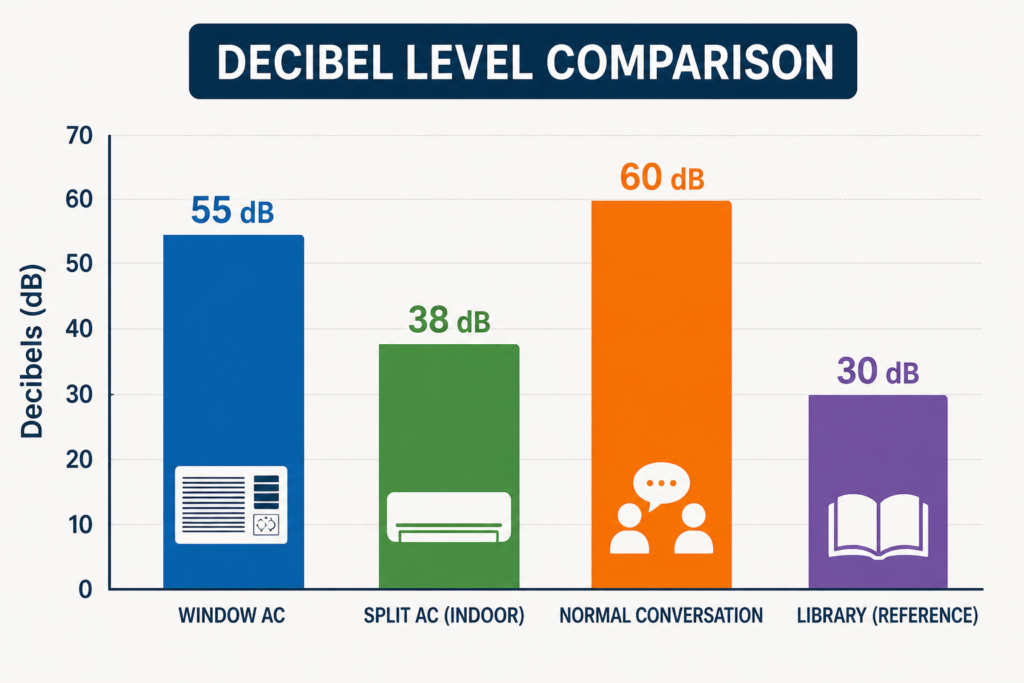
- Typically 50 to 58 decibels
- You hear the compressor starting and stopping
- Fan noise is noticeable, especially at higher speeds
- Similar to the sound of a ceiling fan at medium speed or a conversation nearby
Split AC noise level
- Indoor unit: 32 to 42 decibels
- Outdoor unit: 50 to 58 decibels (but placed outside)
- You hear mostly air movement from the indoor unit
- The compressor starting and stopping is not noticeable from inside the room
For light sleepers, split AC is clearly better. Some people can sleep comfortably with a window AC. But if you are sensitive to sound, the difference matters.
Before you decide, here are a few mistakes that end up costing more than the AC itself.
Common mistakes buyers make
- Choosing split AC without checking installation distance
- Ignoring noise factor for bedrooms
- Buying cheapest AC without checking electricity cost
- Not considering maintenance cost
Which one should you choose
The final split AC vs window AC decision depends on your budget, noise preference, and installation constraints.
Quick decision rule
- Budget low → Window AC
- Noise important → Split AC
- Long-term stay → Split AC
- Rental house → Window AC
There is no single correct answer. Based on the factors above, here is a realistic recommendation depending on your situation.
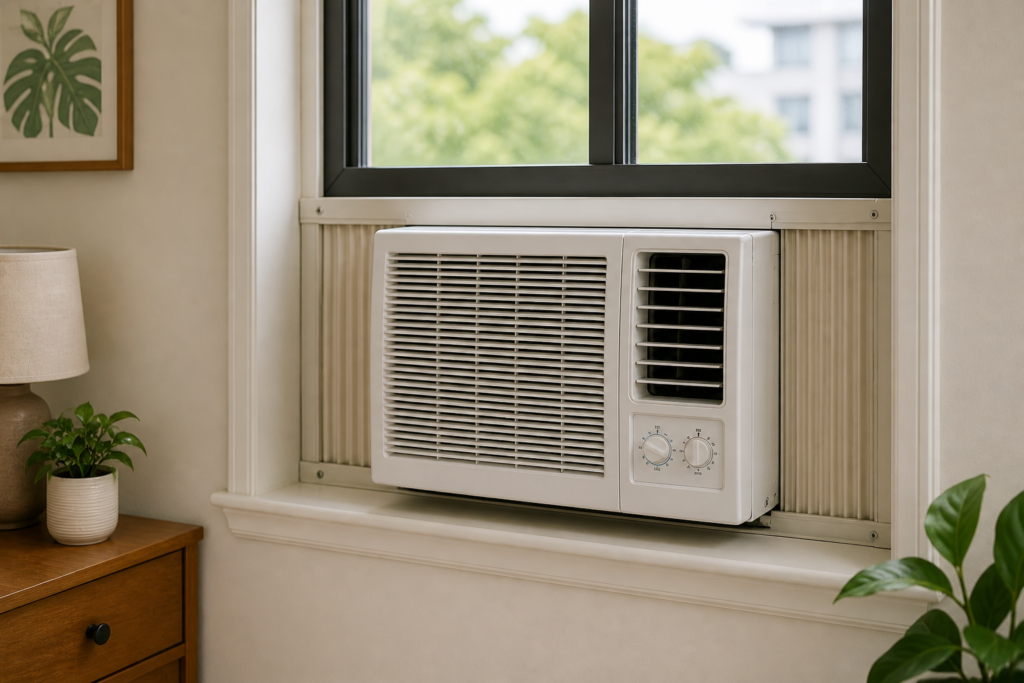
Choose a window AC if
- You have a suitable window or wall opening ready
- Your budget for the AC plus installation is under ₹30,000 for 1.5 ton
- You do not want to spend on separate stabilizer and copper pipe extensions
- Noise is not a major concern for you
- You live in a rented home where you cannot make holes in the wall for split AC piping
- You want a simpler unit that any local technician can repair
Choose a split AC if
- You do not have a window suitable for window AC
- Your apartment or society does not permit window ACs sticking out
- Noise is an important factor for you (bedroom, home office, or light sleeper in family)
- You plan to stay in the same home for more than 5 years
- You are willing to pay higher upfront cost for quieter operation and better aesthetics
- You have a balcony or AC ledge to place the outdoor unit safely
When a window AC may still be better for a light sleeper
Some people assume split AC is always quieter. But a poorly installed split AC with vibrating pipes or loose outdoor unit mounting can be noisier than a well maintained window AC. Installation quality matters.
When a split AC may cost you more than expected
If your outdoor unit location is very far (more than 7 meters of copper pipe), installation cost can cross ₹8000. At that point, the total cost of split AC may be ₹15,000 to ₹20,000 higher than a window AC. The electricity savings may not recover that difference for 8 to 10 years.
how to choose the right AC capacity for your room: https://daikinindia.com/perfecting-air
Summary table for quick decision
| Factor | Window AC | Split AC |
|---|---|---|
| Purchase price (1.5 ton) | ₹25,000 to ₹36,000 | ₹32,000 to ₹52,000 |
| Installation cost | ₹500 to ₹2000 | ₹2500 to ₹6000 (typical) |
| Monthly electricity (1.5T 5 star, 8 hrs) | ₹1890 to ₹2170 | ₹1680 to ₹1960 |
| Annual service cost | ₹500 to ₹1000 | ₹800 to ₹1800 |
| Typical lifespan | 8 to 12 years | 10 to 15 years |
| Noise in room | 50 to 58 dB | 32 to 42 dB |
| Requires window | Yes | No |
| Suitable for rented home | Yes | No (needs drilling) |
If voltage issues are common in your area, consider best budget stabilizer for AC in India for protection.
If you’re deciding between models, compare installation, electricity, and maintenance together before choosing.
Related reads
These articles may help you go deeper into AC costs and decisions.
Leave a Reply to 1.5 Ton AC Electricity Consumption: Shocking Monthly Cost Revealed (India 2026) Cancel reply