
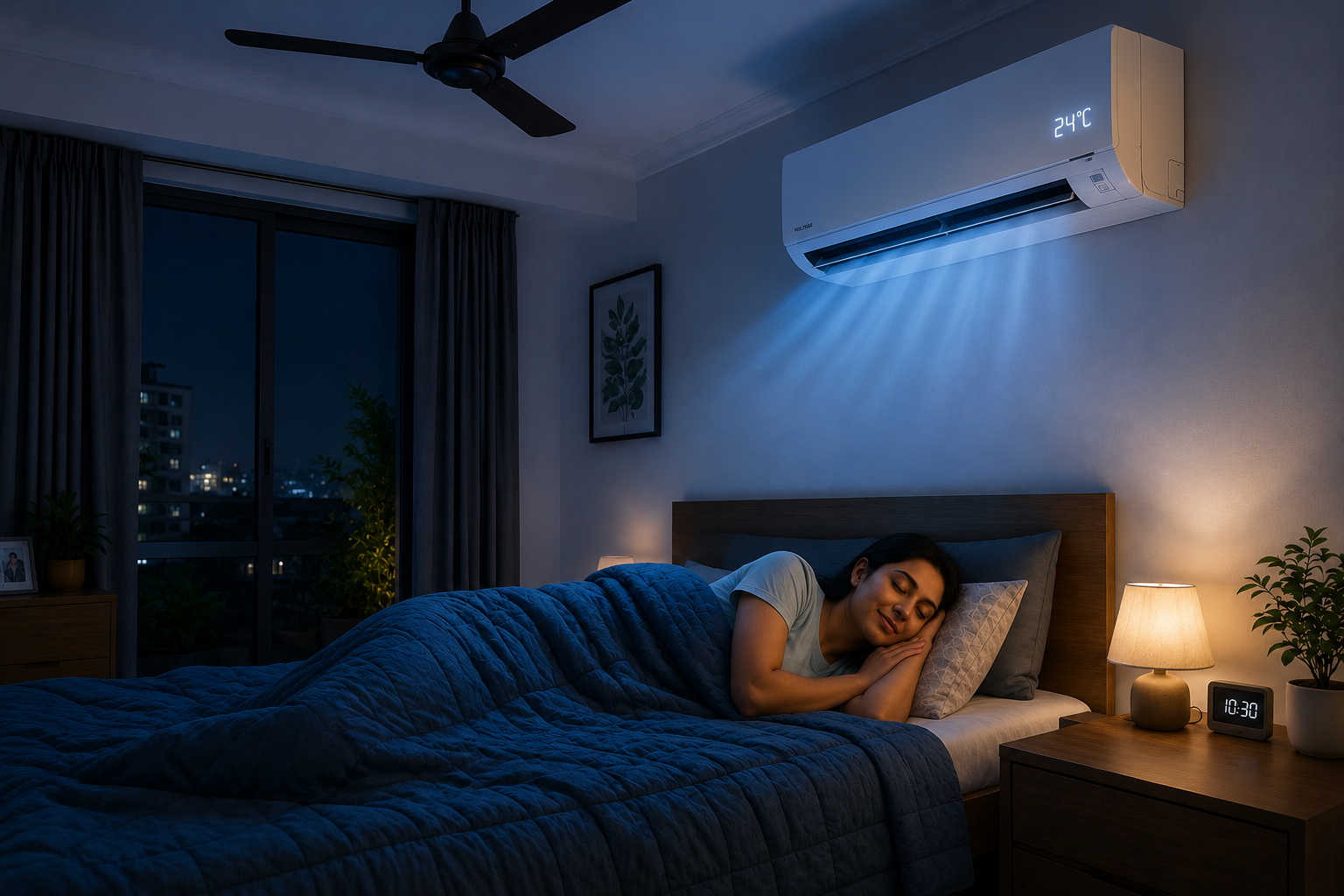
What is the best AC temperature for electricity saving? You come home on a hot afternoon. The room feels like an oven. You pick up the AC remote and press the temperature down button. 25 degrees. 22 degrees. 18 degrees. You stop when the number cannot go lower. You believe that setting 18 degrees will cool the room faster.
This is one of the most common practices in Indian homes. The logic seems simple. Lower setting should mean faster cooling. But ACs do not work this way. And this habit adds hundreds of rupees to your electricity bill every summer.
If your summer bill already feels unusually high, understanding why your electricity bill is high in summer can help identify the biggest causes.
This guide explains what happens inside your AC at different temperature settings, what the best temperature is for Indian weather, and how small changes to your settings can reduce your electricity bill.
Table of Contents
Does setting AC to 18 degrees cool the room faster
What most people misunderstand
The AC compressor already runs at maximum cooling capacity when the room is very hot. Lowering the temperature setting does not increase cooling speed. It only increases how long the compressor keeps running.
The short answer is no. An AC cools at the same speed regardless of the number on the remote.
Here is what actually happens. The AC compressor turns on. It runs at full capacity (in non inverter models) or at a high speed (in inverter models). It removes heat from the room. The temperature starts dropping. The AC keeps running until the room temperature reaches the number you set.
If you set 24 degrees, the AC reaches that temperature faster. The compressor then cycles off or slows down. This is one reason why inverter ACs are considered more efficient for Indian homes compared to older fixed-speed models.
If you set 18 degrees, the AC keeps running for much longer. In many Indian homes, especially during peak summer, the AC may never reach 18 degrees. The compressor runs continuously for hours.
The cooling speed is the same in both cases. The difference is how long the AC has to run. Lower setting does not mean faster cooling. It means longer running time.
A better approach is to set the temperature to a comfortable level, usually between 24 and 26 degrees, and let the AC reach that temperature. You feel cool. The AC takes a break. The electricity meter does not spin as fast.
Best AC Temperature for Electricity Saving by Indian Weather Type
India is not a single climate zone. The best temperature setting depends on where you live and the time of day.
Daytime setting (outdoor temperature 35 to 42 degrees)
For most Indian cities, the best AC temperature for electricity saving during summer afternoons is 24 to 26 degrees, cool enough for comfort but efficient enough to reduce your bill. This range keeps the room comfortable without making the compressor run constantly. Using a ceiling fan on medium speed at the same time allows you to set the AC to 26 or 27 degrees and still feel cool.
Many households reduce electricity usage further by following practical habits from this guide on how to reduce AC electricity bill in India.
Nighttime setting (outdoor temperature drops to 28 to 32 degrees)
At night, the outdoor temperature usually falls. The AC does not have to work as hard. A setting of 25 to 27 degrees is usually sufficient for sleep. Many ACs have a sleep mode that gradually increases the temperature by 1 to 2 degrees over a few hours. This saves electricity and prevents the room from becoming too cold in the early morning.
Humid cities (Mumbai, Chennai, Kolkata, Kochi)
High humidity makes the air feel warmer than the actual temperature. In humid cities, you may need a lower setting (24 to 25 degrees) to feel comfortable. The AC also removes moisture from the air, which takes extra energy. Keep doors and windows fully closed to prevent humid outside air from entering.
Dry heat cities (Delhi, Lucknow, Jaipur, Nagpur)
In dry heat, even 26 to 27 degrees can feel comfortable because sweat evaporates faster. A ceiling fan at medium speed helps air circulation. You can set the AC higher (26 to 28 degrees) and still feel cool. This saves more electricity compared to humid cities.
Quick recommendation table
Quick recommendation:
- Want lowest electricity bill → 26°C + ceiling fan
- Want balanced comfort and savings → 24°C to 25°C
- Very humid weather → 24°C works better
- Sleeping at night → 25°C + sleep mode
| Condition | Recommended temperature | Fan usage |
|---|---|---|
| Daytime, most Indian cities | 24 to 26 degrees | Ceiling fan on medium |
| Nighttime, most Indian cities | 25 to 27 degrees | Ceiling fan on low or sleep mode |
| Humid conditions (coastal cities) | 24 to 25 degrees | Ceiling fan on medium |
| Dry heat (North Indian plains) | 26 to 28 degrees | Ceiling fan on medium |
| Elderly or infants in the room | 26 to 27 degrees | Ceiling fan on low |
These are starting points. Your comfort may vary. Adjust up or down by 1 degree and see what feels right.
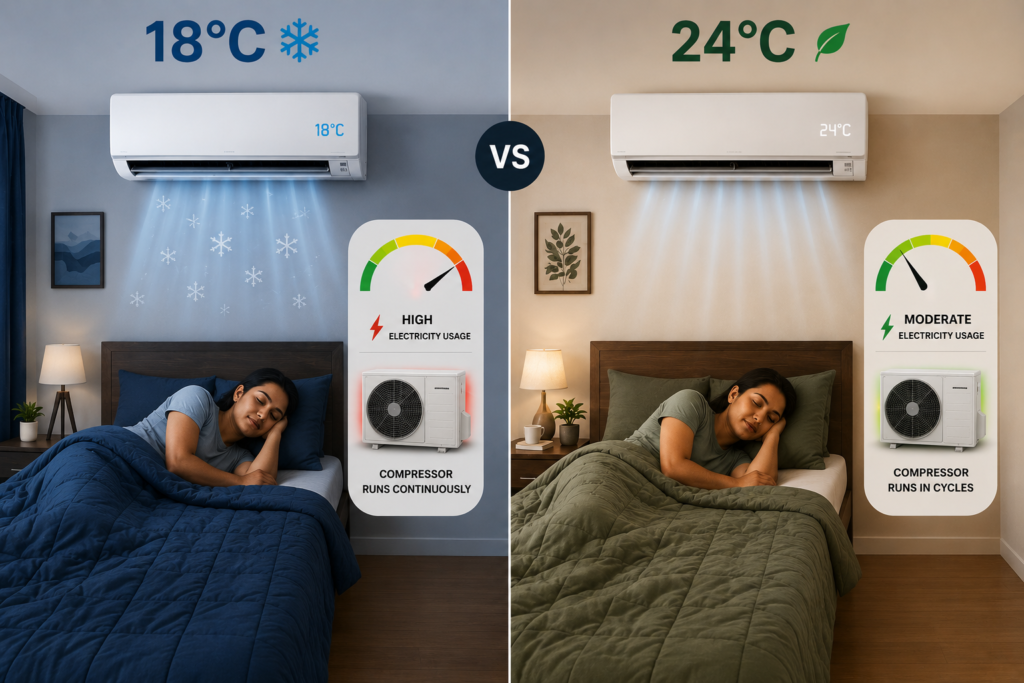
24°C vs 18°C: Why Best AC Temperature for Electricity Saving Matters
The difference in electricity use shows why the best AC temperature for electricity saving is closer to 24 degrees than 18 degrees. It can be 20 to 30 percent of your AC electricity bill.
Why the difference exists
At 18 degrees, the compressor runs almost continuously. The AC is always working hard. At 24 degrees, the compressor reaches the set temperature and then cycles off or runs at lower power. The AC gets rest periods. The total running time is much lower.
Estimated monthly difference for a 1.5 ton AC
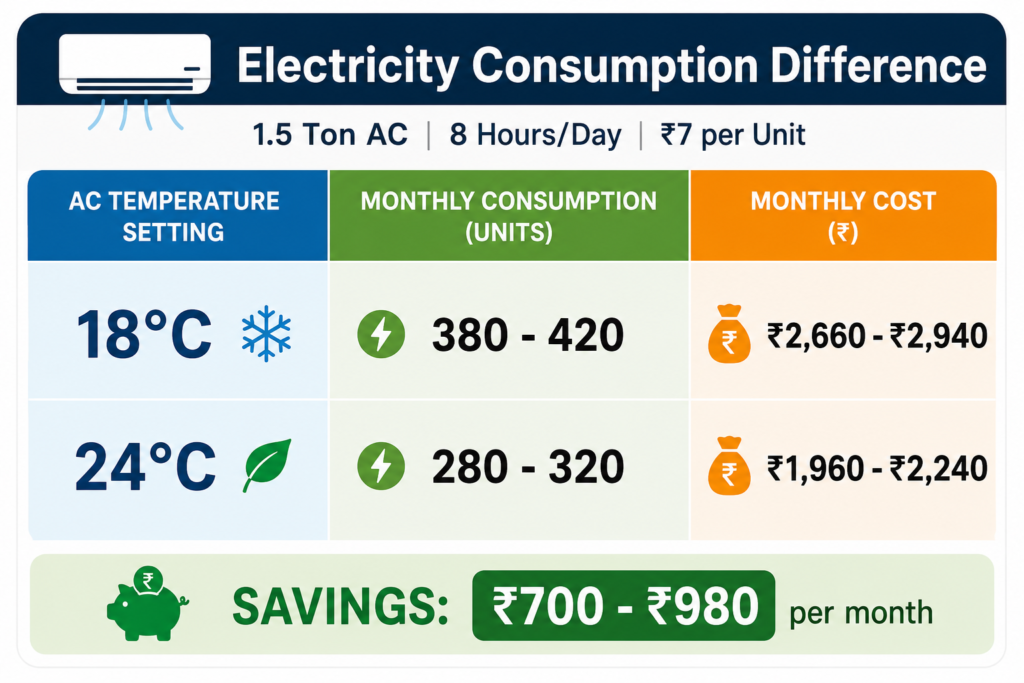
Assume a 1.5 ton 3 star split AC running for 8 hours per day in a typical Indian bedroom. Electricity rate of ₹7 per unit.
For official energy efficiency standards, check the BEE star rating program.
| Temperature setting | Estimated monthly units | Estimated monthly cost | Difference |
|---|---|---|---|
| 18 to 20 degrees | 380 to 420 units | ₹2660 to ₹2940 | Baseline |
| 21 to 22 degrees | 330 to 370 units | ₹2310 to ₹2590 | ₹350 to ₹350 |
| 23 to 24 degrees | 280 to 320 units | ₹1960 to ₹2240 | ₹700 to ₹700 |
| 25 to 27 degrees | 240 to 280 units | ₹1680 to ₹1960 | ₹980 to ₹980 |
If you want a deeper breakdown of actual monthly AC power usage, this guide explains how much electricity a 1.5 ton AC consumes per month in Indian conditions.
These numbers are estimates. Your actual consumption depends on room size, insulation, outdoor temperature, and AC efficiency. But the pattern is clear. In many real-world home conditions, lowering the AC temperature by each degree below 24°C can increase electricity usage noticeably over time, though the exact impact varies by room size, insulation, humidity, and AC model.
Annual savings example
A family that switches from 20 degrees to 25 degrees for 8 hours daily over 6 months of AC use could save ₹4000 to ₹6000 per year. This is for one AC. For homes with two or three ACs, the savings multiply.
Why lower temperatures increase electricity usage
Several factors explain why lower settings consume more power.
Longer compressor running time
The AC compressor is the component that consumes the most electricity. It runs for hours trying to reach 18 degrees. In many cases, during a 40 degree afternoon, it never reaches 18 degrees. The compressor runs continuously for the entire time the AC is on. At 24 degrees, the compressor reaches the target much faster and then cycles off or runs at reduced speed.
Higher heat load from walls and windows
Lower indoor temperatures mean a larger temperature difference between inside and outside. Heat flows from outside to inside faster when the difference is larger. The AC has to remove heat that keeps entering through walls, windows, and gaps around doors. This increases the load on the compressor.
Humidity removal takes additional energy
When you set a very low temperature, the AC runs longer and removes more moisture from the air. Removing humidity requires energy beyond just cooling the air. In humid cities, this effect is more pronounced.
Inverter ACs also consume more at lower settings
Some people believe that inverter ACs consume the same power regardless of temperature. This is not correct. Inverter ACs adjust compressor speed. At lower temperature settings, the compressor runs at higher speeds for longer periods. Electricity consumption is still higher compared to moderate settings. The difference may be smaller than non inverter ACs, but it still exists.
Best AC Temperature for Electricity Saving While Sleeping (Night Settings)
Sleeping with the AC requires a careful balance. Too cold and you wake up with a stuffy nose or sore throat. Too warm and you cannot sleep.
Use sleep mode
Most ACs have a sleep mode button on the remote. When activated, the AC gradually increases the temperature by 1 to 2 degrees over a period of 2 to 4 hours. For example, it starts at 24 degrees, moves to 25 degrees after an hour, then 26 degrees after two hours. You do not notice the change while sleeping. The AC runs less as the night progresses. This saves electricity.
Set a timer for early morning hours
If your AC does not have sleep mode or you prefer more control, use the timer function. Set the AC to turn off 30 to 60 minutes before you usually wake up. The room stays cool enough until morning. The AC does not run unnecessarily in the early morning when outdoor temperatures are lower.
Ceiling fan speed on low
Running the ceiling fan on low speed improves air circulation without creating a draft. This allows you to set the AC to 26 or 27 degrees and still feel comfortable.
Close doors to other rooms
If multiple people sleep in different rooms, keep all doors closed. This prevents cold air from leaking out and warm air from entering.
A note on dry mode
Some ACs have a dry mode that focuses on removing humidity without aggressive cooling. In humid cities, dry mode at 26 to 27 degrees can be comfortable for sleeping while consuming less electricity than cool mode at the same temperature.
Common mistakes people make with AC temperature
Setting 16 or 18 degrees immediately after turning on the AC
The AC does not cool faster at a lower setting. The cooling speed is fixed. Setting 18 degrees only makes the AC run longer. A better method is to set 24 degrees initially. If the room is very hot, use the turbo or high cool mode for first 10 to 15 minutes. Then switch to normal mode at 24 degrees.
Opening doors frequently while AC is running
Every time you open a door to the room, cold air escapes and warm air enters. The AC has to work extra to remove that heat. If you need to leave the room, close the door behind you. If people are moving in and out frequently, set the AC to 25 or 26 degrees to compensate.
Keeping windows or balcony doors slightly open for fresh air
This defeats the purpose of the AC. The cool air escapes. The AC runs continuously. If you want fresh air, turn off the AC for 10 minutes, open the windows fully, then close them and turn the AC back on. Do not run the AC with windows open.
Setting very low temperature and wrapping in blankets
Some people set the AC to 18 degrees because they like the feeling of cold air while sleeping under a blanket. This is inefficient. The AC works hard to cool the entire room when only the bed area needs to be cool. Set the AC to 25 or 26 degrees, use a thinner blanket, and let the ceiling fan run on low.
Ignoring filter cleaning
A dirty filter reduces airflow. The AC cannot cool effectively. You may feel warm and lower the temperature further. This increases electricity use. Clean filters once a month during summer.
What you should do now
Here are simple steps to start saving electricity without buying anything new.
Step 1: Set your AC to 24 degrees
If you usually set to 20 or 22 degrees, try 24 degrees for a week. Use the ceiling fan on medium speed. See if you feel comfortable. Most people adjust within a day or two.
Step 2: Use the ceiling fan
A ceiling fan on medium speed consumes 50 to 70 watts. A 1.5 ton AC consumes 1500 to 1800 watts when the compressor is running. The fan allows you to increase the AC temperature by 2 to 3 degrees. The net electricity saving is large.
Step 3: Clean the air filters
Open the front panel of your indoor unit. Slide out the filters. Wash them under running tap water. Let them dry. Slide them back. Do this every 3 to 4 weeks during summer.
If cooling still feels weak even after cleaning, it may help to understand common repair causes explained in this AC repair cost and troubleshooting guide.
Step 4: Use sleep mode at night
Before sleeping, press the sleep mode button on your remote. If your AC does not have sleep mode, set a timer to turn off the AC 1 hour before you wake up.
Step 5: Check for gaps around windows and doors
Close all windows fully. Check the door gap at the bottom. If there is a large gap, use a door sweep or a rolled towel to block air leakage.
Step 6: Observe your electricity bill
After one month of following these steps, compare your bill with the same month last year. The difference may surprise you.
Quick Summary: Best AC Temperature for Electricity Saving in India
- 24°C to 26°C is usually the best AC temperature for electricity saving, balancing comfort and lower bills
- Lower temperatures do not cool faster
- Ceiling fans help reduce AC workload
- Sleep mode reduces overnight electricity usage
- Dirty filters increase power consumption
- Humid cities may need slightly lower settings
Common questions asked
Is 24 degree setting mandatory for all ACs
No. 24 degrees is a recommendation based on energy efficiency studies by the Bureau of Energy Efficiency. Your comfort matters. Adjust up or down by 1 or 2 degrees based on what feels right.
Will setting 24 degrees damage the AC
No. ACs are designed to operate across a range of temperatures. Setting 24 degrees is well within normal operating conditions.
I feel hot at 24 degrees. What should I do
Try cleaning the filters first. Dirty filters reduce cooling. Check if the room has direct sunlight. Close curtains. Use a ceiling fan. If you still feel hot, set to 23 degrees. The goal is to find the highest temperature that keeps you comfortable, not the lowest achievable.
Does the same rule apply to window ACs
Yes. Window ACs also consume more electricity at lower temperature settings. The difference may be slightly smaller than split ACs, but the principle is the same.
What about inverter ACs
Inverter ACs are more efficient than non inverter models. But they still consume more electricity at lower temperature settings. The difference is smaller but still meaningful over a full summer.
Understanding temperature settings is only one part of reducing AC costs. Electricity usage, servicing habits, insulation, and AC efficiency all work together to affect long-term running cost.
Related reads
These articles provide more detail on AC electricity consumption and cost reduction.
Leave a Reply to Save Money: Real 3 Star vs 5 Star AC Cost Comparison India 2026 Cancel reply