
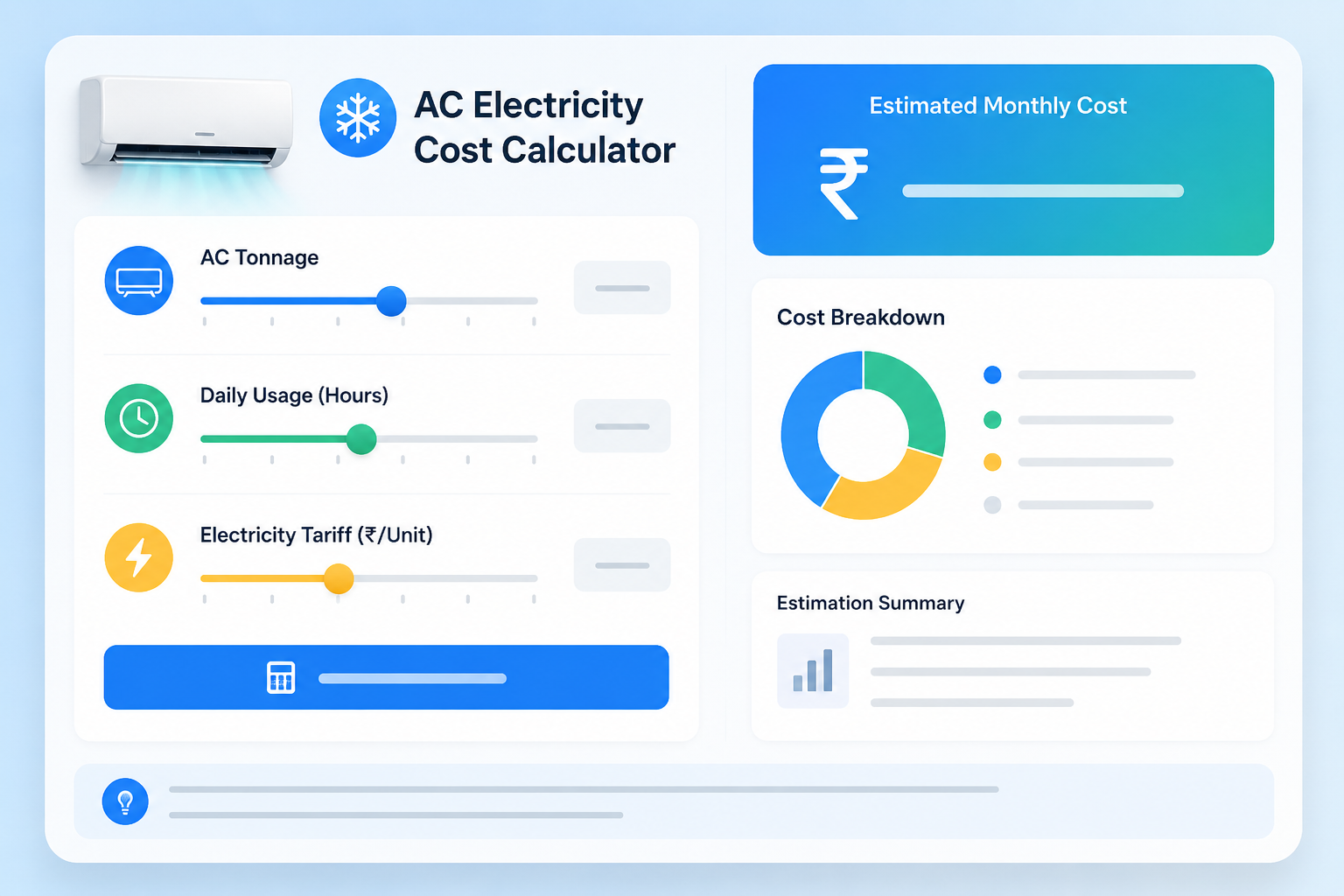
An air conditioner directly adds to your monthly bill, but most homeowners do not know the exact AC electricity cost until the bill arrives. A simple calculator gives a rough number. The real help comes from understanding what drives that AC electricity cost in a typical Indian home.
This AC electricity cost calculator estimates monthly cooling cost using tonnage, inverter type, running hours, and electricity rate. The result is still an estimate because real AC power usage changes continuously based on heat load, insulation, humidity, maintenance condition, and compressor behaviour.
How to use this: Select your AC tonnage, type, average daily running hours, and your state’s approximate electricity tariff. The calculator uses typical wattage ranges for each combination.
This AC electricity cost estimate for your home falls between a lower and upper range, not a single fixed number.
Disclaimer: This is a rough estimate. Your actual bill depends on room insulation, outdoor temperature, AC maintenance, voltage quality, and your specific electricity slab rate. Do not use this for financial decisions without cross checking with your actual meter readings.
In some homes, unstable voltage can quietly increase appliance stress over time, especially if the AC runs for long hours during summer. That is why many households also check whether an AC stabilizer is actually necessary in Indian voltage conditions.
Table of Contents
How This AC Cost Calculator Works
To calculate AC electricity cost reliably, the calculator makes a few basic assumptions about your home. Understanding these assumptions helps you decide whether the estimate is useful for your situation or too far from reality.
The basic formula every electricity bill uses
Your electricity bill charges you for “units” consumed. One unit is one kilowatt hour (kWh). That simply means running a 1000 watt appliance for one hour.
For an AC, the calculation looks like this:
Monthly Cost = (AC Wattage ÷ 1000) × Daily Hours × Days Used × Tariff Rate
But wattage is not fixed. A 1.5 ton AC does not always run at 1500 watts. It changes based on whether the compressor is running at full capacity, partial capacity, or switched off.
Why the calculator asks for AC type
Inverter ACs vary their compressor speed. When your room is close to the set temperature, the compressor slows down and consumes less power. This variable wattage changes the final AC electricity cost significantly compared to a non-inverter unit.
Non inverter ACs work differently. The compressor either runs at full speed or turns off completely. When it runs, it draws full wattage. When it turns off, only the fan runs. This on-off cycling means average consumption depends heavily on how often the compressor cycles.
The calculator uses different wattage ranges for each type:
| AC Type & Tonnage | Typical Wattage Range (per hour of compressor running) |
|---|---|
| 1 Ton Non Inverter | 1000 – 1200 watts |
| 1 Ton Inverter | 600 – 1100 watts |
| 1.5 Ton Non Inverter | 1400 – 1700 watts |
| 1.5 Ton Inverter | 900 – 1600 watts |
| 2 Ton Non Inverter | 1800 – 2200 watts |
| 2 Ton Inverter | 1300 – 2000 watts |
These ranges are not precise specifications. They are observed averages from field data and user reports across Indian climate conditions. Your specific AC model might fall outside these ranges, especially if it is very old or very new.
The inverter effect on estimates
For a non inverter AC running 8 hours, the compressor might actually run for 5 to 6 of those hours, cycling on and off. For an inverter AC running 8 hours, the compressor runs continuously but at varying speeds. This is why two 1.5 ton ACs with the same usage hours can show different consumption.
Many homeowners notice this difference only after comparing their monthly AC usage with actual 1.5 ton AC electricity consumption patterns in Indian homes.
The calculator attempts to account for this by applying different average load factors. But no online tool can predict exactly how often your specific room loses cool air or how hot your roof gets in May afternoon sun.
Electricity tariff and why it varies
Your electricity board charges you a rate per unit. That rate depends on your state, your consumption slab, and sometimes the season. Many states have lower rates for the first 100 or 200 units, and higher rates beyond that.
If you use an AC for 8 hours daily, you will likely cross into a higher slab. That means not only does your AC cost more per unit, but every other appliance in your house also gets charged at that higher rate. The calculator uses a single tariff input, but in reality, the effective rate may be higher if you cross a slab boundary.
For an accurate estimate, check your last electricity bill. Look for the slab wise rate or the average rate you paid. If your bill says “first 100 units at ₹3.50, next 200 units at ₹5.80, above 300 units at ₹7.20” and you typically consume 400 units, your effective rate is closer to ₹6.50 to ₹7.00.
Check your last bill: Look for the slab-wise rate. Your effective AC electricity cost is charged at the highest slab your home reaches, not the first slab.
Example Calculation for a Common Indian Household
Let us walk through a realistic example. This is not a promise of what you will pay. The illustration shows exactly how each factor adds to your AC electricity cost.
Scenario: A family in Hyderabad uses a 1.5 ton inverter AC. They run it for 8 hours every night from 10 PM to 6 AM during April and May. The outdoor temperature ranges from 32 to 40 degrees. Their room is a standard bedroom with normal windows and no special insulation. The AC was serviced six months ago.

Step 1: Estimate average wattage
For a 1.5 ton inverter AC in these conditions, average wattage might be around 1200 to 1400 watts. It runs higher when first cooling the room from 35 degrees down to 24 degrees, then drops to 600 to 800 watts once the temperature stabilises. The average over 8 hours comes to roughly 1200 watts.
Step 2: Calculate daily units
1200 watts = 1.2 kilowatts
1.2 kW × 8 hours = 9.6 units per day
Step 3: Calculate monthly units
9.6 units × 30 days = 288 units
Step 4: Apply tariff
Hyderabad electricity tariff for medium consumption slabs is around ₹7 to ₹8 per unit.
At ₹7.50 per unit: 288 × ₹7.50 = ₹2160 per month
Variation in this same scenario
If the same family used the AC for 12 hours daily on weekends and 8 hours on weekdays, the monthly units would increase. If their room has a west facing window that gets afternoon sun, the AC works harder in the evening. If the outdoor temperature hits 42 degrees for two weeks, consumption goes up.
A different family in the same city with the same AC but a poorly insulated room could easily consume 350 to 400 units. Their monthly bill might be ₹2600 to ₹3000.
This is why estimates always need a range, not a single number.
Average AC Electricity Cost in India by Tonnage
The table below shows observed monthly cost ranges from various Indian cities. These assume 8 hours of daily usage, average summer temperatures, and a tariff rate between ₹6 and ₹9 per unit. Your costs may be lower or higher.
| AC Tonnage | Typical Monthly Units (8 hours/day) | Approximate Monthly Cost |
|---|---|---|
| 1 Ton Non Inverter | 200 – 280 units | ₹1200 – ₹2500 |
| 1 Ton Inverter | 160 – 240 units | ₹950 – ₹2100 |
| 1.5 Ton Non Inverter | 320 – 420 units | ₹1900 – ₹3800 |
| 1.5 Ton Inverter | 250 – 360 units | ₹1500 – ₹3200 |
| 2 Ton Non Inverter | 420 – 540 units | ₹2500 – ₹4800 |
| 2 Ton Inverter | 330 – 460 units | ₹2000 – ₹4100 |
A few observations from these ranges. Inverter ACs show lower consumption consistently, but the difference is smaller at lower usage hours. A 1.5 ton inverter AC might save you 300 to 500 rupees per month compared to a non inverter model if you use it for 8 hours daily. If you use it for 4 hours daily, the saving drops to 150 to 250 rupees per month.
The ranges also tell you that two households with the same AC tonnage can have bills that differ by 1000 rupees or more. That difference often comes from room conditions, maintenance, and temperature settings, not from the AC itself.
Quick AC Cost Benchmarks by Usage Pattern (1.5 Ton Inverter, ₹7/unit)
| Daily Usage | Monthly Units (Range) | Estimated Monthly Cost |
|---|---|---|
| 4 hours/day | 130 – 180 units | ₹910 – ₹1,260 |
| 8 hours/day | 250 – 360 units | ₹1,750 – ₹2,520 |
| 12 hours/day | 380 – 520 units | ₹2,660 – ₹3,640 |
Why Your AC Bill Can Change Even When Usage Stays the Same
You run the AC for the same 8 hours. The temperature setting is also the same. Yet last month’s bill was higher. This happens for real, physical reasons.
- High humidity: The AC spends energy removing moisture from the air, not just lowering temperature.
- Poor insulation: A new gap under the door or a slightly open window makes the AC work longer.
- Outdoor temperature: When outside heat jumps from 35°C to 42°C, the AC works harder to push heat out.
- Low refrigerant: A small gas leak reduces cooling capacity. The AC runs longer to reach the set temperature.
- Dirty filters or coils: This is the most common hidden reason. Restricted airflow forces the compressor to run more.
- West-facing rooms: Afternoon sun heats up walls. The AC fights this extra heat load for hours.
Ways to Reduce Your AC Electricity Bill
These suggestions are practical and tested. None of them will cut your bill by half. But each may reduce consumption by a small percentage. Together, they can make a noticeable difference over a three month summer.
Change the temperature setting to 24 or 25 degrees
This is the single most effective operational change. Every degree lower than 24 degrees increases consumption by roughly 3 to 6 percent. Running at 18 degrees instead of 24 degrees can add 18 to 30 percent to your bill. Most people find 24 or 25 degrees comfortable when combined with a ceiling fan.
Use a ceiling fan or table fan with the AC
A fan uses 50 to 80 watts. Lowering your AC temperature by 2 degrees uses several hundred watts more. Running a fan allows you to keep the AC at a higher temperature while feeling just as cool. This is safe and effective.
Clean the air filters every two weeks
Dirty filters restrict airflow. The AC has to run longer to achieve the same cooling. A simple filter cleaning takes two minutes and requires no tools. Pull the filter out, wash it with water, dry it, and put it back. This does not replace professional servicing but it helps maintain efficiency.
Check for gaps around doors and windows
Warm air entering the room forces the AC to work harder. Feel for air leaks around window edges and under doors. Rubber seal strips or simple door draft stoppers cost very little and reduce infiltration. In many homes, this is an overlooked factor.
Schedule professional service before peak summer
A technician should clean the outdoor unit coils, check refrigerant pressure, and inspect the indoor unit. An AC with low refrigerant or dirty outdoor coils can consume 15 to 25 percent more electricity. Service once a year, ideally in February or March before summer starts, is usually sufficient.
Many users only realise this after comparing rising electricity bills with common AC service and maintenance costs in Indian cities.
Use the sleep mode or timer
Most modern ACs have a sleep mode that gradually raises the temperature by 1 or 2 degrees over several hours. This matches your body’s natural sleep cycle. Using this feature reduces consumption without you noticing the temperature change.
Shade the outdoor unit if possible
The outdoor unit works harder when exposed to direct afternoon sun. A simple shade or awning that allows airflow while blocking direct sunlight can help. Do not enclose the unit or block ventilation. This is not a major saving but it helps in very hot locations.
Consider an upgrade only for very old units
If your AC is more than 8 to 10 years old and is a non inverter model, a new 5 star inverter AC will likely consume less electricity. But the replacement cost is significant. Calculate the payback period. If you use AC for 8 hours daily for 4 months each year, the electricity saving might take 5 to 7 years to recover the purchase cost. For many households, better usage habits and regular servicing are more cost effective.
For older units, it sometimes makes more sense to compare whether AC repair costs are starting to exceed replacement value.
A final reality check: No online calculator knows if your room has a west-facing window or if your refrigerant is low. Use the number from this tool as a starting point, then verify with your meter for one week.
Frequently Asked Questions
Does an inverter AC really save electricity compared to a non inverter AC?
Yes, the AC electricity cost for an inverter model is typically 20-30% lower than a non-inverter, but only when used for longer hours. For 4+ hours of continuous running, an inverter AC typically saves 20 to 30 percent compared to a similar non inverter model. For 2 to 3 hours of daily use, the saving is much smaller, perhaps 5 to 10 percent. The higher purchase price of an inverter AC may not be worth it for occasional users.
How many units does a 1.5 ton AC consume in 8 hours?
It varies widely. A well maintained 5 star inverter AC in a room with good insulation might consume 10 to 13 units in 8 hours. An older non inverter AC in a poor room with high outdoor temperature might consume 16 to 20 units. Check your own meter by noting the reading before turning the AC on and again after 8 hours. That is the only way to know your specific consumption.
Which AC temperature setting saves the most power?
24 to 25 degrees is the commonly recommended range. It balances comfort with electricity use. Setting to 26 or 27 degrees saves more power but may feel less comfortable in humid conditions. Avoid 18 to 20 degree settings unless you have a specific medical need, as the power increase is substantial.
Does turning the AC on and off frequently save electricity?
No. For inverter ACs, leaving them on at a moderate set temperature is more efficient than cycling. For non inverter ACs, turning off when leaving the room for an hour or more makes sense, but turning off every 30 minutes does not. The compressor uses a surge of power to restart. Frequent on-off cycles also add wear.
Is a 5 star AC worth the extra cost over a 3 star AC?
A 5 star AC typically costs 15 to 25 percent more than a comparable 3 star model. It consumes roughly 8 to 12 percent less electricity. If you run the AC for 8 hours daily for 5 months each year, the payback period is usually 3 to 5 years. For lower usage, the payback period extends. Check the specific star rating labels. The BEE website has the official star rating data for each model.
What is the biggest mistake people make that increases AC electricity bills?
Setting the temperature very low, like 18 or 20 degrees, and expecting the room to cool faster. The AC cools at the same rate regardless of set temperature. The difference is how long the compressor runs. At 18 degrees, it runs much longer. Also, ignoring maintenance such as dirty filters and outdoor unit coils increases consumption gradually.
Some households unintentionally increase bills further by using inefficient settings. A better approach is understanding which AC temperature settings balance comfort and electricity savings.
Can solar panels reduce AC electricity costs significantly?
Solar panels can reduce or eliminate your electricity bill depending on system size and net metering policies in your state. But the upfront cost is high. For many households, improving AC efficiency and usage habits is a faster return on investment. If you are considering solar, consult a local installer who understands your state’s electricity board regulations.
Related Articles
If you found this calculator useful, you may want to explore these related guides on the same site:
Why your electricity bill is high in summerHow much electricity a 1.5 ton AC consumes per month3 Star vs 5 Star AC Electricity Cost Difference Over 5 YearsBest AC temperature for electricity saving in India (24°C vs 18°C explained)Does Your AC Need a Stabilizer? India Voltage Guide for 2026
These articles go deeper into specific topics such as maintenance costs, voltage protection, and purchase decisions. The electricity bill guide in particular explains how to read your bill and identify slab rate changes that affect your total cost.
A final note on using this calculator
The numbers you see are estimates. They are based on typical appliance data and user reported consumption patterns. Your actual bill depends on many factors that no online tool can fully predict. For any major decision such as buying a new AC or changing your electricity plan, check your actual meter readings over a week and consult your last three electricity bills. Those real numbers will always be more reliable than any estimate.
Leave a Reply