
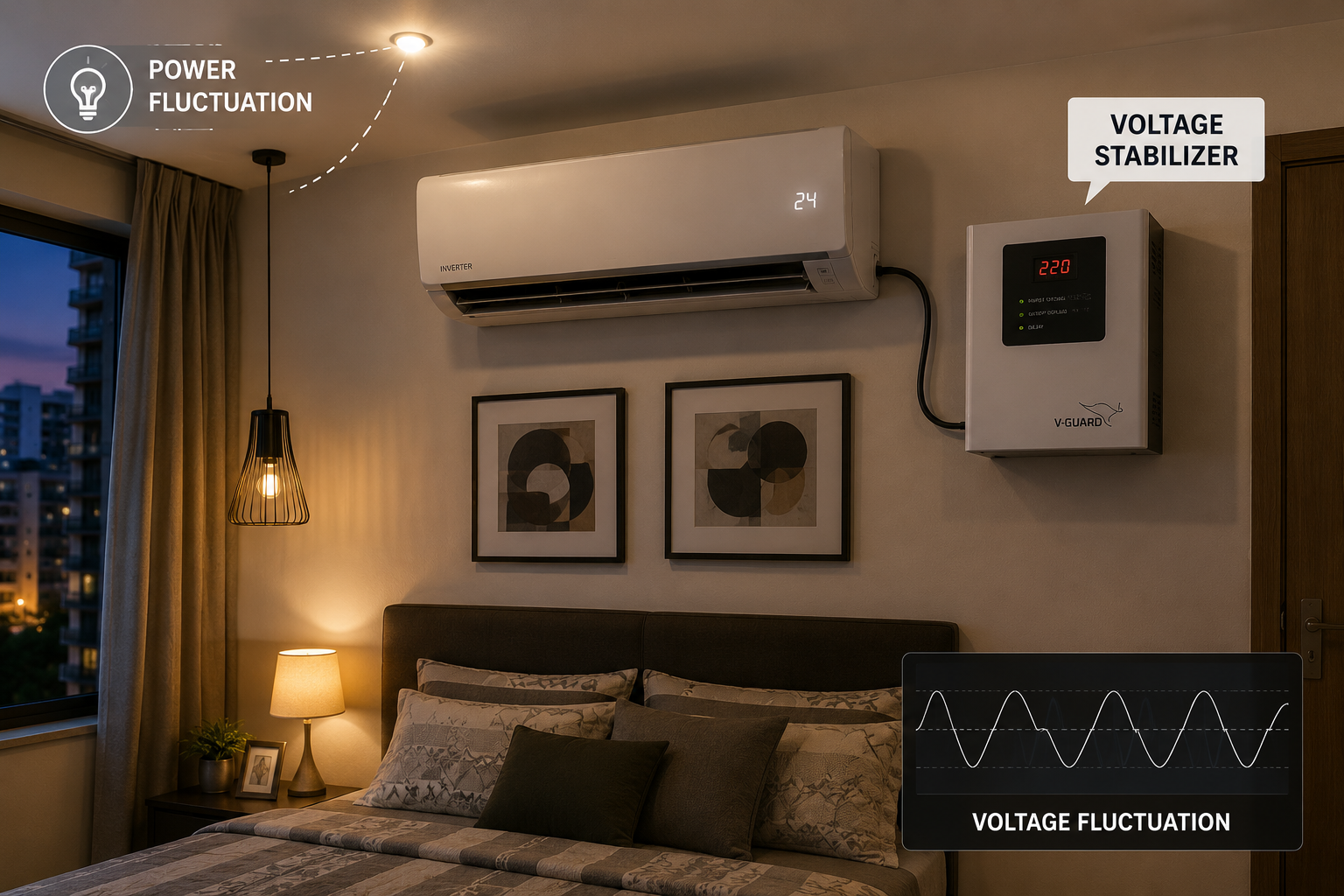
Does AC need stabilizer in India after buying a new inverter AC? The box says ‘stabilizer free operation.’ The salesman tells you that you do not need to buy a separate stabilizer. You come home, get the AC installed, and forget about voltage fluctuations.
A few months later, on a hot afternoon, the AC stops cooling. The technician says the PCB board is damaged. The repair cost is ₹5000 or more. He asks if you used a stabilizer. You say no. He says the voltage fluctuation in your area may have caused the damage.
In some situations, repeated voltage stress can eventually lead to expensive AC repairs or replacement decisions.
This situation is common across India. Modern inverter ACs have built in protection. But Indian voltage conditions can be extreme. So the question is not simple. This guide helps you understand when you need a stabilizer, when you can skip it, and what the risks are in each case.
Table of Contents
What a stabilizer actually does
A voltage stabilizer is a device that regulates the voltage reaching your AC. It takes fluctuating input voltage and delivers a stable output voltage .
For official energy efficiency standards that influence AC design, visit the BEE star rating program website.
How it works
When the incoming voltage drops too low (brownout) or rises too high (surge), the stabilizer detects this. It uses an internal transformer and control circuit to adjust the voltage back to a safe range, typically around 200 to 240 volts for ACs .
Key features of a good AC stabilizer
A stabilizer does not help your AC cool better or consume less electricity. Its only job is protection. A stabilizer does not reduce your electricity bill directly, but it may help avoid voltage related damage during heavy summer AC usage. It shields the AC’s compressor, PCB, and other electronic components from voltage fluctuations.
Servo stabilizer vs relay based stabilizer
There are two main types. Relay based stabilizers are common for home ACs. They use relays to switch between transformer taps. They are affordable and work well for moderate fluctuations. Servo stabilizers use a servo motor to adjust voltage. They are more precise and faster but cost significantly more (₹15,000 to ₹25,000). For a single home AC, a good quality relay based stabilizer is usually sufficient .
When Does AC Need Stabilizer? Situations Where You Can Skip It
Modern inverter ACs, especially from brands like LG, Daikin, Samsung, and Hitachi, come with built in “stabilizer free” operation. The AC has a wide voltage tolerance range. The compressor and control board are designed to handle fluctuations up to a certain limit .
Typical operating ranges of inverter ACs
| Brand or type | Typical operating voltage range |
|---|---|
| LG Dual Inverter | 120V to 290V |
| Most modern inverter ACs | 130V to 285V |
| Premium inverter ACs | 100V to 290V |
If the voltage in your area stays within this range consistently, the built in protection may be sufficient. For many homes, the answer to ‘does AC need stabilizer’ is no under these stable conditions.
You can consider skipping a stabilizer if:
- The AC is a recent model (2022 onwards) from a reputable brand with clear “stabilizer free” specification
- You live in an area with generally stable electricity. Metro cities with modern infrastructure often have fewer fluctuations
- Your home has a constant voltage transformer (CVT) or a high quality UPS for the whole house
- You are willing to accept the risk of PCB or compressor damage from rare voltage events
Important caution
Even with a stabilizer free AC, the protection range has limits. If your area experiences voltage below 100V (common in some rural areas or during peak summer load shedding) or above 300V (possible due to neutral failure or transformer issues), the built in protection may not be enough .
When Does AC Need Stabilizer? Strong Reasons to Buy One
Indian power supply is not uniform. This is why the question ‘does AC need stabilizer’ has a different answer in different homes. Many areas, including parts of Tier 1 cities, face regular fluctuations. In these cases, an external stabilizer adds a layer of protection that can save you from expensive repairs .
You should strongly consider a stabilizer if:
- You live in an area with frequent voltage fluctuations. Signs include lights dimming or brightening, fans slowing down and speeding up, or the AC shutting off and restarting on its own
- Your area experiences very low voltage, below 130V. This is common in summer evenings when many homes run ACs and the local transformer is overloaded
- You live in a rural area or a part of a city with old infrastructure
- Your building has no three phase connection or the phases are unbalanced
- The AC is an older non inverter model. These have a narrower operating range and are more vulnerable to fluctuations
- You want complete peace of mind and are willing to spend ₹3000 to ₹5000 for protection
The cost of not using a stabilizer
PCB boards in inverter ACs are expensive to replace. Depending on the brand, a PCB can cost ₹6000 to ₹25,000 or more . Compressor replacement is even higher, ₹10,000 to ₹40,000 depending on brand and capacity .
A good quality stabilizer costs ₹2500 to ₹5000. This is a one time expense. Compare this to a single PCB repair that can cost ₹5000 to ₹15000. In many homes with unstable voltage, a stabilizer may recover its cost if it helps avoid even one major voltage-related repair.
What Electricians Usually Recommend in Older Buildings
Many Indian homes are in buildings with older electrical infrastructure. Electricians who work in these buildings regularly observe the same patterns:
Older apartments (15-20+ years old)
The wiring may not have been designed for multiple high-power appliances like ACs, geysers, and microwaves running simultaneously. Voltage drops are common when several units in the same building run ACs at night.
Shared transformer load
In many colonies and apartment complexes, one transformer serves multiple buildings. During summer evenings, when most residents run ACs, the transformer becomes overloaded. Voltage can drop from 220V to below 150V during peak hours.
Summer evening voltage drops
This is the most common complaint. Voltage is fine at 10 AM. By 8 PM, with everyone’s AC running, lights dim and fans slow down. ACs start struggling. Inverter ACs may try to compensate, but repeated low-voltage operation stresses the PCB.
Older wiring with loose connections
Loose connections in the main line or meter box can cause intermittent voltage fluctuations that are hard to trace. One day the voltage is fine. The next day, it drops randomly.
What electricians say: In older buildings or areas with known summer voltage drops, most experienced electricians recommend a stabilizer — even for “stabilizer free” inverter ACs. They have seen too many PCB failures caused by repeated low-voltage stress.
Voltage fluctuation signs to watch for
Low voltage is one of the most common power problems during Indian summers.
When voltage drops too low, the AC compressor struggles to start or keeps restarting repeatedly. Inverter ACs try to compensate by adjusting compressor speed, but continuous operation under unstable voltage can stress the PCB and compressor over time.
Common low voltage symptoms include:
- AC shutting off and restarting repeatedly
- Lights dimming when compressor starts
- Weak cooling during evening hours
- Outdoor unit making clicking sounds
Modern inverter ACs are more tolerant than older non inverter models. But if voltage regularly falls below the AC’s specified operating range, long term damage risk increases.
This is why many technicians still recommend stabilizers in areas with known summer voltage drops, even for stabilizer free inverter ACs.
Even if you decide not to use a stabilizer, you should monitor your power conditions. These signs indicate that voltage fluctuations are occurring in your home.
Common signs of voltage issues
- Lights flicker or dim noticeably when the AC compressor turns on or off
- The AC restarts on its own after a few minutes even though you did not turn it off
- The digital display on your AC flickers or shows error codes
- Other appliances like fans, lights, or the refrigerator behave inconsistently
- The stabilizer (if you have one) clicks frequently or shows voltage readings below 140V or above 270V
How to check your voltage
If you have a multimeter or a plug in voltage meter, check the voltage at different times of day. Morning may be fine. Summer evening when many neighbours run ACs may show a drop. Note the lowest and highest readings over a week.
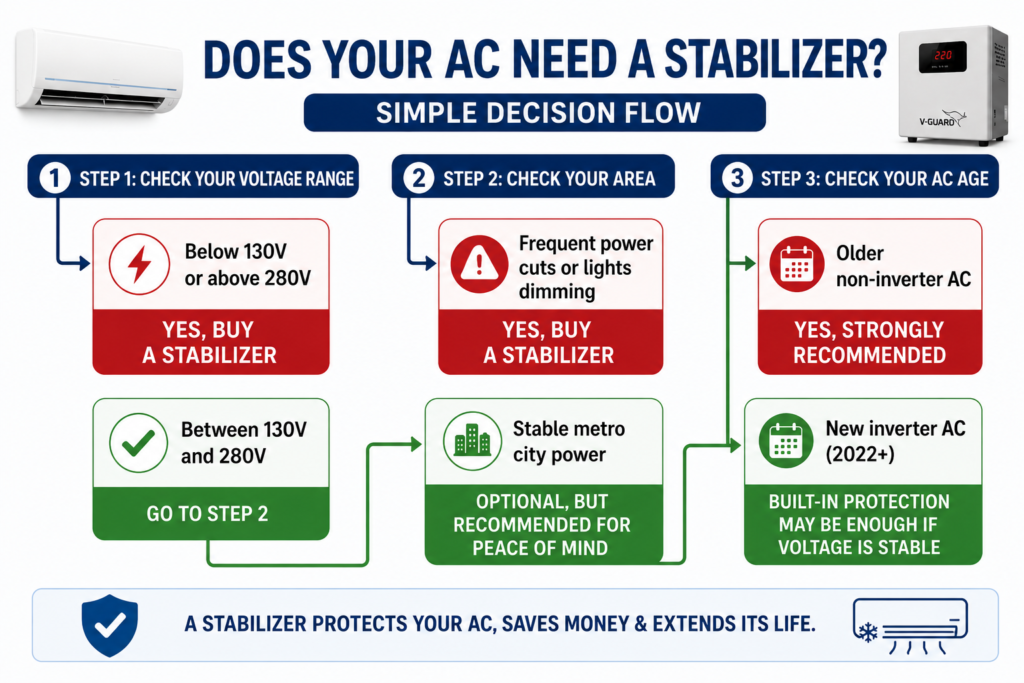
If the voltage drops below 130V or rises above 280V at any time, your AC is at risk. A stabilizer is recommended.
Before Skipping a Stabilizer, Check These 3 Things
Even if your AC says “stabilizer free,” verify your home’s actual conditions before deciding.
1. Voltage range throughout the day
- Check voltage at 10 AM (low load)
- Check voltage at 8 PM (peak AC usage time)
- Check voltage on a Sunday afternoon (different load pattern)
- If voltage drops below 130V or rises above 280V at any time → buy a stabilizer
2. Power cuts in your area
- Frequent power cuts (2-3 times per week) → higher risk of voltage surges when power is restored
- ACs without a stabilizer may restart immediately while compressor is under pressure → damage risk
- Frequent power cuts → stabilizer with time delay is strongly recommended
3. Dimming lights when AC starts
- Turn on your AC. Watch the room lights.
- If lights dim noticeably for 1-2 seconds → voltage drop is significant
- If this happens every time the compressor starts → stabilizer recommended
- This is a simple no-tool test that reveals voltage weakness
If you check all three and everything is stable → skipping stabilizer may be safe.
If any of these three shows a problem → buy a stabilizer.
Stabilizer vs PCB repair cost comparison
This comparison shows the financial risk of not using a stabilizer.
PCB repair and replacement costs by brand (2026 estimates)
What this means for your decision
The cost of a stabilizer is between ₹2500 and ₹5000. The cost of a single PCB repair is typically ₹5000 to ₹15000. The cost of a compressor replacement can exceed ₹25000. If a stabilizer helps prevent even one PCB failure in 5 to 7 years, it will likely have paid for itself. If it prevents a compressor failure, the saving is even larger.
A caution
A stabilizer reduces the risk of voltage related damage. It does not eliminate all risks. Lightning strikes, very high voltage spikes from transformer neutral failure, or manufacturing defects can still damage the AC. But for regular day to day voltage fluctuations, a stabilizer provides effective protection.
This matters even more for homes where the AC runs for many hours every day during peak summer.
Common myths about inverter ACs and stabilizers
Myth 1: Inverter ACs do not need stabilizers at all
This is not fully correct. Inverter ACs have wider voltage tolerance than non inverter models. But this tolerance has limits. If your area experiences voltage below 100V or above 290V, the AC can still be damaged. A stabilizer extends protection beyond the AC’s built in range.
Myth 2: A stabilizer uses a lot of electricity
This is not correct. A good quality stabilizer consumes very little power. Most AC stabilizers draw less than 10 to 20 watts under normal operation. This is negligible compared to the AC’s consumption of 1500 to 2000 watts.
Myth 3: Any stabilizer works for any AC
This is not correct. Stabilizers have different current and power ratings. A stabilizer meant for a 1 ton AC may overload and fail if used with a 2 ton AC. Always match the stabilizer rating to your AC capacity .
Myth 4: Stabilizer protects from lightning
This is partially correct. Standard home stabilizers include some surge protection. But they cannot fully protect against a direct lightning strike or a very high voltage surge from the grid. For complete protection, you would need a dedicated surge protection device.
Best stabilizer capacity for 1 ton, 1.5 ton, and 2 ton ACs
If you decide to buy a stabilizer, the correct capacity is important.
Stabilizer capacity chart
What to look for when buying
- Wide input voltage range: For areas with severe fluctuations, look for 90V to 300V range . For moderate fluctuations, 140V to 280V is acceptable
- Time delay of 2 to 3 minutes: Prevents compressor damage from rapid power restoration
- Thermal overload protection: Shuts down if the stabilizer overheats
- Compatibility with inverter AC: Not all stabilizers work well with inverter ACs. Check the packaging or description for “inverter compatible”
- Digital display: Helps you monitor voltage levels and detect problem conditions early
- ISI mark: Ensures basic safety standards
Brands to consider
Reliable brands for AC stabilizers in India include V-Guard, Microtek, Keeline, Voltas, and Luminous . These brands have wide service networks and reasonable prices.
Quick recommendation
- Stable metro city voltage + modern inverter AC → stabilizer may be optional
- Frequent fluctuations or power cuts → stabilizer recommended
- Older non inverter AC → stabilizer strongly recommended
- Rural or low voltage areas → stabilizer usually worth the protection cost
What you should do now
Here is a step by step approach to decide for your home.
Step 1: Check your AC manual
Look for the section on “operating voltage range” or “stabilizer free operation.” Note the lower and upper limits. Common ranges are 120V to 290V or 130V to 285V .
Step 2: Observe your home voltage for a week
At different times of day (morning, afternoon, evening, night), check the voltage if you have a meter. Or notice signs like lights dimming, fans slowing, or the AC behaving unusually.
Step 3: Compare voltage range with AC tolerance
If your observed voltage stays within the AC’s specified range, you may be safe without a stabilizer. If voltage regularly falls below the lower limit or rises above the upper limit, buy a stabilizer.
Step 4: Consider your risk tolerance
If you cannot afford a sudden ₹5000 to ₹15000 repair, buy a stabilizer. It is a relatively small one time expense for protection.
Step 5: Buy a stabilizer at least for areas with known fluctuation
If you live in a colony or area where neighbours complain about voltage issues, buy a stabilizer even if your voltage seems fine today. Conditions can change with new buildings or increased load on the local transformer.
Final Answer: Does AC Need Stabilizer in Your Home? (Decision Table)
| Your situation | Recommendation |
|---|---|
| New inverter AC (2022+), stable voltage in your area, voltage stays between 130V and 280V | Stabilizer optional. Built in protection may be sufficient |
| New inverter AC but area has fluctuations (lights dim, fans slow) | Stabilizer recommended |
| Older non inverter AC (pre 2018) | Stabilizer strongly recommended |
| Rural area or area with frequent power cuts | Stabilizer strongly recommended |
| You have a stabilizer from your old AC that is 5+ years old | Consider replacing. Older stabilizers may not have the range or features for inverter ACs |
Common questions asked
Does a stabilizer increase electricity bill
No. A stabilizer consumes very little power, typically 10 to 20 watts. This adds ₹10 to ₹20 per month at normal usage.
Can a stabilizer damage my AC
A poorly made or incorrectly rated stabilizer can cause problems. A stabilizer with a slow response time may not correct voltage quickly enough. A stabilizer rated too low for the AC capacity may overheat and fail. Buy a good quality stabilizer from a reputable brand with the correct rating for your AC.
My AC says stabilizer free. Do I still need one
It depends on your voltage conditions. The AC’s built in protection covers a range. If your voltage stays within that range, you are safe. If it goes outside, the AC is unprotected. Observe your voltage before deciding.
What is the difference between a stabilizer and a surge protector
A surge protector only protects from voltage spikes (very high voltage for a short duration). A stabilizer handles both low and high voltage conditions continuously.
My area has frequent power cuts. Do I need a stabilizer
Yes. Power cuts are often followed by voltage surges when power is restored. A stabilizer with a time delay function gives the compressor 2 to 3 minutes to stabilize before restarting. This is important protection. Without a stabilizer, the AC may restart immediately after power is restored while the compressor is still under high pressure. This can damage the compressor.
Voltage protection is only one part of reducing long term AC ownership cost. Temperature settings, servicing, electricity usage, and installation quality also affect reliability and monthly running cost.
Related reads
These articles may help you with other AC related decisions.
Leave a Reply