
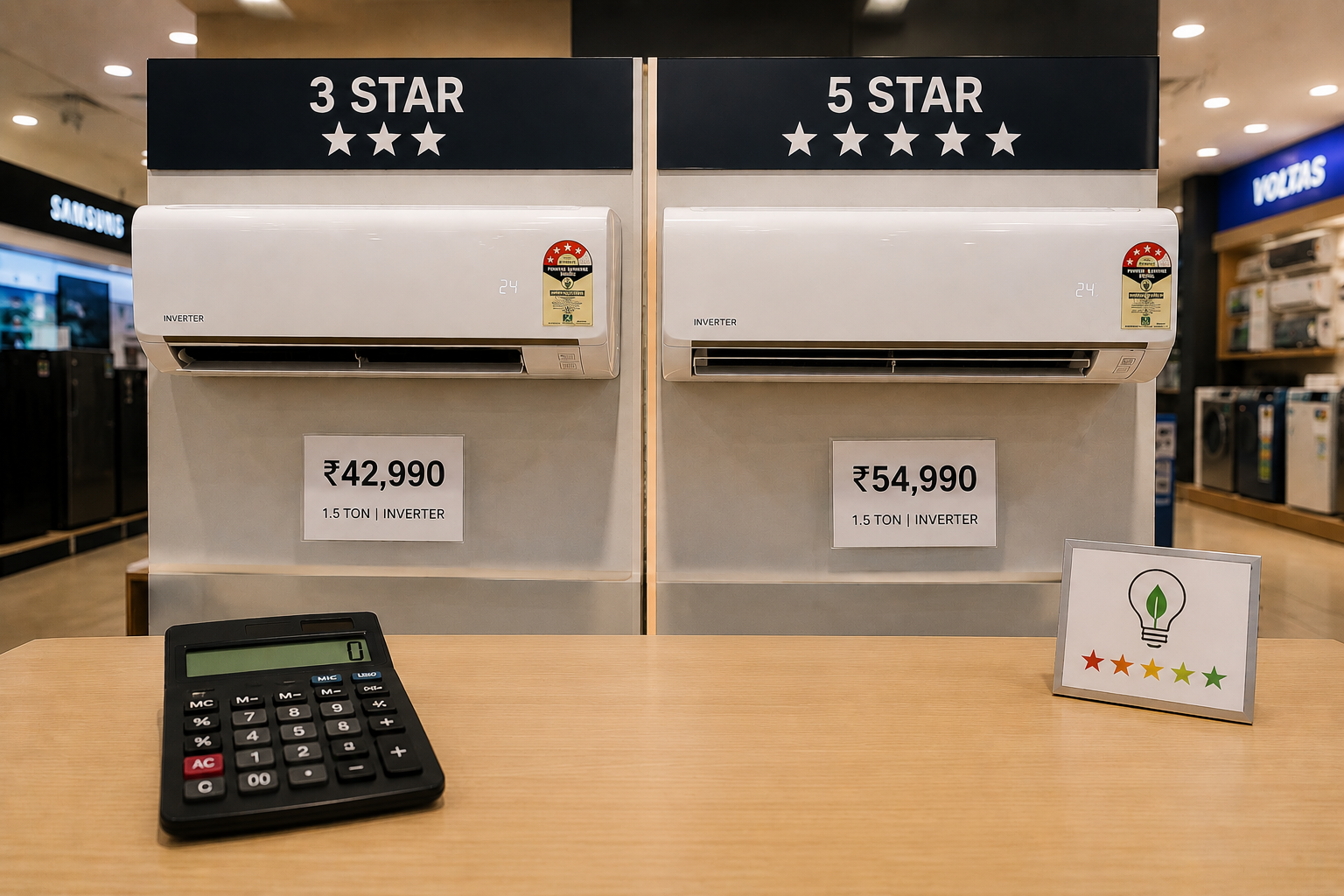
You walk into an electronics store for a 3 star vs 5 star AC comparison. Two ACs catch your attention. Same brand. Same tonnage. Same type. One has a 3 star rating. The other has a 5 star rating. The 5 star model costs ₹5000 more. The salesman says you will recover the difference through electricity savings.
You wonder if this is true. Will you actually save ₹5000 in electricity over the life of the AC? Or will the 3 star model be more cost effective for your usage?
This guide compares 3 star and 5 star ACs in real terms. It looks at electricity consumption, monthly and annual costs, and total cost over 5 years. Based on your usage pattern, you can decide which one makes more sense for your home.
Table of Contents
What Star Ratings Mean in 3 Star vs 5 Star AC Comparison
Star ratings in India are assigned by the Bureau of Energy Efficiency (BEE). For the official standards and current star rating guidelines, visit the BEE star rating program website.
The rating is based on the Energy Efficiency Ratio (EER) for older models or the Indian Seasonal Energy Efficiency Ratio (ISEER) for newer inverter models.
A 5 star AC is more efficient than a 3 star AC. It converts more of the electricity it consumes into cooling. Less energy is wasted as heat.
What the numbers look like for 1.5 ton inverter ACs (2026 standards)
| Star rating | ISEER range (approx) | Typical annual energy consumption (kWh) |
|---|---|---|
| 3 star | 3.50 to 4.49 | 850 to 1050 units |
| 5 star | 4.50 to 5.49 | 650 to 800 units |
These numbers are from BEE guidelines for a 3 star vs 5 star AC comparison. Actual consumption varies by brand, model, and usage conditions.
Temperature settings also affect electricity use significantly, especially during peak summer months.
Important clarification
Star rating is a measure of efficiency under standard test conditions. Your actual electricity consumption depends on how you use the AC. Room size, insulation, outdoor temperature, temperature setting, and maintenance all affect consumption. A 5 star AC used poorly may consume more electricity than a 3 star AC used wisely.
Real Electricity Consumption Difference in 3 Star vs 5 Star AC
The difference between 3 star and 5 star ACs is not the same for all capacities. Larger ACs show a bigger absolute difference because they consume more electricity overall.
1 ton inverter AC – estimated monthly consumption (8 hours daily)
| Star rating | Monthly units (approx) | Annual units (6 months use) |
|---|---|---|
| 3 star | 180 to 210 | 1080 to 1260 |
| 5 star | 140 to 170 | 840 to 1020 |
1.5 ton inverter AC – estimated monthly consumption (8 hours daily)
| Star rating | Monthly units (approx) | Annual units (6 months use) |
|---|---|---|
| 3 star | 250 to 300 | 1500 to 1800 |
| 5 star | 190 to 240 | 1140 to 1440 |
2 ton inverter AC – estimated monthly consumption (8 hours daily)
| Star rating | Monthly units (approx) | Annual units (6 months use) |
|---|---|---|
| 3 star | 350 to 420 | 2100 to 2520 |
| 5 star | 270 to 340 | 1620 to 2040 |
These numbers are estimates based on moderate usage at 24 to 26 degrees temperature setting. Actual numbers may be higher if you set lower temperatures or run the AC longer.
Monthly and annual difference
For a 1.5 ton AC running 8 hours daily for 6 months:
- 3 star AC annual consumption: approximately 1650 units
- 5 star AC annual consumption: approximately 1290 units
- Difference: approximately 360 units per year
At an electricity rate of ₹7 per unit, the annual saving is approximately ₹2520.
How much extra does a 5 star AC save every month?
For many buyers, yearly savings feel too abstract. Monthly savings are easier to understand.
Here is a rough estimate for a 1.5 ton inverter AC used 8 hours daily during summer months.
| Star rating | Estimated monthly electricity cost |
|---|---|
| 3 star | ₹1750 to ₹2100 |
| 5 star | ₹1350 to ₹1700 |
In many Indian homes, the monthly saving ranges between ₹300 and ₹600 depending on electricity rate, room conditions, and usage habits.
This may not feel dramatic in one month. But across multiple summers and multiple ACs in the same home, the difference becomes significant.
5 year electricity cost comparison
This section shows the total cost of ownership including purchase price and electricity cost over 5 years.
Assumptions used for this comparison
- 1.5 ton inverter split AC
- AC used for 8 hours daily for 6 months per year
- Electricity rate of ₹7 per unit (average across Indian states)
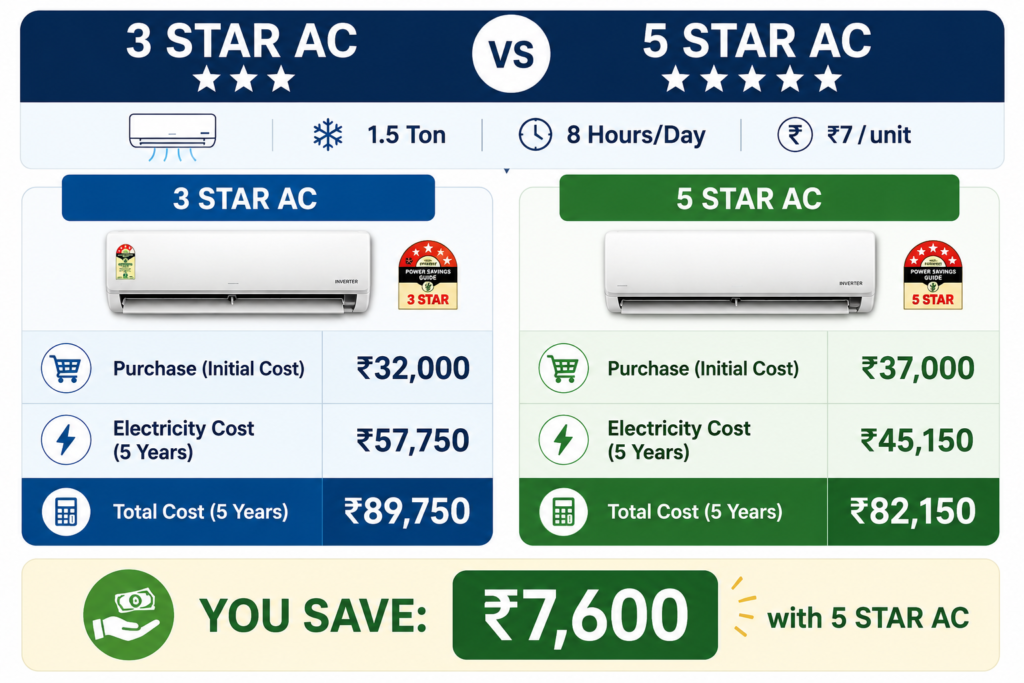
- 3 star AC purchase price: ₹32,000
- 5 star AC purchase price: ₹37,000 (₹5000 higher)
5 year cost calculation – 3 star AC
| Cost component | Amount (₹) |
|---|---|
| Purchase price | ₹32,000 |
| Annual electricity cost | (1650 units × ₹7) = ₹11,550 |
| 5 year electricity cost | ₹11,550 × 5 = ₹57,750 |
| Total 5 year cost | ₹89,750 |
5 year cost calculation – 5 star AC
| Cost component | Amount (₹) |
|---|---|
| Purchase price | ₹37,000 |
| Annual electricity cost | (1290 units × ₹7) = ₹9,030 |
| 5 year electricity cost | ₹9,030 × 5 = ₹45,150 |
| Total 5 year cost | ₹82,150 |
Difference over 5 years
- Total cost of 5 star AC: ₹82,150
- Total cost of 3 star AC: ₹89,750
- Saving with 5 star AC: ₹7,600
Even though the 5 star AC cost ₹5000 more upfront, it saves approximately ₹7600 over 5 years. The net benefit is roughly ₹2600.
What this means
If you use the AC for 8 hours daily for 6 months every year, in many moderate-to-heavy usage situations, the higher upfront cost of a 5 star AC may be recovered through electricity savings in roughly 2 to 3 years. After that, the savings continue.
When 5 star AC makes sense
In the 3 star vs 5 star AC decision, a 5 star AC is more expensive upfront but saves money over time. It makes the most sense in these situations.
You run the AC for more than 6 hours daily
The more you use the AC, the faster the electricity savings add up. A family that runs AC for 10 to 12 hours daily will recover the higher upfront cost in 12 to 18 months.
You live in a state with high electricity rates
In states like Maharashtra, Tamil Nadu, or Karnataka where per unit rates exceed ₹8 or ₹9, the annual saving from a 5 star AC is larger. At ₹9 per unit, the annual saving for a 1.5 ton AC is roughly ₹3240 instead of ₹2520.
You plan to keep the AC for 7 to 10 years
The longer you keep the AC, the more you benefit from the lower electricity consumption. Over 10 years, the saving from a 5 star AC can exceed ₹15,000 to ₹20,000 depending on usage.
You have multiple ACs in your home
If your home has two or three ACs, buying 5 star models for all of them multiplies the savings. The higher upfront cost may feel significant, but the cumulative electricity saving each year is also larger.
You are buying a 2 ton AC
Larger ACs consume more electricity. The absolute difference between 3 star and 5 star models is larger for 2 ton ACs. The payback period is shorter.
When 3 star AC is smarter
A 3 star AC is cheaper upfront but consumes more electricity. It makes more sense in these situations.
You run the AC for less than 4 hours daily
If you use the AC only in the evenings for a few hours or only on weekends, the electricity saving from a 5 star model will be small. It may take 5 to 7 years to recover the higher upfront cost. If you do not plan to keep the AC that long, the 3 star model is more cost effective.
You live in a moderate climate (hill stations or coastal areas with cool summers)
In cities like Ooty, Shimla, Manali, or in coastal areas where summer temperatures rarely exceed 35 degrees, AC usage is limited to a few weeks or a few hours per day. The electricity saving from a 5 star AC in these conditions is too small to justify the higher price.
You are on a tight budget and need an AC immediately
A 3 star AC may be the only option within your budget. Buying a 3 star AC and using it wisely (24 degrees temperature, clean filters, fan assistance) can still keep your electricity bill reasonable.
The 5 star model has a very high premium
In some cases, the price difference between 3 star and 5 star models exceeds ₹8000 or ₹10,000. At this premium, the payback period extends to 4 or 5 years. A 3 star model may be a better financial choice unless you run the AC heavily.
You are buying for a rental property or a room that is rarely used
If the AC is for a guest bedroom used only a few times a year, the 5 star model will never recover its higher cost. A 3 star model is sufficient.
Biggest myth about 5 star ACs
Myth: A 5 star AC will cut my electricity bill by half
This is not correct. The difference between 3 star and 5 star is typically 15 to 25 percent, not 50 percent. If your AC electricity bill is ₹3000 per month, switching from a 3 star to a 5 star model may bring it down to ₹2400 to ₹2550 per month. This is a meaningful saving, but it is not a dramatic reduction.
Myth: A 5 star AC consumes very little electricity
A 5 star AC still consumes significant electricity. A 1.5 ton 5 star inverter AC running for 8 hours daily consumes roughly 190 to 240 units per month. At ₹7 per unit, that is ₹1330 to ₹1680 per month. This is lower than a 3 star model, but not negligible.
Myth: Star rating is the only thing that matters
Star rating is important. But usage habits matter just as much. A 3 star AC used at 26 degrees with a ceiling fan and clean filters can consume less electricity than a 5 star AC used at 18 degrees with dirty filters. The efficiency of the machine matters, but how you use it matters more.
What most buyers overlook
These factors affect your electricity bill as much as the star rating.
Room insulation
Better insulated rooms lose less cool air. A 5 star AC in a poorly insulated room may still have a high electricity bill. Check for gaps under doors, single pane windows, and uninsulated walls. Curtains, door sweeps, and window seals are inexpensive improvements.
Usage habits
Temperature setting, use of ceiling fans, and how often doors are opened affect consumption more than star rating in many cases. A user who follows best practices with a 3 star AC may have a lower bill than a user who ignores best practices with a 5 star AC.
Regular servicing
A dirty filter or low gas makes any AC run longer. A 5 star AC with dirty filters may lose enough efficiency to perform like a 3 star AC. Annual servicing and monthly filter cleaning protect your investment.
Installation quality
For split ACs, poor installation with air or moisture in the copper pipes reduces efficiency. This affects 5 star ACs as much as 3 star ACs. Ensure the technician uses a vacuum pump and does proper flaring.
Poor installation can reduce cooling efficiency even in premium 5 star inverter ACs.
Voltage stability
In areas with frequent voltage fluctuations, the AC may run less efficiently. A stabilizer helps protect the AC and maintain efficiency. Some inverter ACs have built in wide voltage range operation.
Quick recommendation
- Use AC daily for 8+ hours → 5 star usually makes sense
- Use AC occasionally or weekends only → 3 star is often enough
- High electricity rate area → 5 star gives faster payback
- Tight upfront budget → 3 star may be more practical
Final decision framework
Use this step by step process to decide between 3 star and 5 star.
Step 1: Estimate your daily AC usage in peak summer
- Less than 4 hours per day → 3 star likely sufficient
- 4 to 7 hours per day → consider both, calculate payback
- 8 or more hours per day → 5 star recommended
Step 2: Check your electricity rate
Open your last electricity bill. Look at the per unit rate for your consumption slab. If the rate is ₹6 or lower, the saving from 5 star is smaller. If the rate is ₹8 or higher, 5 star makes more sense.
Step 3: Compare the price difference
Check online prices for the same brand and tonnage. If the difference is ₹3000 to ₹5000, 5 star is reasonable. If the difference exceeds ₹8000, the payback period extends significantly.
Step 4: Consider how long you will keep the AC
- Keeping for 3 to 4 years → 3 star may be better
- Keeping for 5 to 7 years → calculate payback
- Keeping for 8+ years → 5 star usually better
Step 5: Make your 3 star vs 5 star AC choice based on these guidelines
| Your situation | Recommendation |
|---|---|
| Daily AC use 8+ hours, electricity rate ₹7+, keep for 7+ years | 5 star |
| Daily AC use 6 to 8 hours, moderate electricity rate | 5 star if budget allows, otherwise 3 star |
| Daily AC use 3 to 5 hours, modest budget | 3 star |
| Occasional use (weekends or only peak summer weeks) | 3 star |
| Rental property or guest room | 3 star |
This framework is a guideline. Your specific numbers may differ.
Common questions asked
How many years to recover the higher cost of a 5 star AC
For a 1.5 ton AC used 8 hours daily for 6 months, with electricity at ₹7 per unit, the payback period is approximately 2 years.
Does a 5 star AC cool better than a 3 star AC
Star rating measures efficiency, not cooling power. A 3 star and 5 star AC of the same tonnage have similar cooling capacity. The difference is how much electricity they use to provide that cooling.
Should I replace my old 3 star AC with a new 5 star AC
It depends. If your 3 star AC is less than 5 years old, replacing it will cost more than the electricity savings. If your AC is 8 to 10 years old and inefficient, a new 5 star model may save you enough in electricity to justify replacement.
What is the difference in price between 3 star and 5 star
The difference varies by brand and capacity. For 1.5 ton inverter split ACs, the difference is typically ₹3000 to ₹7000. Premium brands may have a larger gap.
Can I check the exact annual consumption of a model before buying
Yes. The BEE star label on the AC shows the estimated annual energy consumption in kilowatt hours. This number is for standard test conditions (1600 hours of operation per year). Use this number to compare models within the same tonnage.
Star rating is only one part of long-term AC ownership cost. Installation quality, servicing, usage habits, room insulation, and temperature settings all affect the final electricity bill.
Related reads
These articles provide more detail on AC electricity consumption and purchase decisions.
Leave a Reply to Stop High Bills: 85% Less Cooler Electricity Consumption Per Month India Cancel reply