
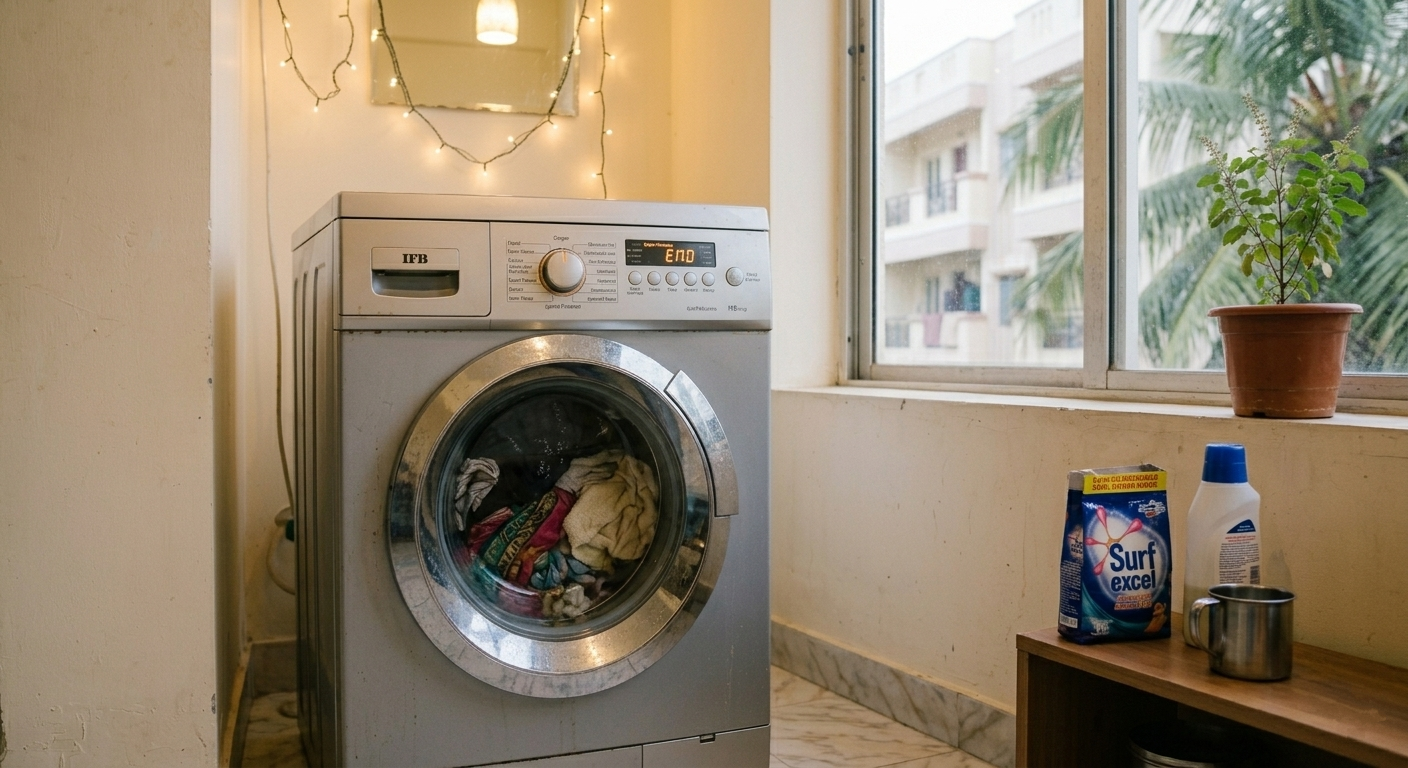
A washing cycle finishes, but when you open the door, your clothes are dripping wet. The drum did not spin. This is frustrating. Before panic sets in, you need to understand washing machine not spinning repair cost, because some fixes are cheap, and others mean it’s time for a new machine.
In some situations, it also helps to compare washing machine repair vs replacement cost in India before deciding whether a major repair is financially practical.
Many people search phrases like ‘washing machine not spinning but draining’ or ‘is it worth repairing a washing machine motor’ because the repair cost can vary widely depending on the problem.
This guide explains the typical reasons a washing machine stops spinning, what you can expect to pay for repairs in different Indian cities, and a balanced way to think about repair versus replacement. The goal is not to give you a fixed answer. The goal is to help you make a decision based on your machine’s age, the repair cost, and your own situation.
Table of Contents
Quick Answer: What Is Washing Machine Not Spinning Repair Cost?
Most washing machine spin problems in India cost between ₹500 and ₹2,500 to repair, especially when caused by drain blockages, loose belts, or sensor issues. More expensive repairs like motor or control board replacement may cost ₹4,000 to ₹10,000 or more depending on the brand and machine age.
Before you call a technician, know this: washing machine not spinning repair cost typically falls between ₹500 and ₹2,500 for 80% of problems.
This is not a fixed quote. Actual repair cost depends on the machine type, spare parts availability, technician pricing, and your city.
Common Reasons Behind Washing Machine Not Spinning Repair Cost
Not every spinning problem means a major failure. In fact, many causes are simple and inexpensive to fix. Here are the most common issues reported by service technicians across India.
Overloaded drum
Putting too many clothes inside prevents the drum from rotating freely. The machine detects this and stops the spin cycle to protect the motor.
Unbalanced load
When heavy items like bedsheets or jeans gather on one side, the drum becomes unbalanced. The machine will not spin at high speed because it would shake excessively.
Drain blockage
If water does not drain completely, the spin cycle will not start. Most machines have a safety feature that prevents spinning when water remains in the drum.
Broken belt (common in older non direct drive models)
A worn or snapped belt means the motor cannot turn the drum. This is more common in machines that are 6 or more years old.
When you search for washing machine not spinning repair cost, belt replacement is one of the most common and affordable fixes.
Lid switch or door sensor issue
The machine needs to detect that the door is fully closed before spinning. A faulty sensor or a misaligned lid will stop the cycle.
Motor or capacitor issue
The capacitor helps the motor start and run. If it fails, the drum may not spin. Motor problems are less common but more expensive to fix.
Faulty control board (less common)
In fully automatic machines, the electronic control board manages all cycles. A board failure can prevent spinning. This repair is usually expensive.
A practical observation: In many households, the problem is either a blocked drain, an overloaded drum, or a loose belt. These are not major failures. A technician can usually identify the issue within 15 to 20 minutes.
When a Spin Problem Is Probably Minor vs Serious
Not every spin issue demands an expensive repair. This quick guide helps you understand what you might be dealing with before a technician arrives.
Probably Minor (Low Repair Cost)
- Unbalanced load – redistribute clothes
- Drain blockage – clean the filter or hose
- Overloading – remove some clothes and try again
- Loose belt – replacement is ₹800 to ₹2,000
Possibly Serious (Higher Repair Cost)
- Burning smell during spin cycle
- Loud grinding or scraping noise
- Control board failure – ₹4,000 to ₹10,000+
- Motor not responding – ₹3,000 to ₹7,000+
If you notice anything in the serious category, do not keep using the machine. Running it with a failing motor or worn bearing can damage other components and increase your final washing machine not spinning repair cost.
How Long Can You Continue Using a Machine With Spin Problems?
A washing machine that occasionally skips the spin cycle may continue working temporarily, especially if the issue is load imbalance or drainage related. You might get weeks or even months of partial function from a machine with a loose belt or intermittent sensor issue.
However, continuing to use a machine with persistent motor noise, burning smell, or repeated failed spin cycles can place additional stress on internal components. A ₹2,000 belt problem can become a ₹7,000 motor problem if ignored.
If the problem repeats frequently, more than once or twice a week, it is usually safer to get an inspection before using the machine heavily again. The few hundred rupees for a diagnostic visit is worth avoiding a much higher washing machine not spinning repair cost later.
Why Your Machine Washes But Does Not Spin (A Key Factor in Repair Cost)
This specific situation confuses many people. The machine fills with water. The drum moves back and forth. The wash cycle completes. But when it reaches the spin stage, nothing happens or the drum moves very slowly.
In most cases, this happens because:
- The drain pump is clogged or not working. Water remains inside. The machine will not spin until the water is gone.
- The belt is loose. The motor runs, but the belt slips and does not turn the drum fast enough.
- The lid switch is intermittent. The machine thinks the door opened during the spin cycle and stops for safety.
- The machine is in a pause or soak mode. Some models have a built in pause before spinning. Waiting a few minutes may resolve it.
If the machine completes the wash cycle but leaves clothes soaking wet, start by checking the drain hose for kinks or blockages. That is the simplest possible cause.
This specific failure pattern directly affects washing machine not spinning repair cost because drain issues are cheap to fix, but motor problems are not.
Signs Your Washing Machine May Need Attention Before Repair Cost Rises
These early signs do not guarantee failure. But they suggest that a component is wearing out. Noticing them early may give you time to plan instead of dealing with a sudden breakdown.
- Clothes come out noticeably wetter than before, even on the same settings
- The machine makes a louder than usual noise during the spin cycle
- The drum starts and stops repeatedly instead of spinning continuously
- A burning smell comes from the machine, especially during spinning
- The machine vibrates or moves across the floor during spin
- The spin cycle takes much longer than it used to
If you notice any of these, consider having the machine inspected when you have time. Waiting until it stops completely may leave you with a pile of wet clothes and no immediate solution.
Ignoring these signs won’t save you money, it often increases washing machine not spinning repair cost by allowing minor damage to spread.
Washing Machine Not Spinning Repair Cost in India (2026 Estimates)
Repair costs vary by city, by technician, and by the brand of your machine. The numbers below are based on service data from major Indian cities including Chennai, Mumbai, Delhi, Bengaluru, and Hyderabad. These are typical ranges, not fixed prices.
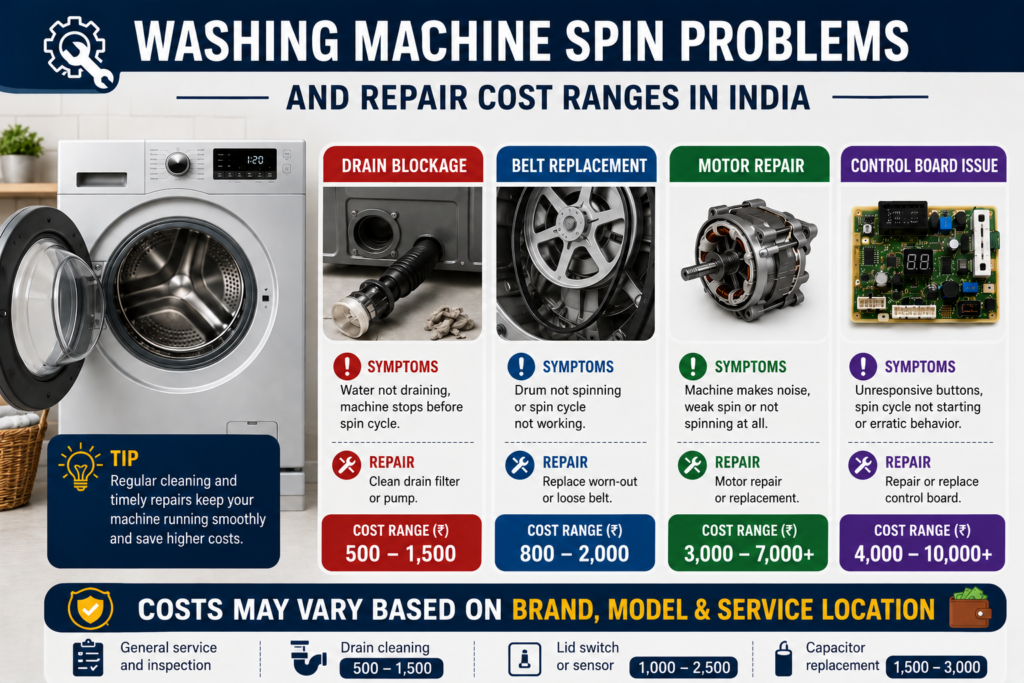
General service and inspection
₹300 to ₹800
Most technicians charge a visit fee that includes basic inspection. Some waive or adjust it if you approve the repair.
Drain cleaning or unblocking
₹500 to ₹1,500
This includes clearing the drain hose, drain pump filter, or removing a small object stuck in the pump.
Belt replacement
₹800 to ₹2,000
The belt itself costs ₹300 to ₹800. The rest is labour. More common in older semi automatic or non direct drive fully automatic machines.
Lid switch or door sensor replacement
₹1,000 to ₹2,500
The sensor part is usually ₹500 to ₹1,200. Labour adds the rest.
Capacitor replacement
₹1,500 to ₹3,000
The capacitor helps the motor start. Failure is more common in areas with voltage fluctuations.
Motor repair
₹3,000 to ₹7,000 or more
Motor rewinding or replacement is the expensive category. For some lower cost machines, motor repair may approach half the price of a new unit.
Control board repair or replacement
₹4,000 to ₹10,000 or more
This is the highest cost repair for fully automatic machines. Board replacement often exceeds the practical value of an older machine.
Summary Table of Typical Repair Costs
| Problem | Typical cost range (₹) |
|---|---|
| General service and inspection | 300 – 800 |
| Drain cleaning | 500 – 1,500 |
| Belt replacement | 800 – 2,000 |
| Lid switch or sensor | 1,000 – 2,500 |
| Capacitor replacement | 1,500 – 3,000 |
| Motor repair | 3,000 – 7,000+ |
| Control board repair | 4,000 – 10,000+ |
Important caution: These are averages. A technician in a smaller town may charge less. A premium brand service centre in a metro may charge more. Always ask for a written estimate before approving work.
How to Decide Based on Washing Machine Not Spinning Repair Cost
There is no single rule that works for every household. But these guidelines can help you think through the decision.
Situations Where Repair Often Makes Sense
- The machine is less than 5 years old
- The problem is minor (belt, drain blockage, capacitor, lid switch)
- The repair cost is under ₹2,500 to ₹3,000
- The machine was working fine before this issue appeared
- You have a trusted local technician who charges reasonable rates
Situations Where Replacement May Be Worth Considering
- The motor or control board has failed, and repair cost exceeds ₹5,000 to ₹6,000
- The machine is 7 to 10 years old or older
- This is the third or fourth repair in the last 12 to 18 months
- The machine is a lower cost model where a new unit costs only ₹12,000 to ₹15,000
- Spare parts for your brand are hard to find in your city
Your decision should always start with one question: does the estimated washing machine not spinning repair cost exceed 40% of a new machine’s price?
A Word on Electricity Efficiency
Older washing machines, especially those 8 to 10 years old, tend to use more water and electricity compared to newer models. A modern 5 star rated machine typically consumes less power per cycle. However, the electricity saving alone is rarely enough to justify replacing a working machine. The saving becomes a meaningful factor only when you are already considering replacement for performance or repair reasons.
Electricity efficiency differences become easier to understand when you compare them with other high-consumption appliances at home. This guide on what appliances consume the most electricity at home in India explains where washing machines usually fit.
For verified efficiency standards, check the BEE star rating standards for appliances on the official Bureau of Energy Efficiency website.
Quick Decision Table: When Does Repair Make Sense?
This table helps you think through whether a repair is worth approving based on the specific problem and your machine’s age.
| Situation | Repair Usually Makes Sense? |
|---|---|
| Drain blockage | Yes – cheap and effective |
| Belt replacement | Yes – parts are affordable |
| Capacitor issue | Usually yes – ₹1,500 to ₹3,000 |
| Lid switch or sensor | Usually yes – unless machine is very old |
| Motor replacement on 10-year-old machine | Often no – cost approaches new machine value |
| Control board replacement on low-cost machine | Often no – board costs ₹4,000 to ₹10,000+ |
| Minor sensor issue | Yes – quick and inexpensive |
Use this as a starting point. Get a written estimate. If the repair cost exceeds ₹5,000 and your machine is over 7 years old, ask yourself honestly whether putting that money toward a new machine makes more sense for your household.
What You Can Do Now (Step by Step)
Before calling a technician, spend 10 minutes on basic checks. Many problems stop at this stage.
Step 1: Reduce the load
Remove half the clothes. Run a short spin cycle. If it works, you have been overloading.
Step 2: Balance the clothes
Open the drum. Spread heavy items evenly. Remove any single heavy item like a wet blanket that may be causing imbalance.
Step 3: Check the drain hose
Look behind the machine. Ensure the drain hose is not kinked or blocked. If your machine has a drain filter (usually behind a small door at the bottom front), clean it.
Step 4: Check the lid or door
Close the lid firmly. On front load machines, ensure the door is fully latched. If the machine starts normally but stops when spinning, the door sensor may be faulty.
Step 5: Listen for unusual sounds
Run a spin cycle with no clothes. If you hear scraping or grinding, something may be stuck in the drum or the bearing may be failing.
Step 6: Call a technician for inspection
If basic checks do not help, call a technician. Ask for a diagnosis and a written estimate before approving any repair.
This becomes especially important for older appliances where repair costs may slowly add up over time, similar to the situations discussed in refrigerator repair vs replacement decision guide for India.
Step 7: Compare the estimate with the machine’s age
Use the guidelines above. A low cost repair on a relatively new machine is almost always worth doing. A high cost repair on an old machine may not be.
Once you have an estimate in hand, compare that washing machine not spinning repair cost against your machine’s age using the table below.
Simple Habits That Reduce Your Future Repair Cost
These habits do not guarantee that your machine will never break. But they reduce the load on components and may help avoid some common failures.
- Do not overload the drum. Leave some space for clothes to move.
- Clean the drain filter every 2 to 3 months.
- Use the correct wash mode for different fabric types.
- Do not wash single heavy items (like one bedsheet) alone. Add a few towels to balance the load.
- Use a voltage stabilizer if your area has frequent fluctuations. This protects the control board and motor.
- Level the machine using its adjustable feet. An unsteady machine puts stress on the drum and bearings.
Quick Reference: Cost Range by Problem and Approximate Age of Machine
| Problem | Typical repair cost | Machine under 5 years | Machine 7+ years |
|---|---|---|---|
| Drain blockage | ₹500 – ₹1,500 | Repair | Repair unless other issues exist |
| Belt replacement | ₹800 – ₹2,000 | Repair | Repair |
| Lid switch or sensor | ₹1,000 – ₹2,500 | Repair | Consider replacement if other problems exist |
| Capacitor | ₹1,500 – ₹3,000 | Repair | Repair |
| Motor repair | ₹3,000 – ₹7,000+ | Consider based on exact cost | Usually replace |
| Control board | ₹4,000 – ₹10,000+ | Consider based on machine value | Usually replace |
This table is a guideline, not a rule. Your decision may differ based on the brand, the machine’s condition, and your budget.
Common Questions About Washing Machine Not Spinning Repair Cost
Why is my washing machine not spinning but draining normally?
If water drains but the drum does not spin, check the belt (if your machine has one) or the capacitor. In direct drive models, the issue may be with the motor control board or the lid switch.
How much does washing machine repair cost in India for spin problems?
Most common spin problems cost between ₹500 and ₹2,500 to repair. Motor or control board issues cost more, typically ₹3,000 to ₹7,000 or higher depending on the brand.
How long does a washing machine typically last in Indian conditions?
With regular use and average maintenance, a washing machine lasts 7 to 10 years. Machines in areas with hard water or voltage fluctuations may have a shorter life. Machines used gently in smaller households may last longer.
Voltage instability can affect motors, sensors, and electronic boards over time. This is one reason some households consider best budget stabilizer for AC in India style protection solutions for expensive appliances.
Is it worth repairing a 10 year old washing machine?
It depends on the repair cost and the machine’s condition. A small repair under ₹2,000 may be worth it to postpone a new purchase. A repair over ₹4,000 on a 10 year old machine is often better put toward a new machine.
Can I replace the motor myself to save cost?
Motor replacement requires disassembling the machine and handling electrical connections. Unless you have experience, this is not recommended. Incorrect installation can damage other components or create safety risks.
Related Reads
- Washing Machine Repair vs Replacement Cost in India
- What Appliances Consume the Most Electricity at Home in India?
- Refrigerator Repair vs Replacement Decision (India 2026)
- How to Calculate Electricity Bill at Home in India
- AC Repair vs Replacement Cost India
Final Thought
A washing machine that does not spin is usually not an emergency. In many homes, the cause turns out to be a simple issue like an unbalanced load or a blocked drain. Even when a component fails, the repair cost is often reasonable.
The mistake some people make is approving expensive repairs without checking the machine’s age or the true cost of replacement. Other people buy a new machine too quickly without getting a second opinion on a minor problem.
If your electricity bill has also increased recently, it may help to review how much electricity a fridge uses per month in India and other household appliance costs alongside washing machine usage.
Take the time to do the basic checks. Get a clear estimate. Compare that number with your machine’s age and your own plans. That approach will help you make a decision that balances cost, convenience, and how long you expect the machine to last.
Leave a Reply